The International Criminal Court (ICC) on Friday welcomed the Nobel Peace Prize awarded to its former judge, Navanethem “Navi” Pillay. The honour showed the importance of international justice in securing lasting peace, the ICC said.
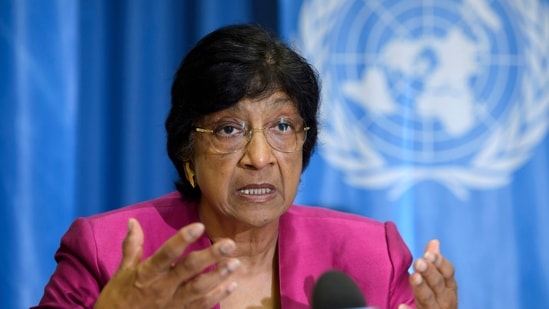
Pillay was recognised for her key role in ensuring the prosecution of war crimes, crimes against humanity and genocide, according to the Norwegian Nobel Committee.
“This is an important recognition of the vital role that international justice plays as a cornerstone of lasting peace,” ICC President Tomoko Akane said, as per AFP. “At a time of profound challenges to the international legal order and the rule of law, this recognition carries particular significance,” she added.
Deep Dive
Why did Navi Pillay win the 2026 Nobel Peace Prize?
How did Navi Pillay’s legal work advance international justice?
Why did the ICC link Navi Pillay’s Nobel Prize to lasting peace?
Who is Navi Pillay?
Pillay, 85, is a South African jurist of Indian-origin whose decades-long career has spanned South African courts, international tribunals and the United Nations. A prominent global human rights defender, she has served as a judge at the ICC and the International Criminal Tribunal for Rwanda, and as the UN High Commissioner for Human Rights from 2008 to 2014.
{{/usCountry}}Pillay, 85, is a South African jurist of Indian-origin whose decades-long career has spanned South African courts, international tribunals and the United Nations. A prominent global human rights defender, she has served as a judge at the ICC and the International Criminal Tribunal for Rwanda, and as the UN High Commissioner for Human Rights from 2008 to 2014.
{{/usCountry}}Born in 1941 to a Tamil family in Durban, South Africa, Pillay grew up under apartheid. The daughter of a bus driver, she studied law at the University of Natal before earning a master's degree and doctorate from Harvard University.
She became the first non-white woman to establish a law firm in Durban, where she represented opponents of apartheid. In 1973, she secured the right of political prisoners held at Robben Island, including those imprisoned alongside Nelson Mandela, to access legal counsel.
ALSO READ | Navi Pillay wins Nobel Peace Prize: Her grandparents were Indian indentured labourers
In 1995, a year after South Africa's first democratic elections, Pillay became the first woman of colour to be appointed to the country's High Court. Mandela subsequently recommended her for service on the International Criminal Tribunal for Rwanda, where she became one of the judges involved in a landmark case that recognised rape as an act of genocide in 1998.
As UN High Commissioner for Human Rights, a position she held until 2014, Pillay emerged as a prominent voice against government repression and discrimination. She condemned crackdowns on popular protests in the Arab world, including in Libya and Syria.
Between 2021 and 2025, she chaired a commission of inquiry established by the UN Human Rights Council to investigate the root causes of the Israeli-Palestinian conflict.
In 2025, she told AFP that the commission had concluded that genocide was occurring and continuing in Gaza, placing responsibility on Israel. The findings were strongly criticised by Israel. The ICC also set out a warrant for Israeli PM, Benjamin Netanyahu, for war crimes against Palestinians.
Pillay is also serving as an ad hoc judge at the International Court of Justice in a case concerning allegations that Myanmar violated the 1948 Genocide Convention through its treatment of the Rohingya minority.
What is the ICC?
The ICC, established in 2002 under the Rome Statute, prosecutes individuals accused of genocide, war crimes, crimes against humanity and the crime of aggression, subject to its jurisdiction. It currently has 125 member states and is investigating alleged crimes in several regions, including the Palestinian territories, Ukraine and parts of Africa.
The court has faced resistance from several countries, including the United States, Russia and Israel, which are not members and have challenged its jurisdiction in various cases.