E-Paper



Justice Nagarathna calls for a more inclusive, diverse Indian judiciary
Delivering the 28th Justice Sunanda Bhandare Memorial Lecture, Justice Nagarathna emphasised that having more women on the bench can contribute to a more effective space for the delivery of justice

 Prefer HTon Google


The participation of women in the judiciary is not only a constitutional imperative but also a necessary step to achieve the goal of robust, transparent, inclusive, effective and credible judicial process, Supreme Court judge BV Nagarathna said on Friday, emphasising that having more women on the bench can contribute to a more effective space for the delivery of justice in India.
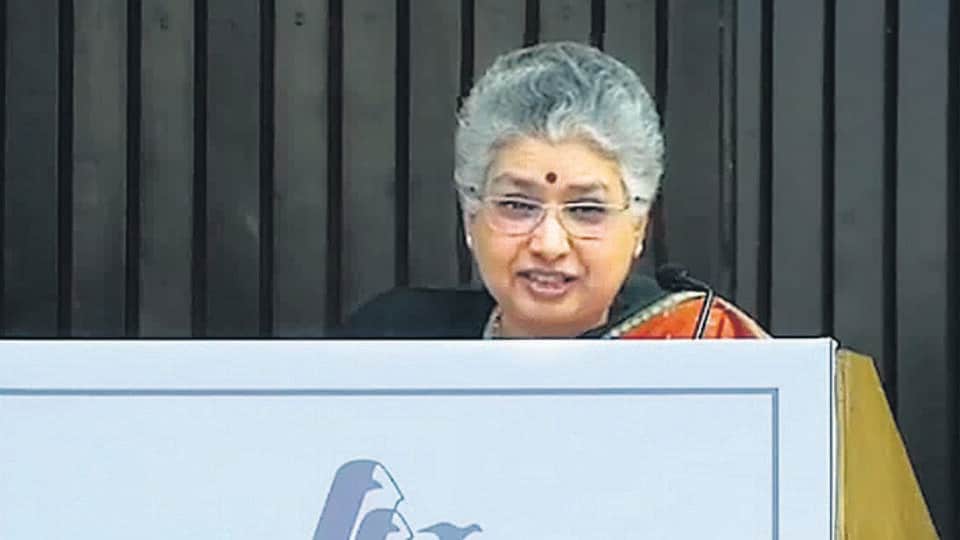
Delivering the 28th Justice Sunanda Bhandare Memorial Lecture in the national capital, justice Nagarathna maintained that “there is an urgent need for all organs of the state, institutions engaged in the regulation and growth of the legal profession and institutions engaged in legal education to work within their mandate to make the Indian judiciary more inclusive and diverse.”
According to the judge who is poised to take over as the first woman Chief Justice of India (CJI) in 2027, having more woman as judges would contribute significantly to improving the quality of judicial review and adjudication.
“I will only point to three reasons for this. First, (it) is the matter of the credibility and legitimacy of courts; second, (it) is about the language and vocabularies of judgments and third, (it) is the administration of courts and the need for different experiences to ensure courts become more gender-neutral spaces,” said justice Nagarathna.
Speaking on the topic ‘The role of the judiciary in the empowerment of Indian woman’, the judge cited a spree of landmark top court judgments that marshalled women’s fights for equality, equal opportunity, dignity and autonomy. She said that the judiciary’s role as the protector of fundamental rights is not limited to checking state action but also in some circumstances, initiating a transformative social dialogue as a part of transformative constitutionalism.
“The Indian judiciary has played a yeoman’s role in the noble national endeavour for gender equality,” said justice Nagarathna, adding the institutional role of the judiciary in this quest has three distinct, yet intersecting dimensions.
First, she pointed out, the judiciary has subjected gender-biased laws, policies and norms to constitutional scrutiny. “Thus, the courts – as guarantors of equal protection -- have played a critical role in ensuring that non-discrimination and fairness emerge as the central governing principle of state policy in all spheres of public life,” said the judge.
Second, justice Nagarathna added, the judiciary has amplified special laws and policies enacted for women by accentuating the constitutional intent, thereby assuming the role of “affirmative action enabler” by reading up statutes which protect and preserve women’s rights and striking down those laws which discriminate against women.
“Third, the judiciary has crafted creative remedies to redress systemic injustice and exploitation of women and taken up the role of an initiator of societal reform and transformation,”she said, further underlining the pivotal role of the State’s affirmative action.
Equality would be reduced to a mere slogan in the absence of persistent and targeted state action for the empowerment of women, said justice Nagarathna, lamenting that despite social reform and progress, the social structure remains biased against women.
“Such bias is pernicious that it afflicts women from womb to tomb...Affirmative action to enhance the representation of women in all spheres of public life is a bounden duty of all organs of the State. The cornerstone of the constitutional mandate of affirmative action are the provisions for equitable representation of women in the political realm, and most importantly in local self-governance institutions.”
She added that India can take heart from the fact that the enlightened commitment of the Parliament and the political executive to its constitutional mandate is manifest in special laws such as the 1994 Pre-Conception and Pre-Natal Diagnostic Techniques Act and the 2005 Protection of Women from Domestic Violence Act, and that fact that the country has the largest number of elected women representatives in the world.
Sounding the right notes on gender equality within homes and in society, justice Nagarathna cautioned that a condescending attitude towards women in the family is the cause of the cracks and, domestic violence and infidelity are the outcome of the emerging cracks.
“Personally speaking, I find cultural norms that see women as inferior to men to be highly unscientific, irrational and inefficient. I would like to emphasise that it is high time that the institution of marriage and family is protected and sustained in our country and that it’s very sustenance is dependent upon happiness, comfort and well-being of women and everybody in the family must make concrete efforts towards that objective,” said the judge.
Just as the erosion of the proper and just function of an organ of the State can have damaging consequences on the entire structure of governance, justice Nagarathna said, the erosion of the identity of women, in whatever capacity in the family, is bound to cause eventual breakdown of family and marriage.
Referring to some Supreme Court judgments that acknowledged the value of a woman homemaker’s worth in monetary terms, she said that grant of due value and recognition to household work is another frontier of gender justice where the judiciary has been leading a transformative conversation.
“Property is one of the important endowments or natural assets to accord opportunity, right to equal status and dignity of person. Equal property rights can promote greater social equality between men and women. This can help to reduce harmful gender norms that contribute to domestic violence, such as the belief that men have the right to control women,” said justice Nagarathna.
Former Supreme Court judge Madan B Lokur, acting chief justice of the Delhi high court, justice Manmohan and eminent jurist Fali S Nariman were also present at the event.
Nariman, who was the guest of honour, expressed his “regret” over the lack of dissent in the latest decision upholding abrogation of Article 370. “My regret in Article 370 judgment is that there was no dissent. Dissent is not just a safety valve but an assurance to the general public that the highest court is in robust health,” he said.
Justice Sunanda Bhandare was an eminent judge of the Delhi high court who died in November 1994 during her service. The lecture series was instituted by her husband and former Odisha Governor Murlidhar Bhandare, and her two children.