Gogunda: In sharp contrast to some parts of Aravallis where mining and real estate are threatening common lands, in Rajasthan’s Gogunda, a network of ponds is being conserved, utilised and carefully rationed by villagers.
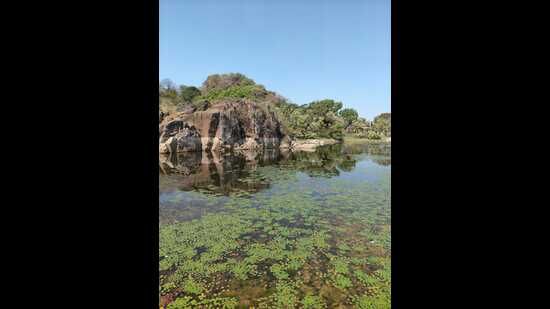
The rules are clear: use water efficiently for irrigation from wetlands, leave the rest for livestock, wild animals, insects and birds.
Gogunda’s Kanji Ka Guda is an example of how wetlands, pastures, hills, small streams and sacred groves are carefully managed as “common” lands spanning around 400 hectares of Aravalli landscape. “The rule is that villagers can take water only for the Rabi crop. There is enough water for the crop. The rest will be left for livestock, animals and birds because if there is no water, there is no life,” said Bawar Singh (70), head of charagah samiti, a local committee, particularly in Rajasthan, that is responsible for managing and developing pasture land.
These wetlands are created through the collection of rainwater in natural depressions and help irrigate crop land where wheat, mustard, chickpeas, fenugreek among others.
“Many animals and birds visit us here. There are big fish in these ponds. Nature is in its bounty because there is water left in these ponds almost all the time. Nobody is allowed to source water beyond the limit among the 100 families that source ,” added Singh. Water is diverted to the village for irrigation through a gravity dam. Those with least or no irrigation facility at all are prioritised in water rationing from the wetland’s water.
{{/usCountry}}“Many animals and birds visit us here. There are big fish in these ponds. Nature is in its bounty because there is water left in these ponds almost all the time. Nobody is allowed to source water beyond the limit among the 100 families that source ,” added Singh. Water is diverted to the village for irrigation through a gravity dam. Those with least or no irrigation facility at all are prioritised in water rationing from the wetland’s water.
{{/usCountry}}Foundation For Ecological Security has been studying how the network of 10 ponds and the hills here that feed the Banas river create an ecological habitat for birds and insects. They have been monitoring water quality, ecological indicators such as presence of dragon and damselfly and birds.
“We are trying to study and facilitate efficient use of shamlath (common) lands in these parts of Aravallis. This area is significant because it is the Aravallis and a fair usage of commons such as forests, wetlands, hillocks can be seen here among people who are traditionally livestock rearers. The benefits they are getting from the common lands are obvious,” said Vinod Paliwal, senior programme manager, Foundation For Ecological Security.
Also Read: Plan to restore ecology of Aravallis flagged off
Apart from limited cultivation, livestock rearing and collection of minor forest produce, villagers also depend on Mahatma Gandhi National Rural Employment Guarantee Scheme or the 100-day work programme for round the year sustenance. Caste is a dominant factor in all villages here with several social norms determined by caste dynamics. But when it comes to “commons” the rules are even. “You may say that caste inequities take a backseat when it comes to common resources,” added Paliwal. Gogunda is largely dominated by scheduled tribes from the Meena, Gametia and Garasia but Rajputs and other general category populations are also living here.
FES’s monitoring in the region has revealed at least 36 species of odonates including Red Marsh Trotter, Black Stream Glider, Blue Ground Skimmer; Ditch Jewel; Blue Darner; Little Blue Marsh Hawk among others. These findings are soon to be published in a journal.
Migratory bird species recorded here include: Greenish Warbler; Garganey; Citrine Wagtail; Siberian Stonechat; Ferruginous Duck; White Wagtail; Western Yellow Wagtail; Green Avadavat; Red-breasted Flycatcher; Bluethroat; Common Pochard; Green-winged Teal; Northern Pintail; Gadwall; Northern Shoveler.
“The idea is that people have enough to sustain themselves, there is also a rich biological habitat that these common lands provide,” explained Paliwal.
In the same Gogunda hills which border the Kumbhalgarh Wildlife Sanctuary, community forest rights have been recognised in 48 villages. In Kundalawas where women are leading the task of protecting and managing forests, they are awaiting CFR rights to be recognised. They also run a seed bank where several varieties of endemic grass seeds are stored. Here also, the focus is on rationing and efficient utilisation of forest resources. Kundlawas’s forests mainly have teak trees.
Also Read: ‘Last opportunity’: SC warns govt on Aravalli definition
“We have been waiting for 20 years for official recognition of our rights. But the process was complicated and hence took time. When it comes to forests and 100 day work, our women are leading. Everyone is working,” said Davri Bai (50).
Though the notion is that men are decision makers, women are having their say now in gram sabha’s matters. The biggest decision that women here have taken is that people will take only as much as they need. Earlier there was a lot of unnecessary tree felling because people took more than they needed and sold off timber, said Davri Bai.
“I helped with the paperwork to file for CFR. It was important and it has given us authority to ration resources, take care of forests,” said Rekha Bai (26) who has studied till class 10.
Custard apple and a variety of grasses provide livelihood to most women here. They also rear livestock but rearing camels has seen a sharp decline in recent years.
“There was a camel in every home before. Now there are barely 8 camels in the entire village. There is no value in keeping camels anymore,” said Rekha Bai.
Hardly any camels are visible in the hinterlands surrounding Udaipur. Villagers said the Rajasthan Camel (Prohibition of Slaughter and Regulation of Temporary Migration or Export) Act which restricts the transport, illegal possession and slaughtering of camels may have led to many abandoning camel rearing. But people here continue to rear goats, sheep, cows and buffaloes.
HT reported on April 26 that Income Tax department boards have come up in Faridabad’s Mangar village stating that 430 acres of land at village Mangar has been attached by Benami Prohibition Unit, Chandigarh of Income Tax Department. Mangar spread over 4262 acres (of which 3810 acres is hill area) is among the most biodiversity rich areas of the Aravallis in the National Capital Region (NCR). Within Mangar village, Mangar Bani (677.12 acres) is NCR’s most sacred grove, and possibly the only patch of primary forest in the region. It is also mostly common land which had been privatised over the years.
HT reported on October 3, 2023 that the Forest (Conservation) Amendment Act, 2023 will benefit real estate companies that own land in what was to be declared “deemed forest” in Haryana’s Aravallis. One of the contentious provisions of the new law is that it exempts unrecorded deemed forests from the modified law on forest conservation and hence leaves areas such as Mangar Bani vulnerable.
Jayashree Nandi is a recipient of Promise of Commons Media Fellowship, on the significance of Commons and its community stewardship.