A hard lockdown may benefit developed countries more than developing and low-income countries, a new study has suggested, indicating that policymakers need to keep in mind the human and economic costs of sweeping restrictions in place to stem the spread of the coronavirus disease (Covid-19).
The study comes at a time when the Indian government has extended the national lockdown till May 3 but partially relaxed curbs in some areas amid reports of high economic distress in agricultural and small sectors, and in rural areas.
The study, by two social scientists at Yale University, used modelling and disease projection data by the Imperial College, London, and found that social distancing and other measures can save a large number of lives in high-income countries because practically any economic cost is worth bearing.
But in lower-income countries such as Nigeria, India or Bangladesh, the benefits diminish. The value of benefits estimated for each country translates to a savings of 59% of US GDP, 85% of German GDP, but only 14% of Bangladesh’s GDP, or 19% of India’s, the study contended.
“Assuming equally effective social distancing policies, the economic value of moving from a policy stance of no mitigation to social distancing is estimated to be 23.5 times more valuable for the United States compared to India,” Zachary Barnett-Howell, one of the authors of the study and a professor at Yale, told HT on email.
{{/usCountry}}“Assuming equally effective social distancing policies, the economic value of moving from a policy stance of no mitigation to social distancing is estimated to be 23.5 times more valuable for the United States compared to India,” Zachary Barnett-Howell, one of the authors of the study and a professor at Yale, told HT on email.
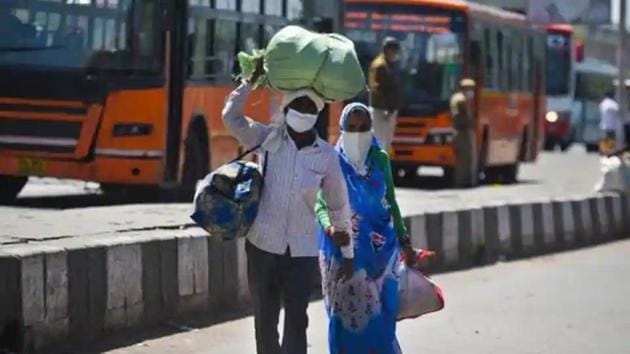
{{/usCountry}}The authors said the lower estimated benefits of restrictions were driven by the fact that large sections of the population in low-income countries are dependent on daily wages and small-scale work, which get shuttered. Moreover, many such countries have a relatively younger population, which is less vulnerable to Covid-19.
“Not only are the epidemiological and economic benefits of social distancing much smaller in poorer countries, such policies may also exact a heavy toll on the poorest and most vulnerable. Workers in the informal sector lack the resources and social protections to isolate themselves …by limiting their ability to earn a living, social distancing can lead to an increase in hunger, deprivation, and related mortality and morbidity in poor countries,” the study said.
Experts admit that enforcing a lockdown is a difficult decision in a country like India because policymakers have to weigh public health benefits with costs such as a sudden economic shock to a large section of people who rely on daily wages to make ends meet.
A recent paper for the Centre for Economic Policy Research argued for limited relaxation in the lockdown to allow workers under 40, who are at lower risk of infection, along with antibody testing and suitable social distancing safeguards.
“The trade-off is not really between public health and the economy so much as it is between lives and lives: lives that could be compromised by the pandemic on the one hand, and lives, on the other, that could be compromised by loss of incomes, employment, security and access to the necessities of life, including nutrition,” said S Subramanian, one of the authors of the paper ‘India’s Lockdown’ by Debraj Ray, S Subramanian and Lore Vandewalle.
Ray, first author of the paper and a professor of economics at New York University, said that a complete lockdown minimised Covid-19 deaths, but not total deaths. “It is a question of lives vs lives, and not lives vs GDP. That is the difference between a developing country and an (economically) developed country. In the latter we can think of serious transfers that will compensate for loss of livelihoods. In the government of India relief package, the transfers are better than nothing, but they’re not enough to prevent the widespread hardship that will accompany a lockdown,” he said.
“There are deaths one way or the other. The lockdown deaths will be hugely correlated with people’s economic status --- the poor bear the brunt of it,” he added.