
 E-Paper



HT This Day: April 25, 1936 -- Bharatiya Sahitya Parishad meets
The first session of the Bharatiya Sahitya Parishad met in the Convocation Hall this morning at 9-30 with Mahatma Gandhi as the President.


The first session of the Bharatiya Sahitya Parishad met in the Convocation Hall this morning at 9-30 with Mahatma Gandhi as the President. Among those who were resent were Pandit Jawaharlal Nehru, Babu Rajendra Prasad, Sardar Vallabhbhai Patel, Mr. Kanhiyalal, Munshi Prem Chand, Seth Jamnalal Bajaj, Mrs. Kasturba Gandhi, Babu Purshottamdas Tandon, Mr. Makhan Lal Chaturvedi, Mr. Ravi Shanker Shukla, Mr Brijlal Biyani and Mr Mahadeo Desai.
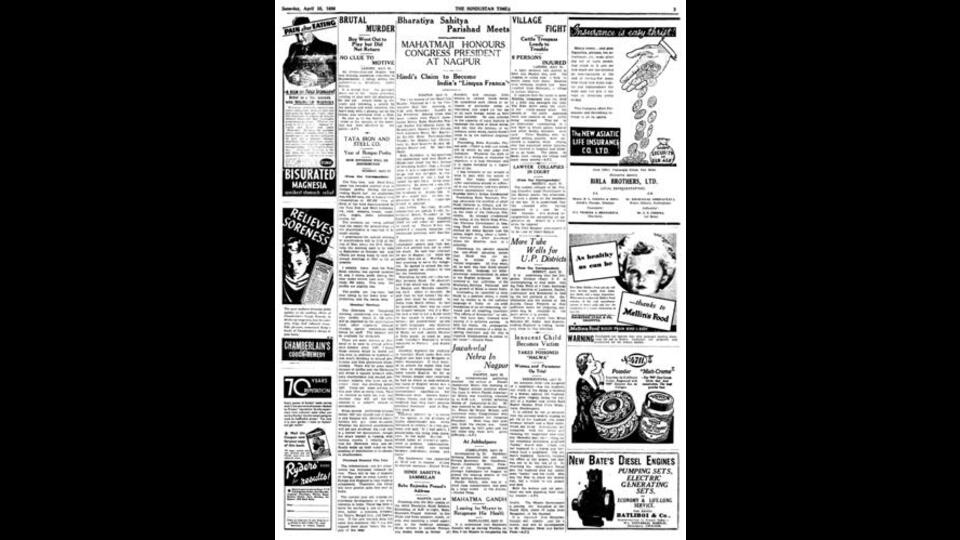
Kaka Kalekkar in inaugurating the conference, said that Hindi or Hindustani stood the best chance of becoming India’s ‘lingua franca’ since it was a comprehensive language and was receptive to outside influences in that it had absorbed the best from every other literature. He favored a simplification of Hindi and deprecated the tendency to Sanskritize it. He also urged that current expressions in different languages should be adopted.
Just before Mahatma Gandhi commenced his speech, Pandit Jawaharlal Nehru, President of the Congress, arrived and Gandhiji stood up and asked the audience to stand up. Pandit Nehru was accorded a rousing reception and exchanged greetings with Gandhiji.
Gandhiji in the course of his ‘extempore’ speech said that doctors had advised him not to exert too much. He said that although he was in Nagpur, his mind was neither here nor at Wardha. He was yearning to serve the villagers. He agreed to attend the conference purely on account of love for the Conference.
Proceeding, he referred to the conflict between Hindi (Hindustani) and Urdu which was due mainly to Hindus and Muslims considering each other as enemies. He said that he had noticed the dispute ever since he returned to India from South Africa. In fact he considered, there was no cause for dispute because even if a Muslim took a vow to use a Hindi word he was unable to keep it mainly because the grammatical system of both languages was identical. Neither could a staunch advocate of Hindi, he said, abolish Persian or Urdu words as could be seen from Tulsidas’s Ramayana which abounded in Persis and Arabic words.
Gandhiji deplored the tendency to translate Hindi books first into English and then into Bengalee or other vernaculars. If they wanted to achieve the object they had in view, he emphasized, that they must banish English. So far as the Indian masses were concerned he had no desire to underestimate the value of English which was a universal language and had an international significance, but Hindustani must become India’s lingua franca and the pernicious tendency that they could produce excellent literature only in English must go.
Gandhiji referred in the course of his speech, to the plethora of highly objectionable and erotic literature in evidence in every province and said. “If I had power, I should taboo the thing from literature. In the same manner. I should taboo all literature calculated to promote communalism, fanaticism, ill-will and hatred between individuals, classes and races.”
The Conference then adjourned at 10-45 am to resume sitting tomorrow morning.


