
 E-Paper



Manuscripts: PM to attend Gyan Bharatam Conference; Amit Shah to sign Delhi Declaration
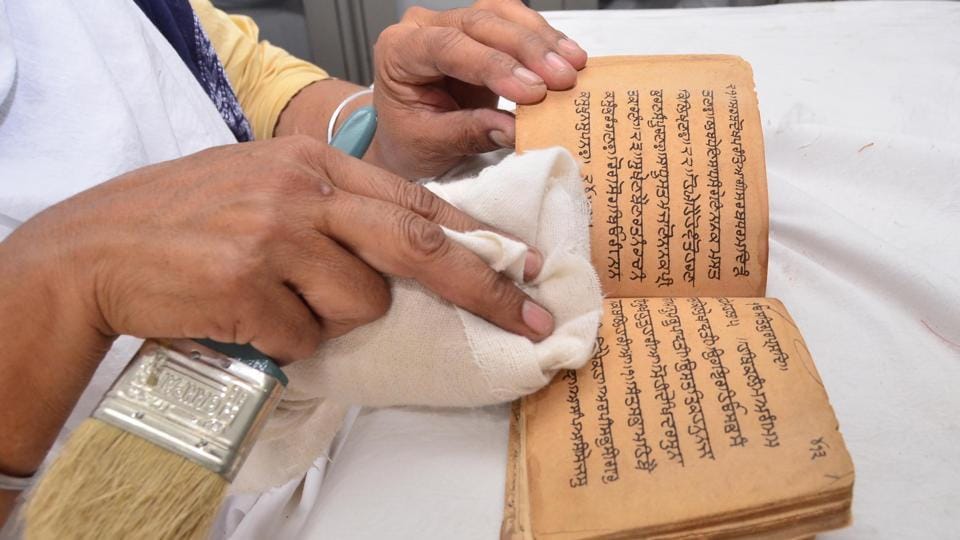
Gyan Bharatam replaces the slow-moving National Manuscripts Mission launched in 2003 and aims to digitise and catalogue over 10 million manuscripts.

 Prefer HTon Google


A Delhi Declaration uniting manuscript custodians across India will cap a three-day international conference on manuscript heritage starting Thursday at Vigyan Bhawan in New Delhi. At the event, the government will also launch the ₹400-crore Gyan Bharatam Mission, announced in the Union Budget 2025-26, to create an ASI-style institution for preserving and interpreting manuscripts.
Prime Minister Narendra Modi will attend the event on September 12 to hear presentations from working groups and address participants, while home minister Amit Shah will chair the September 13 valedictory session, where the declaration will be adopted.
“What ASI is for monuments, Gyan Bharatam will be for manuscripts,” Union culture secretary Vivek Aggarwal said, explaining that the Delhi Declaration will formalise cooperation among public institutions, private trusts, universities, libraries, and individual collectors. Gyan Bharatam replaces the slow-moving National Manuscripts Mission launched in 2003 and aims to digitise and catalogue over 10 million manuscripts through a national headquarters in Delhi supported by a network of regional centres across states.
The conference coincides with the 132nd anniversary of Swami Vivekananda’s 1893 Chicago address and is expected to draw around 1,100 participants, including academics, administrators, professionals, research scholars, students, and custodians of manuscripts. Eight working groups will deliberate on deciphering ancient scripts such as Indus, Gilgit, and Shankha, improving survey and documentation methods, establishing metadata standards, and developing advanced digitisation tools and protocols.
They will also discuss conservation and restoration techniques, decoding manuscripts for knowledge systems in science, mathematics, astronomy, engineering, and medicine, and exploring the use of manuscripts as instruments of cultural diplomacy. Legal and ethical frameworks for ownership, access, and repatriation of manuscripts held abroad will be a key focus.
Aggarwal noted that disputes over manuscripts in foreign institutions will be part of the discussion. “Physical custody is not that important if we have access and preservation, but these issues will be discussed as we move forward,” he said.
The Gyan Setu AI challenge will be another feature of the event, showcasing 40 entries and 10 shortlisted tools for decoding and cataloguing manuscripts, with awards for entries offering practical implementation value. UNESCO officials, 17 international speakers, and Indian scholars will participate in sessions on how technology, access rights, and global cultural diplomacy intersect with heritage preservation.
Officials said the ₹400-crore allocation is an initial outlay that may expand as Gyan Bharatam becomes institutionalised like the Archaeological Survey of India. Regional centres will be scaled according to manuscript density, with multiple hubs planned in states such as Uttar Pradesh and Jammu & Kashmir. An exhibition on India’s manuscript heritage, displaying scripts, languages, and materials, will run alongside the conference.
Aggarwal said the deliberations will guide the next phase. “After consultation with stakeholders, the strategy for Gyan Bharatam will be formulated and implemented nationally.”


