
On November 6, at around 11.30pm, the front right tyre of my car burst on a potholed road in western Uttar Pradesh. My wife and I were travelling from Delhi to the Jim Corbett National Park for a day-long visit. A burst tyre is infuriating, and on an unlit road at that hour, it is also dangerous.
But that is not what this piece is about. What has stayed with me is what happened over the next hour that night: an almost unreal demonstration of how old-fashioned Indian kindness went hand in hand with the growing penetration of AI and social media in small-town UP. Let’s call this personal anecdote A Midnight Scare & Two (Very) Good Samaritans.
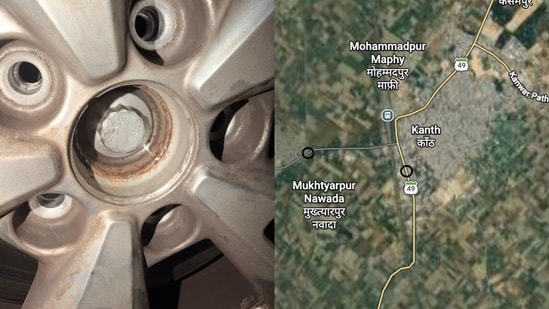
The moment the tyre went bust after hitting a jagged pothole, I made an instinctive call to keep driving slowly until I found somewhere safe to stop. Google Maps threw up two possibilities after a 3km detour -- a “motor shop” and an Indian Oil fuel station close to it at the periphery of West UP’s Kanth.
Hoping against hope that the repair shop would be open that late, I dragged the car on, reducing the burst tyre to raw soot along the way. It turned out to be a tiny, makeshift shed. Naturally, it was shut that late in the sleepy townlet.
The fuel station was another 200 metres down the road. It was small, barely lit, and had none of the usual satellite shops; no puncture-repair facility and no mechanic. I asked a young man, a member of the staff at the Indian Oil station, if he could help. He readily agreed, and with a warmth that washed away half my worries in a moment.
{{/usCountry}}The fuel station was another 200 metres down the road. It was small, barely lit, and had none of the usual satellite shops; no puncture-repair facility and no mechanic. I asked a young man, a member of the staff at the Indian Oil station, if he could help. He readily agreed, and with a warmth that washed away half my worries in a moment.
{{/usCountry}}Together, we decided to swap the burst tyre for the spare in the car. I had bought the vehicle only in January this year and was still figuring out what all sat in the boot. The full toolkit was there. But there was a hitch. The lug wrench would not fit the wheel bolts, or what appeared like wheel bolts (we later realised that these were bolt-shaped caps that had to be pulled out with a clip, with the actual bolts hidden underneath).
We spent a few minutes rummaging through the toolkit, convinced we were missing a tool. Then, the Indian Oil attendant said, almost offhandedly: “Photo leke ChatGPT pe daaliye, bata dega kya karrna hai. (Take a photo, put it on ChatGPT, it will tell you what to do).”
I was stunned, and a little embarrassed that the idea had not occurred to me. I did exactly as he said and within minutes, we had worked out the trick with the caps, and every bolt came off.
His instinct and awareness, I realised later, was in line with the penetration OpenAI has been talking about in India. In February, OpenAI chief executive Sam Altman said India had 100 million weekly ChatGPT users, second only to the United States. By early November, OpenAI’s India managing director Prabhjeet Singh was saying India had become ChatGPT’s largest market by weekly users, with the user base doubling since January.
And I also realised that, typically, these numbers tend to conjure images of students and coders in Bengaluru. But my experience that night and the broader data suggests something deeper. The IAMAI-Kantar Internet in India Report 2025 found that 44% of internet users had used AI-enabled features such as voice search, image-based search and chatbots. A fuel station attendant asking me to point my phone at the wheel of my car was clearly part of that statistic.
And even as this man helped me with a warm smile and a large heart that night, we ran into the next problem. The wheel, possibly because of the impact, was unusually difficult to remove, even after the bolts were gone. Repeated blows with hands and feet would not budge it. We began wondering, again, whether we were missing a trick.
Around then, a man rode in on a motorcycle to get fuel at the station. It being a small town, he knew the attendant. He grasped the situation in seconds and immediately made my problem his own. He rode off to find a mechanic he knew; he was back in five minutes, declaring that the shop was shut and the owner was not at home either. Though we were still well in the middle of a crisis, this second man’s immediate willingness to help made me think: “There’s something about small towns; Good Samaritanism runs in the blood.”
Then came the second almost-unreal moment of that night. The person with the motorbike told the attendant he somewhat knew a man in the neighbourhood who could help, but he did not have his cellphone number. “Woh mechanic thha, aajkal content creator ban gaya hai Instagram pe (he used to be a mechanic; (these days he is a content creator on Instagram, making videos on fixing cars and bikes)… Saat hazaar follower hain usske (he has 7,000 followers).”
And out came his phone. He sent the “content creator” a direct message asking for his phone number. The reply came almost immediately. A call followed, then a video call, with the phone camera trained on the stubborn wheel. The mechanic-turned-creator talked us through exactly what to do and within minutes, the wheel was off, and the spare was on.
Now, publicly available data tells that a mechanic with 7,000 followers in western UP is not supposed to be a point of disbelief, however strange it sounds anecdotally. He is part of a wave. An Indian School of Business (ISB) and Hashfame study released in July found that India’s creator base grew from about 0.96 million in 2020 to 4.12 million in 2025, and that 66% of creators now came from outside the metros. Uttar Pradesh and Maharashtra together accounted for nearly a quarter of them.
The audience is there too. The IAMAI-Kantar report counts 588 million short-video users, about 61% of India’s internet population, with rural users now marginally outnumbering urban ones.
As the spare went on, the journalist mode in me got engaged. I had started thinking about what I had just witnessed. One man in a small town in western UP told me to show a photo to ChatGPT. Another reached an Instagram creator he barely knew. Between them, they solved my problem in the dead of the night.
What struck me most, though, was not the technology. It was who held it. I did not think of ChatGPT as much as a fuel station attendant in smalltown UP did. The Instagram creator did not appear on my feed; a stranger on a motorcycle knew of him because this person was a micro-influencer in his townlet.
Before I left, I tried to offer both men some decent money for the time they had wasted on a stranger’s problem close to midnight. Not only because I wanted to buy their time. It was because I could not think of a way to thank them and return the favour at that point in the night. But they simply would not accept it.
The fuel station attendant said: “Safar mein hamesha madad karrni chahiye logon ki (one should always help people on a journey).”
I drove on towards the destination (though, at a very careful speed because the spare comes with a much lower speed limit). But since that night, I have not been able to shake off this story. The adoption of emerging technology may have been news to me that night, but what was really old (centuries old, even) was the kindness that germinates every day in smalltown India.
ABOUT THE AUTHOR
Nisheeth Upadhyay is Editor and Chief Operating Officer at Hindustan Times Digital, where he is responsible for editorial strategy and growth, strengthening audience engagement and leading business functions. He began his journey as a journalist in the Hindustan Times newsroom in 2011, working closely with the print operations. In his first stint with the HT Media group, he worked as the Production Editor for the newspaper, coordinating production across desks, and planning the daily news schedule and long-term projects. He also worked as the Homepage Editor and Shift Head for www.hindustantimes.com, managing and editing the news sections of the website. During this time, he picked up skills in tracking and writing breaking news. He later worked at ThePrint as Editor (Operations), acting as a member of the core editorial leadership. His responsibilities in the digital-only newsroom included heading the Integrated Desk, the infographics and photojournalism sections and operations for Hindi, Tamil and Marathi languages. He also anchored two weekly video shows on YouTube, AISight and Everybody’s Business. Nisheeth’s work reflects a commitment to maintaining journalistic rigor while navigating the fast-evolving challenges and shifting opportunities in digital news media.