
 E-Paper



Modi meets Egypt’s Sisi to deepen bilateral ties
India and Egypt have upgraded their relationship to a strategic partnership, with Prime Minister Narendra Modi and President Abdel Fattah El-Sisi signing an agreement to boost cooperation in security, trade, investment and technology. The two sides signed three memorandums of understanding for cooperation in agriculture, archaeology and antiquities, and competition law. Egypt has also expressed confidence in India's presidency of G20 and its readiness to cooperate with India to advance talks at G20 in a constructive direction to address energy crises, climate change, food shortages, and access to financing for developing countries.

 Prefer HTon Google


India and Egypt on Sunday formally elevated their relationship to a strategic partnership, as Prime Minister Narendra Modi and President Abdel Fattah El-Sisi focused on bolstering cooperation in security, trade, investment and technology.
Modi, the first Indian Prime Minister to make a bilateral visit to Egypt in 26 years, and Sisi, who was chief guest at India’s Republic Day celebrations in January, signed an agreement to upgrade ties to a strategic partnership following their discussions at Ittihadia Palace in Cairo.
In a tweet, Modi described his talks with Sisi as “excellent” and said the two leaders reviewed the full range of bilateral relations and “agreed to further augment economic and cultural linkages”. A spokesman for the Egyptian president said the two leaders confirmed their mutual commitment to push relations to “broader horizons across various fields”.
The two sides signed three memorandums of understanding (MoUs) for cooperation in agriculture, archaeology and antiquities, and competition law. Sisi conferred the Order of the Nile, Egypt’s highest state honour, on Modi at a brief ceremony. Among others who have received this award are former South African president Nelson Mandela and former US president Jimmy Carter. Modi thanked the government and people of Egypt for the honour and tweeted. “It indicates the warmth and affection they have towards India and the people of our nation.”
Modi arrived in Cairo on Saturday after a visit to the US and held talks with his Egyptian counterpart Mostafa Madbouly and the “India Unit”, a special group created within the Egyptian cabinet by Sisi, that focused on taking forward cooperation in renewable energy, information and communication technology (ICT), health, agriculture and infrastructure.
A statement from the Egyptian cabinet quoted Modi as saying that India and Egypt are “moving forward quickly” to achieve the goal of boosting trade to $12 billion in five years.
Modi’s discussions with Sisi on Sunday focused on deepening the partnership in trade, investment, defence and security, renewable energy, culture and people-to-people ties, external affairs ministry spokesperson Arindam Bagchi said.
According to a statement from the Egyptian president’s office, the talks also touched on ways to enhance cooperation in ICT, pharmaceutical industries, vaccines, higher education, renewable energy including green hydrogen, and tourism, including direct flights between Cairo and New Delhi.
“This is in addition to boosting trade and the exchange of strategic goods between the two countries, as well as developing Indian investments in Egypt in the coming period,” the statement said.
Modi and Sisi also discussed several regional and international issues. Modi invited Sisi to the G20 Summit in New Delhi under the Indian presidency. Egypt is among the guest countries included by India in the G20 process this year.
Building better alliances and relationships globally is crucial, and the PM’s efforts in this domain are welcome. The partnership between India and Egypt can be beneficial for both for several reasons, not in the least of which is trade. India exported $4.11 billion of goods to Egypt in the last fiscal year, while importing $1.95 billion – the potential here is clear.
Sisi expressed Egypt’s confidence in India’s presidency of G20, saying it “contributes to containing the negative repercussions of international challenges on the global economy”. He stressed Egypt’s readiness to cooperate with India to advance talks at G20 in a constructive direction to address energy crises, climate change, food shortages, and access to financing for developing countries.
Foreign secretary Vinay Kwatra told a media briefing in Cairo that green hydrogen has emerged as a potential area for cooperation between the two sides in renewable energy. There are “very strong possibilities” of investment and technology partnership in the field of green hydrogen and experts from the two countries are looking at this evolving field, he said.
There were also discussions on possible Indian investments in the Suez Canal Economic Zone, Kwatra said. Responding to a question on Egypt’s application to join the BRICS grouping, he said member states are discussing the criteria and and procedure for the bloc’s expansion. “We are looking actively at all the applications, naturally including of a very friendly and strategic partner like Egypt,” he added.
Besides the official engagements, Modi met Egypt’s Grand Mufti, Shawky Ibrahim Allam, on Saturday and discussed social and religious harmony in society and countering extremism and radicalisation. Modi announced that India will set up a centre of excellence in IT at Dar-al-Iftaa, a justiciary and advisory body headed by Allam.
Modi also held separate meetings on Saturday with Tarek Heggy, a leading author and petroleum strategist, Reem Jabak and Nada Adel, two young yoga instructors, and Hassan Allam, CEO of Hassan Allam Holding Company, one of the largest Egyptian companies operating in the Middle East and North Africa.
On Sunday, Modi visited visited Al-Hakim Mosque in Cairo, which has been renovated by the Bohra community. He met community leaders, who are involved in the upkeep of the Fatimid era Shia mosque and highlighted the strong people-to-people ties between India and Egypt. He visited the Heliopolis War Cemetery and paid homage to more 4,300 Indian soldiers who lost their lives in Egypt and Aden during World War 1.
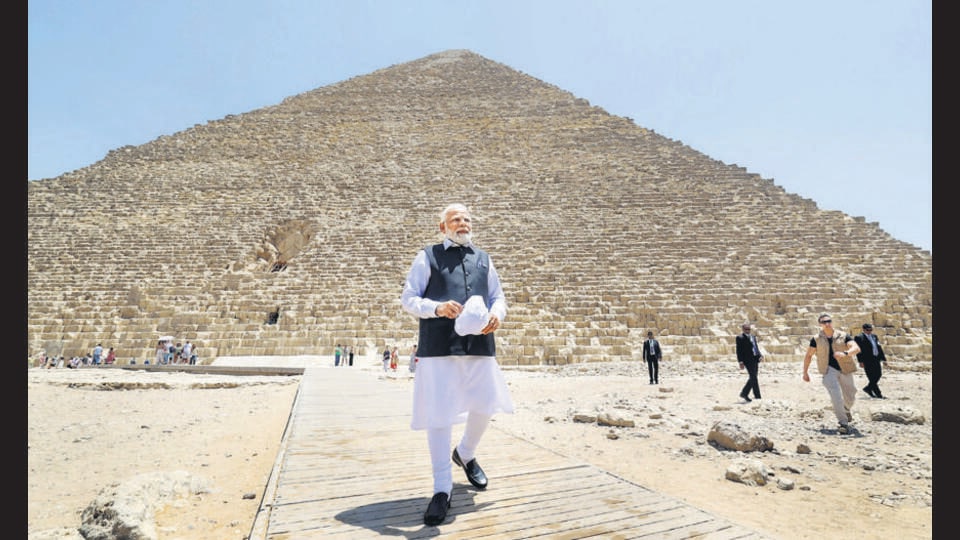
Modi also visited the pyramids with his Egyptian counterpart, Mostafa Madbouly. “We had a rich discussion on the cultural histories of our nations and how to deepen these linkages in the times to come,” he tweeted.



