
 E-Paper



Modi recalls 24 years as head of government
PM Modi marks 25 years in public office, reflecting on his journey from Gujarat CM to Prime Minister, highlighting reforms and challenges faced.


Prime Minister Narendra Modi stepped into his 25th year of public office on Tuesday with a message on social media, recalling the October morning in 2001 when he took the oath as Gujarat’s chief minister for the first time.
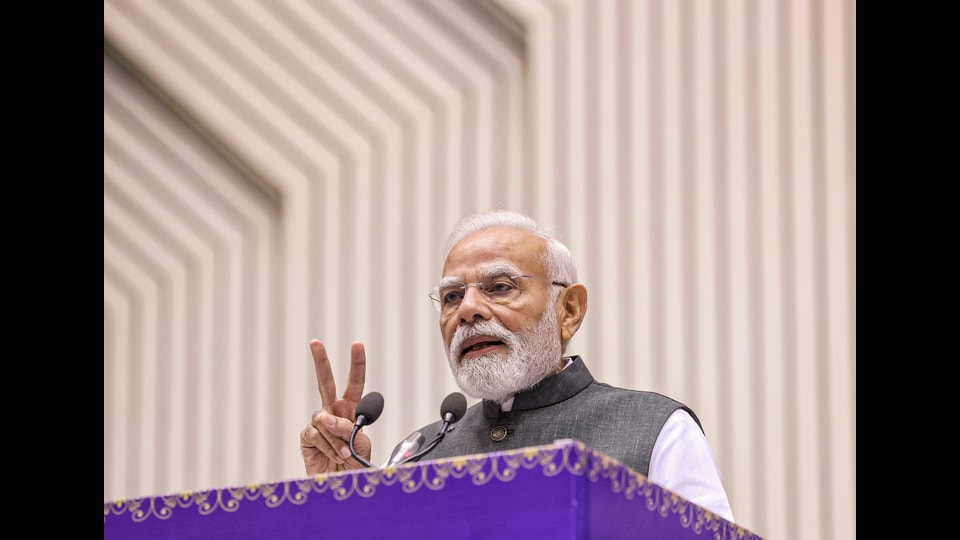
“On this day in 2001, I took oath as Gujarat’s Chief Minister for the first time,” he wrote on social media. “Thanks to the continuous blessings of my fellow Indians, I am entering my 25th year of serving as the head of a government.”
That oath had been taken in Gandhinagar, inside the austere hall of the Raj Bhavan. Outside, the state was still marked by ruins from the Bhuj earthquake that had struck nine months earlier, leaving entire neighbourhoods flattened and livelihoods erased. Political uncertainty hovered in the air; Gujarat had cycled through unstable governments, droughts and a super cyclone in the preceding years. Modi, a lifelong member of the Rashtriya Swayamsevak Sangh and a party organiser who had never held public office, was a surprise choice as CM.
The first images of Modi as CM show him standing before the microphone, his hands folded, the oath read out line by line in Gujarati. In his post, he recalled what his mother told him that day. “I do not have much understanding of your work,” she said, “but I only seek two things. First, you will always work for the poor and second, you will never take a bribe.”
When he assumed office, Gujarat’s villages still faced routine power cuts. Agriculture was strained by erratic rainfall and salinity in groundwater. The industrial sector, hit by the earthquake and a general lack of investment, was slow to recover. Modi’s first months in power were spent touring the state’s affected districts, visiting relief camps and overseeing reconstruction efforts. Out of those months grew the framework of what came to be known as the “Gujarat model,” a blend of administrative centralisation, infrastructure expansion, and business-friendly governance.
The Jyotigram Yojana, conceived in the early 2000s, separated electricity feeders for agriculture and rural households, ensuring uninterrupted power for the latter. The Sujalam Sufalam scheme sought to recharge the state’s water table through a network of check dams, canals and rainwater harvesting structures. Both initiatives would later echo in national programmes, from Saubhagya to Jal Jeevan Mission.
Industrial policy, too, underwent a quiet overhaul. The first Vibrant Gujarat Summit in 2003 was modest by later standards, but it became an emblem of a state courting global investors. Ports expanded along the Kutch and Saurashtra coasts, special economic zones were notified, and new industrial corridors were drawn on planners’ maps. The years that followed saw manufacturing accelerate, roads and power networks spread across districts once marked by scarcity, and Gujarat begin to project itself as an efficient, self-confident economy.
That image, however, was shadowed by one of India’s worst episodes of communal violence. In February 2002, the burning of a train coach in Godhra triggered riots that left more than a thousand people dead, many of them from the minority community. The administration’s handling of the violence became subject of long national debate. But Modi was cleared of wrongdoing by India’s Supreme Court years later.
By the time Modi completed a decade in power in 2011, Gujarat had achieved one of the highest growth rates among Indian states. Power supply had stabilised, industrial investment had deepened, and roads and ports had expanded in scale and reach.
By 2013, Modi had become the Bharatiya Janata Party’s prime ministerial candidate, positioning himself as an outsider to Delhi’s political establishment. “Those days, the nation was witnessing a crisis of trust and governance,” he wrote in his post, referencing the corruption scandals that plagued the Congress-led government at the time. He campaigned on a promise of governance reform, economic growth, and anti-corruption measures under the slogan “Acche Din Aane Wale Hain” — “Good days are coming.” His party’s 2014 victory — the first single-party parliamentary majority in three decades — reshaped India’s political landscape and began the BJP’s era of dominance.
As prime minister, Modi’s government enacted a series of structural reforms. In 2016, the sudden demonetisation of high-value currency notes aimed to address unaccounted money . The Goods and Services Tax, implemented in July 2017, unified India’s indirect taxation system, replacing a patchwork of state and central levies. Aadhaar, the biometric identification system that was launched under the previous government, expanded to link millions of citizens to banking, social welfare, and subsidy programmes. The Jan Dhan Yojana brought unbanked citizens into the financial system, forming what the government calls a “JAM trinity” of Jan Dhan, Aadhaar and mobile connectivity for direct benefit transfers.
His second term, beginning in 2019, coincided with major political developments, including the revocation of Jammu and Kashmir’s special status and the introduction of the Citizenship Amendment Act. The Covid-19 pandemic also tested administrative reach, with nationwide lockdowns and one of the world’s largest vaccination campaigns.
”Over 25 crore (250 million) people have been removed from the clutches of poverty,” Modi wrote. “India is seen as a bright spot among major global economies. Our farmers are innovating and ensuring that our nation is self-reliant. We have undertaken extensive reforms and the popular sentiment is to make India Aatmanirbhar across all sectors.”
Modi’s administration has pursued a prominent role on the international stage, positioning India as a voice of the Global South, hosting the G20, and championing renewable energy initiatives such as the International Solar Alliance. Yet his tenure has also drawn Opposition allegations of shrinking democratic space, the targeting of political rivals, and the growing consolidation of power in the executive.
On Tuesday, Modi described the journey as one of gratitude. “To serve our beloved nation is the highest honour, a duty that fills me with gratitude and purpose,” he wrote. “With the values of our Constitution as my constant guide, I will work even harder in the times to come to realise our collective dream of a Viksit Bharat (developed India).”


