Prime Minister Narendra Modi will attend a 90-minute stage adaptation of Bankim Chandra Chattopadhyay’s Anandamath, the 1882 novel that includes India’s national song Vande Mataram, on Friday at Gujarat’s Ekta Nagar on the eve of Sardar Vallabhbhai Patel’s 151st birth anniversary. The National School of Drama (NSD) production will feature around 300 artistes on a 100 feet by 100 feet stage.
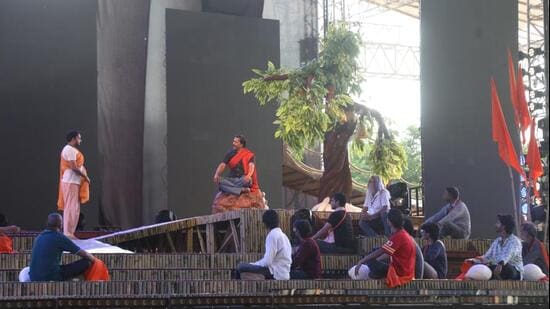
Gujarat government officials aware of the matter said the adaptation would offer a contemporary interpretation of the novel, highlighting every Indian’s responsibility to help build the country’s future, remain connected with its cultural heritage and contribute to national aspirations.
Shantanu Chattopadhyay, Barnali Chattopadhyay and Sumitro Chattopadhyay, members of the novelist’s family, will attend the adaptation at the invitation of the Union home ministry.
Vande Mataram was first published in 1875 and later incorporated into Anandamath. The song became a rallying cry during the freedom movement. Rabindranath Tagore composed its music and sang it at the 1896 session of the Indian National Congress in Calcutta.
The Union home ministry this year mandated that a six-stanza-long, 3 minutes and 10 seconds version of Vande Mataram be played or sung at official occasions.
The move came against the backdrop of the Union government’s push to popularise Vande Mataram, a debate in Parliament to mark the 150th anniversary of the national song, and the display of tableaux during the Republic Day parade themed on the song.
{{/usCountry}}The move came against the backdrop of the Union government’s push to popularise Vande Mataram, a debate in Parliament to mark the 150th anniversary of the national song, and the display of tableaux during the Republic Day parade themed on the song.
{{/usCountry}}In 1950, the first two stanzas of the song were adopted as India’s national song. Until the home ministry’s mandate, there was no official protocol during the singing of Vande Mataram, unlike Jana Gana Mana, with defined rules on the tune, duration, and singing.
The Supreme Court in September declined to examine whether Vande Mataram should be recognised as the National Song or whether its official rendition should comprise two or six stanzas. It said the choice of national symbols and the aspirations associated with them fall within the remit of an elected government.
The court agreed to examine whether that recognition can carry criminal consequences for a citizen who, on grounds of conscience or religion, chooses not to sing it.
Carnatic vocalist, author and Ramon Magsaysay Award recipient TM Krishna moved the court against prescribing the complete six-stanza version of Vande Mataram for specified governmental, ceremonial and cultural occasions.
Krishna cited a breach of fundamental rights relating to equality, religious freedom, free speech, and protection against discrimination. He argued that the 2026 amendment to the Prevention of Insults to National Honour Act, which extended criminal protection under Section 3 to the “National Song”, alongside the National Anthem, and the home ministry’s directions effectively compel citizens to participate in the rendition of all six stanzas, including portions that expressly invoke Hindu deities.
A second official said the adaptation of Anandamath will bring the novel’s themes of devotion to the motherland, sacrifice and national consciousness to the stage. He added it seeks to connect its literary legacy with contemporary India, highlighting the responsibility of citizens to contribute to the country’s future while remaining connected with its cultural heritage.
The novel has also been adapted for cinema. In 1952, director Hemen Gupta made the Hindi film Anand Math, starring Prithviraj Kapoor.
Officials said the NSD production will bring the historical narrative to the stage through a large-scale theatrical presentation, combining acting and stagecraft.
The performance will be part of the National Unity Day celebrations marking Sardar Vallabhbhai Patel’s birth anniversary at Ekta Nagar, home to the Statue of Unity, which honours his role in integrating India’s princely states after Independence.
It will be among the cultural events planned during Prime Minister Narendra Modi’s two-day Gujarat visit on October 30 and 31.
Modi will inaugurate Bharat Parv 2026, a festival showcasing the traditions, folk performances, regional cuisine, handicrafts and tourism attractions of states and Union territories, at Ekta Nagar. The festival will continue until November 15. He will witness Ekta Prakash Parv, featuring illuminated displays along the 530-metre Valley of Flowers road and a 180-metre glow tunnel, before attending the Narmada aarti.
On October 31, Modi will pay floral tribute to Patel at the Statue of Unity, the world’s tallest statue at 182 metres, and inaugurate development projects worth more than ₹400 crore at Ekta Nagar. These include a Rain Forest attraction spread across 47,000 square metres and developed at a cost of ₹9.49 crore. Its main attraction is a 220-metre glass-deck skywalk, with vegetation representing the Western Ghats, the Himalayas and the Andaman and Nicobar Islands.
The National Unity Day programme will include the Ekta Parade, with contingents from central armed police forces, state police forces and central police organisations.
The celebrations will also feature a separate NSD production on a Maoist-free India, involving around 2,000 artistes from erstwhile 126 Left-wing extremism-hit districts, according to a government statement.
A tableau and cultural performances will centre on Vande Mataram, while a presentation involving around 5,000 artistes from across India will showcase the country’s classical and folk traditions.