E-Paper



Negotiators in last-ditch bid for climate deal
The draft agreement, uploaded to the UN Framework Convention on Climate Change website around 3 am Friday after marathon negotiations that stretched past 9 pm Thursday

 Prefer HTon Google


BELEM, Brazil
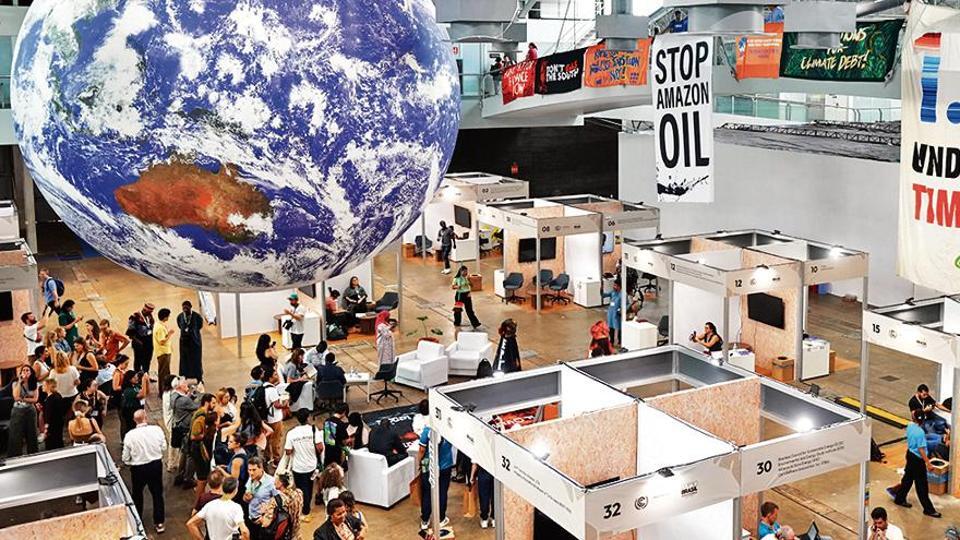
UN climate talks teetered on the brink of collapse Friday as negotiators released a final text that dropped all mention of fossil fuel phaseout roadmaps, exposing a fundamental divide between developed and developing nations over who should bear the burden of emissions cuts and how quickly the world should transition away from coal, oil and gas.
The draft agreement, uploaded to the UN Framework Convention on Climate Change website around 3 am Friday after marathon negotiations that stretched past 9 pm Thursday — even surviving a fire in the conference’s blue zone — omitted the words “fossil fuels” or “roadmap” entirely. This came despite Brazilian President Luiz Inacio Lula da Silva publicly supporting such language weeks ago and personally shuttling between negotiating rooms to forge consensus.
The omission split the nearly 200 nations at COP30 into opposing camps. China, India, Saudi Arabia, Nigeria and Russia rejected any prescriptive fossil fuel roadmap, according to a negotiator who wished to remain anonymous, arguing that developed countries should lead emissions cuts given their historical responsibility. Meanwhile, around 30 countries led by Colombia warned they could not accept a deal without it, saying the climate emergency demands immediate action.
“What is now on the table is unacceptable,” EU climate commissioner Wopke Hoekstra told reporters. “And given that we’re so far away from where we should be, it’s unfortunate to say, but we’re really facing a no-deal scenario.”
France’s ecological transition minister, Monique Barbut, called the omission “incomprehensible at a time of climate emergency”.
The impasse underscored the challenge of proving that international cooperation can still function in a fractured world — particularly in the absence of President Donald Trump’s United States — and of achieving consensus among nations with vastly different development needs, energy dependencies and economic realities.
Competing visions
The 30-country letter, drafted by Colombia, stated bluntly: “We cannot support an outcome that does not include a roadmap for implementing a just, orderly and equitable transition away from fossil fuels.”
More than 80 countries — including Australia, Austria, Belgium, Cambodia, Chile, Colombia, Costa Rica, Denmark, Fiji, Finland, Ireland, Jamaica, Kenya, Luxembourg, Marshall Islands, Mexico, Micronesia, Nepal, Netherlands, Panama, Spain, Slovenia, Vanuatu and Tuvalu — responded by backing a separate Belem Declaration calling for transitioning away from fossil fuels.
After the presidency text emerged, Colombia — which first proposed the fossil fuel roadmap — held a briefing to promote the alternative declaration. “The declaration is grounded in the scientific truth that fossil fuels are the primary driver of the climate crisis,” Colombia said. “Keeping the 1.5 or 1.7 degrees objectives requires a fast, fair and fully financed phase out.”
The “Mutirao” text — named after the Portuguese word for collective action — emerged without brackets, indicating a final iteration. Instead of addressing fossil fuels directly, it acknowledges the likelihood of a temporary overshoot of the Paris Agreement’s 1.5°C warming goal whilst reiterating “its resolve to pursue efforts to limit the temperature increase to 1.5°C, to limit both the magnitude and the duration of any temperature overshoot, and to close adaptation gaps”.
Historical accountability
Marking 10 years since the Paris Agreement, the text “strongly reaffirms its commitment to multilateralism and the principles and provisions of the Paris Agreement and resolves to remain united in the pursuit of efforts to achieve the purpose and long-term goals of the agreement with a view to delivering climate action and support for people and the planet”.
It captures the global context of historical emissions, stating that the carbon budget consistent with achieving the Paris Agreement temperature goal is now small and being rapidly depleted, with historical cumulative net carbon dioxide emissions accounting for at least four-fifths of the total carbon budget for a 50% probability of limiting global warming to 1.5°C.
The text notes that despite progress, global greenhouse gas emissions trajectories are not yet aligned with Paris goals. It recognises that limiting warming to 1.5°C requires deep, rapid and sustained reductions in global greenhouse gas emissions of 43% by 2030 and 60% by 2035 relative to 2019 levels, reaching net zero carbon dioxide emissions by 2050.
Critically, it recalls that developed countries failed to achieve the Intergovernmental Panel on Climate Change’s previous target of reducing emissions by 25-40% below 1990 levels by 2020 — a point developing countries have repeatedly emphasised in arguing that wealthy nations should lead mitigation efforts.
Finance breakthrough with caveats
The package delivered a key demand from developing countries, particularly India, by establishing a two-year work programme on climate finance under Article 9, paragraph 1, in the context of Article 9 as a whole.
Article 9.1 is a legal obligation requiring developed countries to provide financial resources to developing nations for climate mitigation and adaptation efforts. The text “reaffirms that developed country Parties shall provide financial resources to assist developing country Parties with respect to both mitigation and adaptation in continuation of their existing obligations under the convention and also reaffirms that other Parties are encouraged to provide or continue to provide such support voluntarily”. It also reaffirms the long-term goal of making finance flows consistent with a pathway towards low greenhouse gas emissions and climate-resilient development.
The text reaffirms the call to scale up financing to developing countries from all public and private sources to at least $1.3 trillion per year by 2035, taking note of the “Baku to Belem Roadmap to 1.3 T”. Most significantly, it calls for efforts to triple adaptation finance compared to 2025 levels by 2030 and urges developed countries to increase the trajectory of their collective provision of climate finance for adaptation to developing nations.
The proposed high-level ministerial roundtable to reflect on the implementation of the New Collective Quantified Goal was welcomed, as was recognition that adaptation must remain locally determined.
However, Arunabha Ghosh, chief executive of the Council on Energy, Environment and Water, said the outcome fell short of what developing countries needed to deliver climate action.
“At COP30, the global south is not asking for favours — it is asking for the basic foundations needed to deliver a fair and effective global climate response,” Ghosh said. “Climate action must be underpinned by equity, fair rules and reliable support. The new texts — at this stage — suggest more progress and deliberations will be needed in the coming hours to arrive at an outcome that, most importantly, protects the vulnerable.”
While welcoming the recognition that adaptation must remain locally determined and that alternative pathways towards just transitions exist, Ghosh noted critical gaps. “The absence of a new adaptation finance goal within the GGA discussions, and the continued reliance on broad ‘all-actors’ language on finance, could limit the mobilisation of finance. Moreover, the two-year work programme on climate finance falls short of a focused, dedicated process on how developed countries would fulfil their obligations.”
“A credible COP outcome must strengthen the enablers of climate action for developing countries — not leave them navigating a more demanding transition with fewer tools,” he said.
Trade: a linguistic compromise
On trade, another priority for the entire G77+China and Like Minded Developing Countries blocs, the text offered a carefully worded compromise on unilateral measures such as Europe’s Carbon Border Adjustment Mechanism, which China and India have jointly opposed as trade-restrictive, unilateral and incompatible with equity principles.
The text reaffirms that parties should cooperate to promote a supportive and open international economic system that would lead to sustainable economic growth and development in all parties, particularly developing countries. It “also reaffirms that measures taken to combat climate change, including unilateral ones, should not constitute a means of arbitrary or unjustifiable discrimination or a disguised restriction on international trade”.
The text requests subsidiary bodies to hold dialogues at their 64th, 66th and 68th sessions, with participation from parties and stakeholders including the World Trade Organisation, UN Trade and Development and the International Trade Centre, to consider opportunities, challenges and barriers in enhancing international cooperation related to trade’s role in climate action.
Vaibhav Chaturvedi, senior fellow at the Council on Energy, Environment and Water, called the language a “smart compromise” that nonetheless represented a defeat for developing countries.
“The developed world has yet again torpedoed the effort of the developing world to include ‘unilateral trade measures’ in the cover text,” Chaturvedi said. “The language has been flipped to say that unilateral ‘climate’ measures should not arbitrarily restrict trade. The play on words is a smart compromise. The EU continues to hold this as a red line. Such unilateral trade measures will now be discussed within the framing of an ‘open and supportive’ international economic system, though one is not sure what is so supportive about such unilateral trade measures.”
Implementation and forests
COP30 decided to launch the “Global Implementation Accelerator” as a cooperative, facilitative and voluntary initiative under the guidance of the presidencies of the seventh and eighth sessions of the Conference of the Parties serving as the meeting of the Parties to the Paris Agreement.
The initiative will accelerate implementation, enhance international cooperation across all actors to keep 1.5°C within reach and support countries in implementing their nationally determined contributions and national adaptation plans. The accelerator was a demand from small island nations for whom breaching 1.5°C is a matter of survival. The text also recognised alternative pathways towards just transitions.
On deforestation, the text reiterated 2030 goals, stating: “Mindful about being in the heart of the Amazon and emphasising the importance of conserving, protecting and restoring nature and ecosystems towards achieving the Paris Agreement temperature goal, including through enhanced efforts towards halting and reversing deforestation and forest degradation by 2030 in accordance with Article 5 of the Paris Agreement, and other terrestrial and marine ecosystems acting as sinks and reservoirs of greenhouse gases and by conserving biodiversity, whilst ensuring robust social and environmental safeguards.”