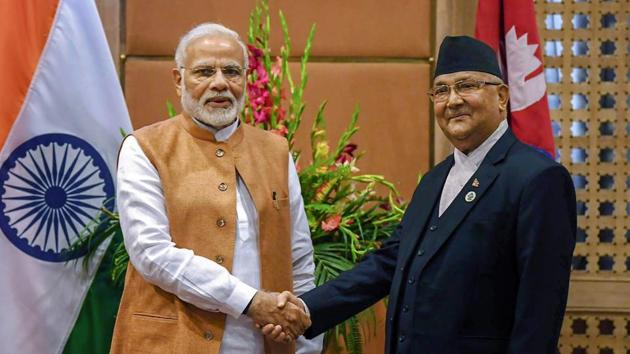
Nepal Prime Minister KP Sharma Oli on Saturday dialled Prime Minister Narendra Modi on Saturday to wish India on its 74th Independence Day, the first direct contact between the two leaders in four months. PM Oli’s ice-breaking phone call was quickly followed by tweets from Nepal’s former prime ministers, Pushpa Kamal Dahal ‘Prachanda’ and Madhav Nepal of the ruling Nepal Communist Party, and Sher Bahadur Deuba, president of the opposition Nepali Congress.
PM Oli had set up a row over an 80-km road built by the Border Roads Organisation in April this year and issued a new map the next month that depicts Indian territories, Kalapani and Lipulekh as part of Nepalese territory.
A statement by the external affairs ministry said PM Oli greeted the government and people of India on the occasion of its 74th Independence Day. He also conveyed congratulations for India’s recent election as a non-permanent member of the UN Security Council.
“The leaders expressed mutual solidarity in the context of the efforts being made to minimise the impact of the Covid-19 pandemic in both countries,” the statement said.
Prime Minister Modi offered India’s continued support to Nepal to deal with the pandemic and “recalled the civilizational and cultural links that India and Nepal share”.
{{/usCountry}}Prime Minister Modi offered India’s continued support to Nepal to deal with the pandemic and “recalled the civilizational and cultural links that India and Nepal share”.
{{/usCountry}}The two prime ministers had last spoken on April 10, a conversation that had focussed on the Covid-induced lockdown and the problems being faced by people on both sides of the border.
PM Oli’s early morning tweet, and then the phone call, was followed up by more tweets from across Nepal’s political spectrum.
“I would like to convey my heartfelt greetings and congratulations to PM Modi ji, his government and people of India,” tweeted Dahal, better known by his nom de guerre Prachanda.
Madhav Nepal tweeted his letter to PM Modi that expressed optimism about the future of India-Nepal relations. “We are confident that Nepal-India relations based as they are on close cooperation, historical ties and people-to-people contacts, would continue to grow in coming years to the satisfaction of the people of two countries,” Madav Nepal’s letter said.
Deuba, who heads the lead opposition party Nepali Congress, extended “cordial greetings and best wishes to the friendly people and the government of India” in his tweet.
In his Independence Day address early on Saturday, PM Modi had stressed on peace and harmony in the South Asia region. “All the leaders of the countries of the region have a huge responsibility, an important responsibility for the development and progress of such a vast population,” he said.
“The more peace and harmony there is in this whole region, the more it will work for the welfare of humanity,” he said of the region that is home to a quarter of the world’s population. PM Modi also spoke about New Delhi’s efforts to forge deeper connections with India’s neighbours.
PM Oli’s phone call comes days ahead of the meeting of the India-Nepal body overseeing the implementation of development projects funded by New Delhi that is scheduled to meet in Kathmandu next week.
This meeting between Indian ambassador Vinay Mohan Kwatra and Nepal’s foreign secretary Shanker Das Bairagi is also the first between the two sides after the row over Nepal’s new map took relations to a new low.
India has been sharply critical of Kathmandu’s decision to issue a new map, describing it as untenable and an “artificial enlargement of claims” that isn’t based on historical facts or evidence. “It is also violative of our current understanding to hold talks on outstanding boundary issues,” New Delhi said in June this year after lawmakers cleared an amendment to incorporate the new map in Nepal’s emblem.
Indian officials had, however, made it clear that New Delhi would not hold back on assistance granted to Nepal due to the boundary row and would continue to focus on deepening people-to-people ties between the two countries. It was in this context that the Indian army had earlier this month gifted 10 ventilators to Nepalese army.