The Delhi Police on Friday said they denied permission for the proposed October 10 protest at Jantar Mantar by the Cockroach Janta Party (CJP), citing the short notice given by the organisers, their previous instances of violating their undertakings and not following lawful directions during the previous protest at the site. Delhi Police cited the prevailing public order, safety, traffic and law and order situation as key reasons behind the decision.
In a press conference held at the Delhi Police headquarters, joint commissioner of police (New Delhi Range) Nupur Prasad said that on October 7, the New Delhi police district received an application from CJP’s co-convenor Saurav Das, intimating that they will be holding a protest at protest at Jantar Mantar regarding accountability of Chief Election Commissioner (CEC) on October 10.
Prasad said that the police examined the intimation letter and found that the information was received on very short notice. According to the current guidelines, she said, an application for organising at event at Jantar Mantar is required to be submitted at least 10 days before the scheduled date of the event.
Deep Dive
Why did Delhi Police deny permission for the CJP protest at Jantar Mantar?
What was the CJP protest at Jantar Mantar demanding?
How could the October 10 Jantar Mantar protest affect Delhi Metro and train services?
“It is also relevant to mention that, as per the past conduct of the CJP, their undertakings given on previous occasions and lawful directions were not followed. Keeping in view the non-compliance with the prescribed procedure, instances of non-compliance with laws and guidelines in the past as well, and the prevailing public order, safety and security, law and order and traffic situation, permission for the proposed sit-in protest at Jantar Mantar is not being granted,” said joint CP Prasad.
She reiterated that prohibitory orders under Section 163 of the Bharatiya Nagarik Suraksha Sanhita (BNSS) are already in force in the New Delhi area, under which reasonable preventive restrictions have been imposed to maintain public order and safety.
{{/usCountry}}She reiterated that prohibitory orders under Section 163 of the Bharatiya Nagarik Suraksha Sanhita (BNSS) are already in force in the New Delhi area, under which reasonable preventive restrictions have been imposed to maintain public order and safety.
{{/usCountry}}“It is further informed that if anyone is found violating section 163 of the BNSS or is involved in vandalism and destruction of public property, appropriate legal action will be taken as per the previous directions of the courts,” she said.
The denial of the permission for the proposed CJP protests came amid the ongoing demonstrations by multiple opposition parties, including the Congress Party, students organisations, and civil society activists, demanding the resignation of CEC Gyanesh Kumar over alleged irregularities in the Special Intensive Revision (SIR) process of the electoral rolls.
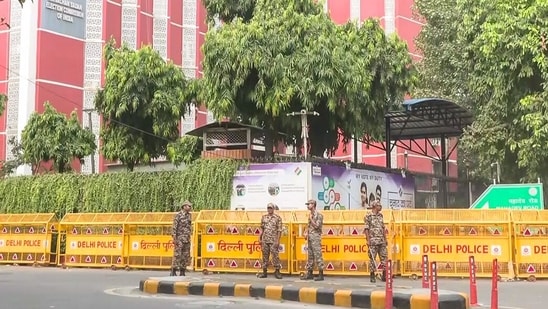
The Delhi Police have already beefed up security arrangements across the city, especially in central Delhi areas, for the protests and while additional deployment of security personnel are being made for the proposed CJP’s protest at Jantar Mantar which already have received support from multiple organisations.
Delhi Police have also asked DMRC to close the entry and exit gates of 57 metro stations from Friday night till Saturday. These metro stations include Rajiv Chowk, Central Secretariat, Patel Chowk, Janpath, New Delhi, Mandi House, ITO, Supreme Court, Indraprastha, Kashmere Gate, Karol Bagh, INA, Hauz Khas, Lajpat Nagar, Jamia Millia Islamia, Seelampur, Welcome, Shahdara, Rithala, Rohini East and Rohini West, among others.