
 E-Paper



Nobel prize in chemistry: They used AI to decipher old proteins, make new ones
The Nobel Prize in Chemistry honors three scientists for using AI to predict protein structures, enhancing medicine and engineering new proteins.

 Prefer HTon Google


The chemistry of life is defined by proteins, which can create muscles, hormones, antibodies or enzymes, each with their own functions. These functions are determined not only by the chemistry of the proteins, but also by their structure: every protein folds magically into its own three-dimensional structure.
Predicting the structure of various proteins can have immense implications, particularly in medicine. So can engineering new proteins of desired structures so that they can perform specific functions. Indeed, some classes of vaccines, for example, bank on the performance of engineered proteins.
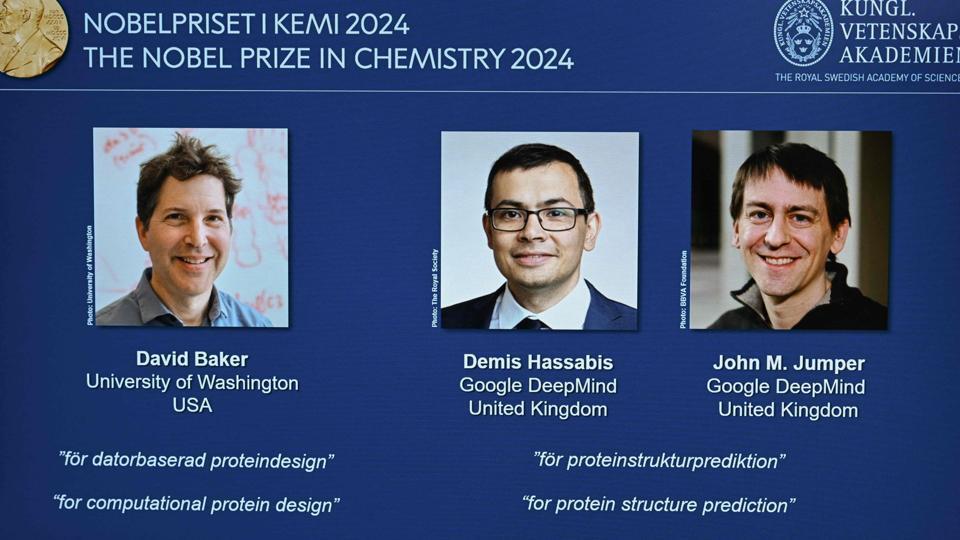
This year’s Nobel Prize for Chemistry, announced on Wednesday, honours three American scientists who used artificial intelligence to make all this possible. Their breakthroughs are very recent. Two of the winners are below 50; in fact, one is not even 40.
Demis Hassabis, 48, a programmer and games developer who co-founded DeepMind, the company whose AI plays board games and which was later acquired by Google, created an AI model called AlphaFold, which could predict the shape of a protein if fed with a given set of amino acids.
John Jumper, 39, a researcher with Google DeepMind, collaborated with Hassabis to update the AI model to a newer version, AlphaFold2, which could predict the structure of proteins with greater accuracy. The two of them share one-half of the Nobel.
David Baker, 62, a biochemist at Washington University, has been awarded the other half. He approached protein folding from the other direction. He entered the desired shape of a protein, and AI responded with the amino acid chains that would be necessary to engineer such a protein from scratch.
The importance of their work is best appreciated if one starts from how challenging it was.
The complexity of proteinsProteins are made of 20 different amino acids, linked in the form of long strings that fold into distinct structures. X-ray crystallography allows scientists to examine these structures, but an easier approach would be to predict the structures. For decades, this was easier said than done. Given that there can be endless possible structures into which a given sequence can fold, how do we know which one actually exists in nature?
In 1994, researchers began a competition, Critical Assessment of Protein Structure Prediction (CASP), where scientists would be asked to predict structures of newly discovered proteins from given amino acid sequences. For decades, the predictions were way off the mark.
The first breakthrough came in 2018, from Hassabis.
Making the predictionHassabis has been acquiring skill after skill since his childhood. He started playing chess at the age of four and became a master at 13. As a teenager, he ventured into programming and developing games. Later, he studied AI and neuroscience, then started to develop neural networks. In 2010, he co-founded DeepMind, which was sold to Google in 2014.
In 2018, Hassabis and his team registered for the CASP competition. They won, using the AlphaFold AI model. Their prediction of a protein’s structure was 60% accurate, far better than previous predictions that had never gone beyond 40%. The scientific community was impressed, but the goal of 90% accuracy was still far away.
Until the next breakthrough came, with Jumper’s contribution.
Jumper had studied physics and mathematics, then worked at a company where he used that knowledge to simulate proteins using innovative ways. In 2017, he joined Google DeepMind, where he collaborated with Hassabis and improved AlphaFold to AlphaFold2.
Using a database of known protein structures, AlphaFold2 could predict new structures with greater accuracy. In 2020, it excelled at CASP.
“For the last 40-50 years, scientists have been chipping away and unravelling the molecular driving forces and fundamental design principles behind the protein folding process,” said Anand Srivastava, an associate professor at the molecular biophysics unit at the Indian Institute of Science, Bengaluru.
“Deep Mind’s AlphaFold suite of algorithms is a game-changer as it is shown to give an accuracy of almost 90%... Truly, in the words of Nobel committee they ‘cracked the code for proteins’ amazing structures’,” he said.
Engineering new proteins
At that time, Baker was already a veteran in the field. His software for predicting protein structures, called Rosetta, had performed well at the CASP competition of 1998.
Baker’s team then thought about using Rosetta “in reverse”: instead of entering amino acid sequences to get protein structures, why not enter a desired protein structure and get suggestions for the amino acid sequence? That sequence could then be used to actually create a new protein.
But how do scientists know what kind of shape the desired protein should have? They don’t know exactly, and it has to be tested out, Srivastava of IISc said. “For an end-to-end solution, the fold has to be actually tested in the wet laboratory… If successful, the designed protein is tested in a biological setting for function, and only then do we know if the predicted functional fold was successful of not.”
Baker’s group drew a protein that does not exist in nature, and Rosetta proposed which amino acid sequence could exist in it. The researchers introduced this sequence in bacteria, which produced the desired protein. When they checked with X-ray crystallography, the protein, Top7, indeed matched the structure they had drawn.
Why it mattersWhen the design principles of protein folding are clearly understood, Srivastava said, these can be used to “engineer” new functional proteins. Such proteins can be applied not only in designing effective drug molecules, pharmaceuticals and vaccines, but also to design biology-inspired new material, catalysts and sensors, he said.
This is where protein design starting from Baker’s work has led to. Srivastava said Baker has had a long-time association with IISc, and most recently visited in 2019 as a Raman Chair Professor, Indian Academy of Sciences.
“Baker’s group has been at the forefront of protein engineering science. Through his computational algorithms (freely available as the Rosetta suite of software) that acts as the first step in protein design and engineering, several new functional proteins have been synthesised and applied for the targeted functions in physiology, chemistry, material science and green energy sector,” he said.


