E-Paper



Not job of court to declare Hindus minority, says Supreme Court
According to a bench of justices Uday U Lalit and S Ravindra Bhat, the top court cannot issue a generic directive declaring Hindus a minority in states without authentic materials on record.

 Prefer HTon Google


It is not the job of a court to declare Hindus a minority in states where they are outnumbered by other communities, the Supreme Court observed on Monday, pointing out that the determination of minority status depends on several empirical factors and statistics because of which the exercise is outside the judicial domain.
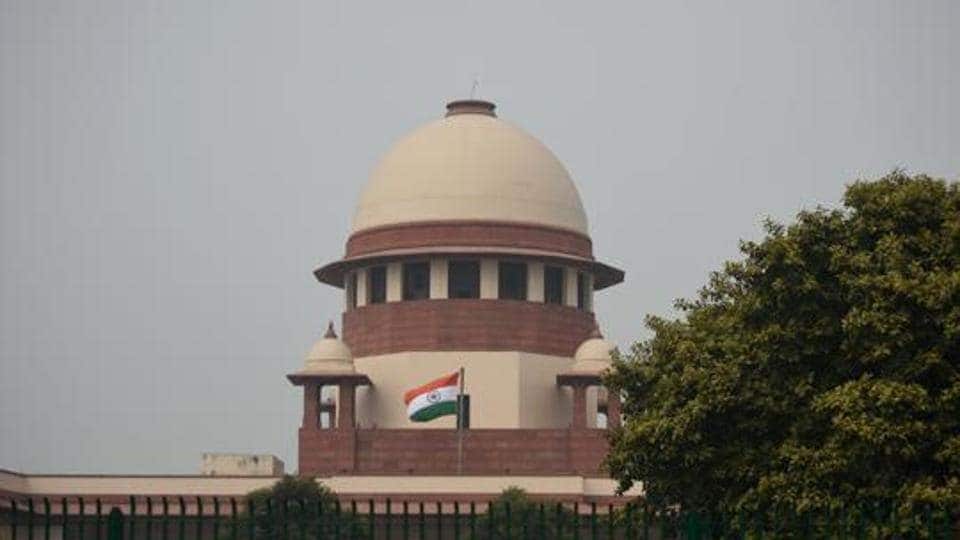
According to a bench of justices Uday U Lalit and S Ravindra Bhat, the top court cannot issue a generic directive declaring Hindus a minority in states without authentic materials on record.
“It is not the job of the court to declare minorities...This has to be on a case-by-case basis. There cannot be a general declaration to declare Hindus as minority unless you show us something concrete about denial of rights,” the bench told advocate Ashwini Upadhyay, who was appearing for petitioner Devkinandan Thakur Ji.
The public interest litigation, filed in June, has challenged the provision of the National Commission for Minorities (NCM) Act, 1992 and NCM Educational Institutions (NCMEI) Act, 2004 that restrict certain benefits and rights available for minorities, including the right to establish and administer institutions, to six notified communities – Christians, Muslims, Sikhs, Buddhists, Parsis and Jains.
On Monday, the bench told Upadhyay that there have been judgments by the top court since 1957 that laid down that minority status for religious and linguistic minorities has to be ascertained by state.
“The issue has gone by since 1957 (Re: Kerala Education Bill Case) when the Supreme Court said it has to be done state-wise. Why should we say or clarify anything now? The problem is that you want to make out a case when there is none,” it told Upadhyay. In the 1957 verdict, the top court held that the minority must be determined with regard to the whole population of the state.
The court added: “If you give us examples where Hindus are in minority and some directions are required, we may perhaps look at that. But you are asking for a general direction to declare Hindus as minority in some states. Why should we do that? We cannot declare any community as a minority because we don’t have the statistics of different states or other facts.”
Regarding a prayer in the PIL on declaration of minority status on a district level, the bench made it clear that such a plea is not proper. “...It can’t be on a district level. This will be contrary to the law and the 11-judge bench decision (in TMA Pai case),” it said. In the 2002 TMA Pai case, the top court, while dealing with the right of minorities to establish and administer educational institutions of their choice, held that the unit for determining status of both linguistic and religious minorities would be the state.
At this point, Upadhyay requested the bench to tag Thakur Ji’s PIL with another case already pending before a different bench of the Supreme Court. In that case, Upadhyay himself is the petitioner. As Upadhyay submitted that the matter before the other bench is expected to come up on August 30, the bench listed Thakur Ji’s plea in the first week of September along with the other PIL.
The petition filed by Upadhyay is currently pending before a bench headed by justice Sanjay Kishan Kaul. In that plea, Upadhyay has challenged the validity of Section 2(f) of the NCMEI Act on grounds that it gives unbridled powers to the Centre to restrict minority benefits to the notified six religious communities.
It stated that Hindus are merely 1% in Ladakh, 2.75% in Mizoram, 2.77% in Lakshadweep, 4% in Jammu and Kashmir, 8.74% in Nagaland, 11.52% in Meghalaya, 29% in Arunachal Pradesh, 38.49% in Punjab, and 41.29% in Manipur. Upadhyay’s plea has also questioned the creation of the NMC (National Minorities Commission) and the Minority Education Commission, arguing that the Centre created these institutions to “divide and rule”.
By an order in May, justice Kaul’s bench allowed the Centre time till August 30 to consult stakeholders and submit a report on whether minority status could be given to Hindus based on their population within a state.
The court order on May 10 came after the Union government said it would initiate a “wide consultation” with states and other stakeholders to examine whether Hindus can be granted minority status in states where their numbers are less than those of other communities.
The government sought time for deliberation while withdrawing its previous stand in March when the Centre sought dismissal of Upadhyay’s writ petition and defended the 1992 NCM Act and the 2004 NCMEI Act.
In its first affidavit filed in March, the central government put the onus on states and Union territories (UTs) to take a call on whether or not to grant minority status to Hindus where they are numerically less, adding that both the Centre and states have the legislative competence to enact laws on the protection of minorities.
However, withdrawing its previous affidavit in May, the government conceded that the question involved in the petition has far-reaching ramifications throughout the country and, therefore, any stand taken without detailed deliberations with the stakeholders may result in an unintended complication for the country.
The May affidavit underlined that although the power is vested with the central government to notify minorities, the stand to be formulated by the Centre with regard to issues raised in the batch of petitions on the issue will be finalised after having a wide consultation with the state governments and other stakeholders.