E-Paper



Number Theory: Should BJP have taken consumer sentiment data by RBI seriously?
.

 Prefer HTon Google


Election results are always easier to explain in hindsight. Therefore, it is tempting to attribute the Bharatiya Janata Party’s inability to secure a majority on its own to economic distress among the majority of voters. A lot of the commentary, including that published in these pages, has underlined the concerns around a K-shaped economic recovery in India since the pandemic. But was there any data which clearly pointed out that economic sentiment was grimmer in the run-up to the 2024 elections than it was in 2019? A comparison between 2019 and 2024 is important because the BJP increased its majority between 2014 and 2019, but relinquished it between 2019 and 2024.
An HT analysis of RBI’s Consumer Confidence Survey (CCS) shows that the ruling party would have done well to take its findings seriously. Here are three charts that explain this in detail.
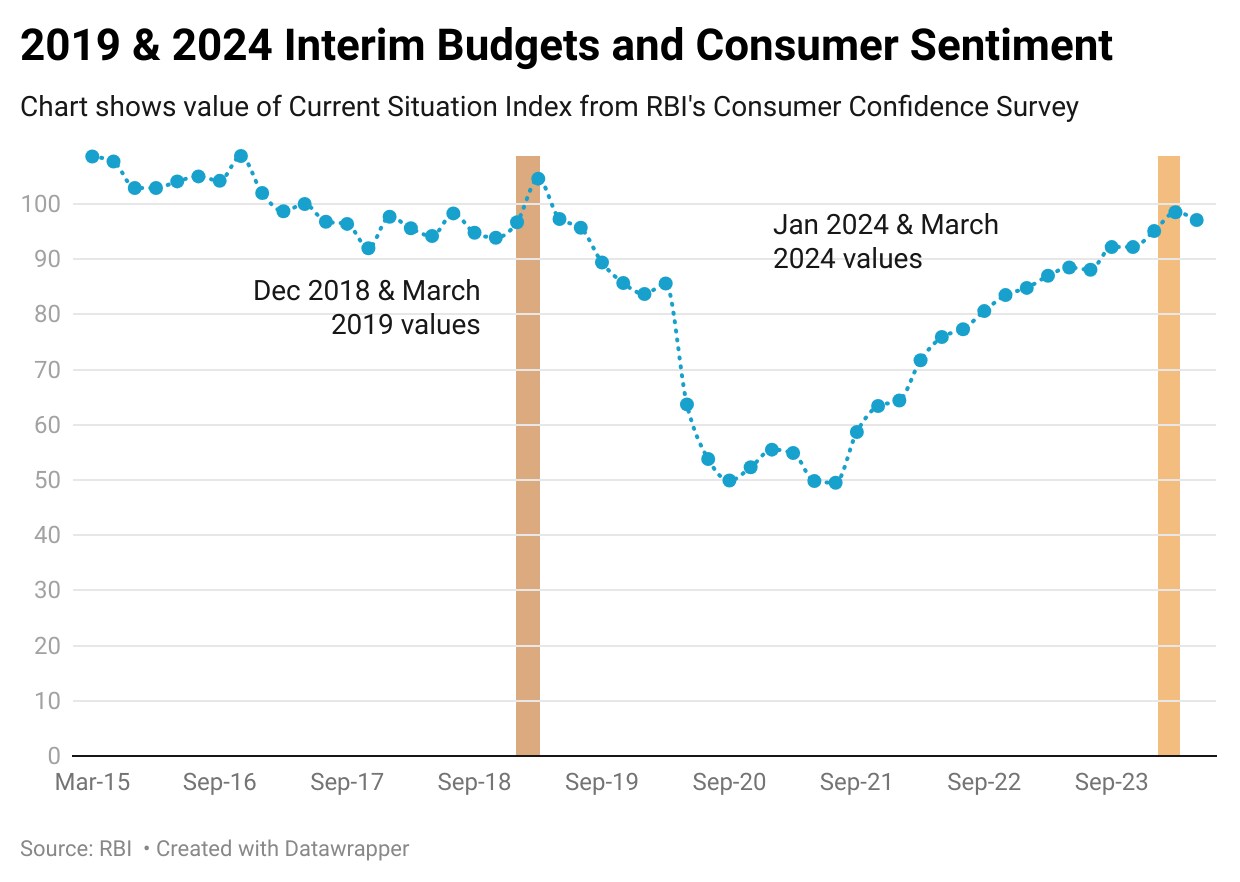
 Headline CCS numbers do not suggest a lot of difference except a missing interim budget boost in 2024The summary number to track from CCS is the current situation index (CSI). CSI is calculated by adding 100 to the average of net responses (General Economic Situation, Employment Scenario, Price Level, Household income and Overall Spending) in CCS. This means that it will be greater than 100 if the net sentiment is positive and less than hundred if it is negative. The current situation index (CSI) of the CCS was at 98.5 and 104.6 respectively in the March 2024 and March 2019 rounds of the survey. Both of these are the last readings of CCS before the 2019 and 2024 general elections started. What is more interesting is that the penultimate readings of CSI before the 2019 and 2024 elections were almost similar; 96.7 in December 2018 and 95.1 in January 2024. This means that the 2019 interim budget gave a bigger boost to economic sentiment than its 2024 counterpart. Given the fact that the 2024 interim budget opted for wider measures, rather than making announcements with an eye on the elections, this is not surprising. To be sure, CCS is only conducted in urban areas.
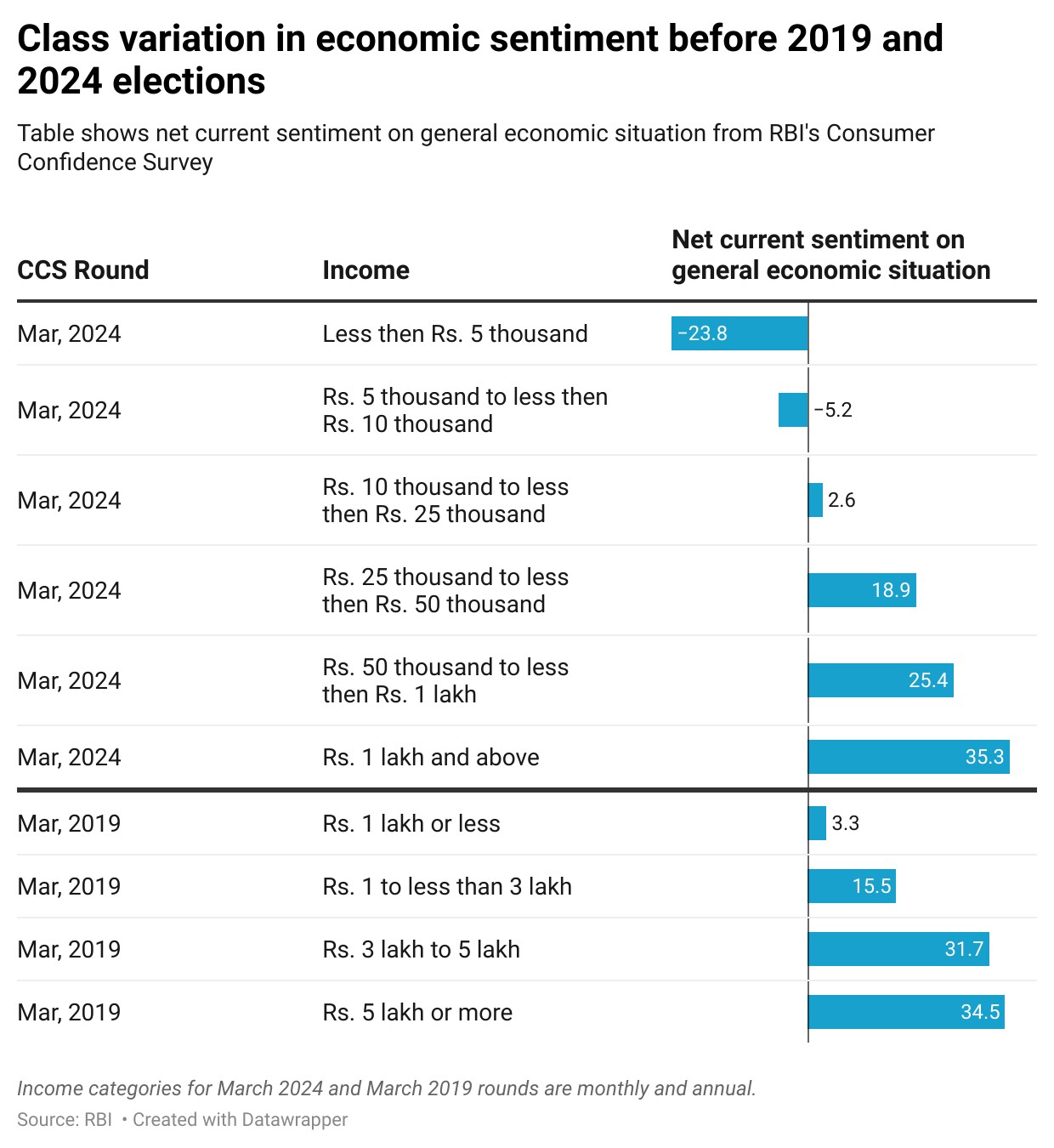
- Class divergence in sentiment was much greater in 2024The fact that the rich were bullish about the general economic outlook while the poor were not was pointed out in a pre-budget story in these pages (https://tinyurl.com/mr385ad4). Given India’s economic inequality, a class divide in economic sentiment is not something which is surprising in itself. But was the class divide bigger before the 2024 elections than it was before 2019? Unit level data from CCS, which includes information on the incomes of respondents, can help us answer this question. The comparison is slightly constrained by the fact that income categories in CCS are different for the March 2019 and March 2024 rounds. However, a comparison of net sentiment on the general economic situation compared to a year ago across classes shows that it was positive across all income categories in March 2019 but negative for the two lowest income categories in March 2024. In hindsight, this should have raised a red flag.
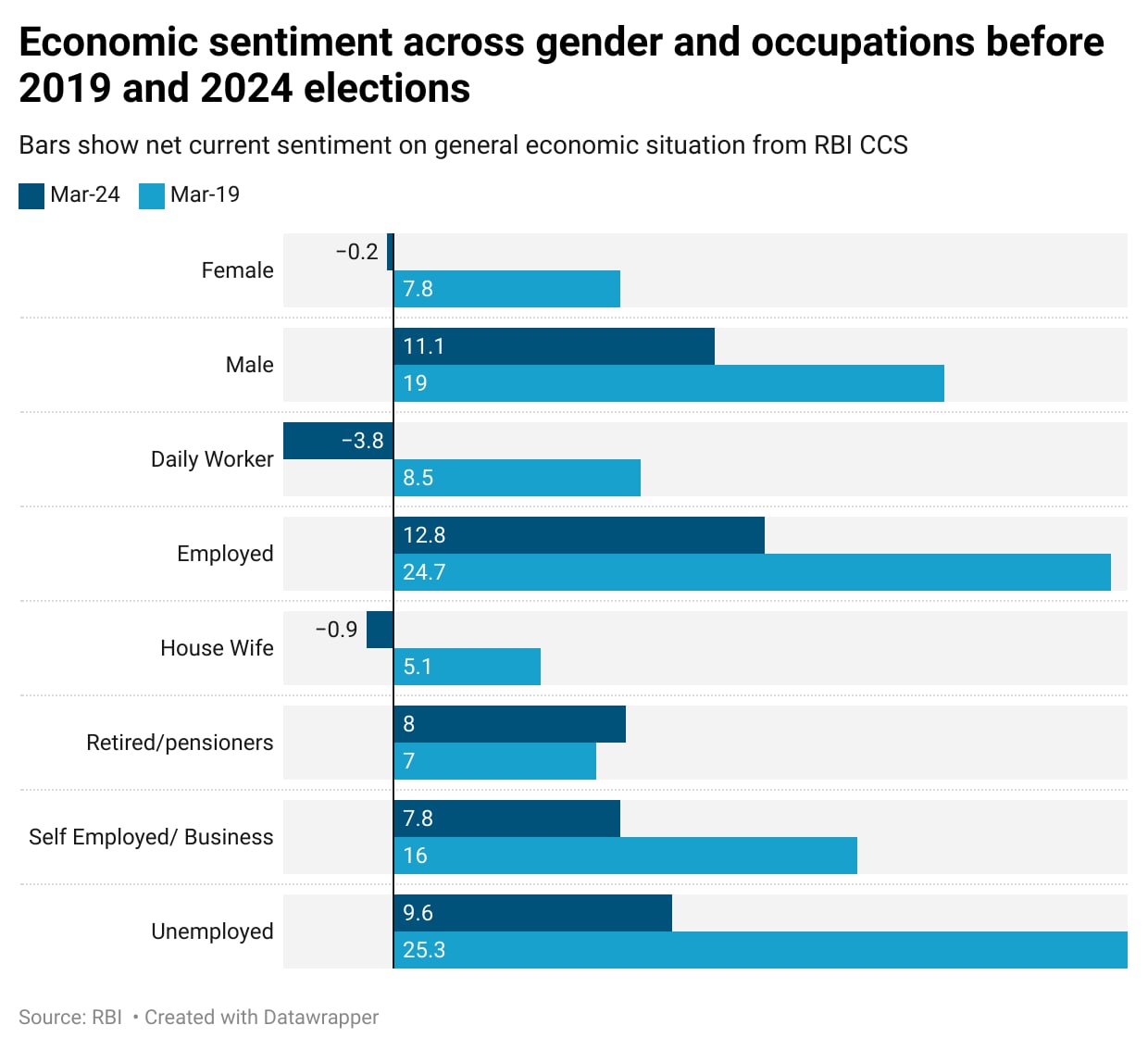
- And there might have been a gender-aspect to the K-shaped recovery as wellCCS also gives information on the gender and occupation of respondents. This allows us to track how economic sentiment differed among men and women and among different occupations. A comparison of the March 2019 and March 2024 rounds is, once again, quite revealing. While net sentiment on the general economic condition was positive for both men and women in the March 2019 round of CCS, it became marginally negative for women in the March 2024 round. A similar pattern can be seen when it comes to economic sentiment among homemakers in CSS in the March 2019 and 2024 rounds. Was weak economic sentiment among the poor and women the only driver of the BJP’s poor showing in the 2024 elections? Not necessarily, as elections are decided by a multitude of factors, including those outside the realm of the economy. However, these statistics do tell us that the ruling party perhaps did not pay enough heed to economic sentiment on the eve of the polls. Will the upcoming Budget in July try to correct this class and gender asymmetry? It will be interesting to watch. Even more interesting to see will be whether RBI also starts a CCS for rural areas to better track sentiment as the current survey is only conducted in cities.