
 E-Paper



On board 13174: A loud bang, and what followed
A train collision near New Jalpaiguri has left 9 dead and 41 injured. Villagers were first responders, helping in the rescue efforts.

 Prefer HTon Google


Siliguri: As the green fields of North Bengal trundled past, Kisan Chhettri, a young man in his twenties, was whiling away time, absent-mindedly playing a game on his mobile phone. There was much to contemplate — Chhetri, from Shillong, was on his way to Sealdah in West Bengal, in search for employment. The train, the Kanchanjunga Express, which over a day-and-a-half cuts through India’s chicken neck in the east, beginning from Agartala and ending in Sealdah, was moving slowly, aiding a post-morning lethargy.
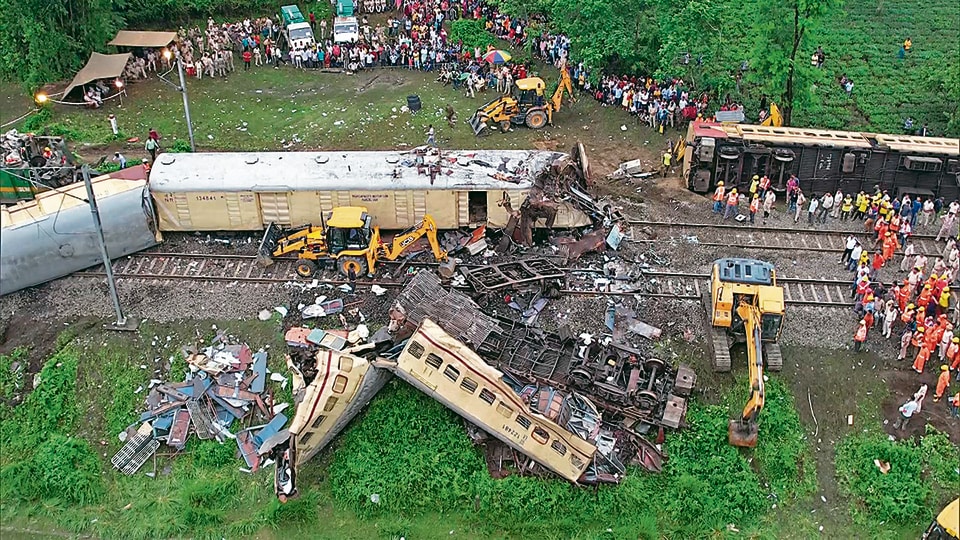
But just short of 9am, all Chettri remembers is a big bang; a bang that shook him out of his reverie; a bang that was the sound of a goods train colliding into the back of the Kanchanjunga Express; a bang that has left9 people dead and 41 people injured.
“I remember playing a game on my mobile phone, when suddenly there was a big bang, and a sudden, huge jerk. Our coach, towards the back of the train, began tumbling, and there was a huge commotion. Panic filled the coach,” Chettri said.
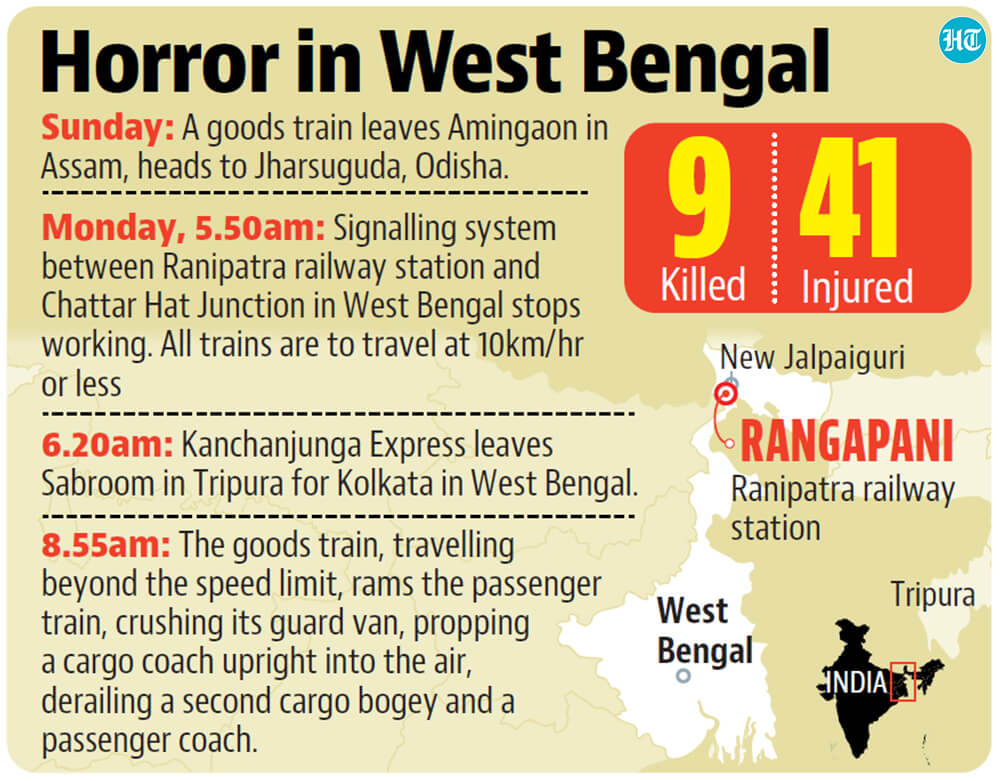
In an accident that brings back haunting memories of a multi-train collision in Bahanaga Bazaar in Odisha that left 300 people dead, a goods train collided into the Kanchanjunga Express near New Jalpaiguri from behind, causing two rear compartments of the passenger train being thrown off the tracks under the impact, while visuals from the site showing that a third bogie was left hanging mid air, with the engine of the goods train lodged underneath. Of the four compartments that suffered maximum impact, at least three — the guard’s compartment, and two parcel vans— had very few passengers. To be sure, at least two of the nine dead are railway personnel, officials said.
In the melee that ensued after the loud “bang”, Chettri evaluated quickly — fortunately he was alive. He looked for his bags and belongings, but could not spot them anymore. Importantly, there were people who were travelling in the coach with him that had gone missing. “There were around 20 passengers in our coach. While most of us were safe, are least two people were missing. We extricated ourselves and looked for them, but could not find them,” Chhettri said.
Johnson Chhettri, another resident of Meghalaya, shaken after the incident and speaking to local reporters gingerly described the minutes after the accident akin to a “nightmare”.
“I lost sense for a couple of minutes. It was only when I felt one of my fellow passengers dragging me out that I gained consciousness and realised what had happened. I was speaking on the phone when the jolt came and did not know what happened after that. Immediately I called my parents and told them that I am safe,” he said.
Abinath Mukherjee, from Barasat in West Bengal, who had boarded the train at Agartala and was on his way home, remembers the train running at a slow speed. “Suddenly, all of us heard a loud sound. Everything went upside down, and our compartment was suspended in the air. We were left helpless like that for close to 15 minutes when locals came to our rescue. I must have seen at least two people who had died,” Mukherjee said.
Some locals also said that a scheduled operational procedure at Lumding, which involved a direction reversal for trains passing through the station, likely prevented a higher casualty figure. With the Kanchanjunga Express hit from behind by the goods train, the three bogeys that took maximum impact those had barely any passengers, but these were initially to the front of the train. One passenger in a sleeper coach said, “The affected coaches were in the front till Lumding.
Narayan Ghosh from Assam said that he was fortunate that he was travelling in the fifth coach from the rear. “Four coaches were derailed and suffered massive damage. I was in deep sleep when the accident happened, and I fell to the floor from the lower berth I was occupying. Once I came to, all the passengers helped each other. But most importantly, local residents arrived at the door to help us come out,” Ghosh said.
Raju Bista, the BJP member of Parliament from Darjeeling, who was among the first officials at the spot, lauded the local villagers of Rangapani for being first responders to the tragedy, and saving lives. “I am grateful to the villagers who were the first to react to the accident. Immediately, they dropped everything and tried to help. The administration, personnel of the SDRF and the NDRF and railway personnel then arrived at the spot, and rescue was completed in a short period of time. The Railway Minister and the Prime Minister have also been constantly monitoring the situation,” Bista said.
Mohammad Raju was one of the villagers who rushed to help, and said that he was returning home after finishing his morning prayers, when he saw the accident take place. “I saw the speeding goods train hitting the passenger train from behind. The latter was moving slowly.”
In the minutes after the accident, Raju was part of a posse of villagers that crawled through the debris, and extricated bodies in the mangled coaches of the two trains. “We brought out seven bodies including that of the goods train driver. At least 14 people we found were alive, though three had severe injuries,” Raju said.
Another one of the villagers, Mohammad Hamid ran to help. “The accident happened not far from my home. I froze for a few seconds and then realised the passengers needed help. Some of my neighbours I dashed to help. When we got close to the site, all we could hear were people crying for help from inside a mangled coach of the express train,” Hamid said.
“We rescued at least eight passengers of whom some appeared to have serious injuries. We also brought out the driver and his assistant from the mangled cabin of the goods train, as well as the guard of the passenger train. Two of them have died. The police arrived half an hour later, after which many agencies came, including railway protection force personnel,” Hamid said.


