
Union education minister Pralhad Joshi on Wednesday chaired the first meeting of the Parliamentary Consultative Committee on Education for 2026, with discussions focusing on taking Indian universities overseas, facilitating foreign university campuses in India and attracting international students to the country.
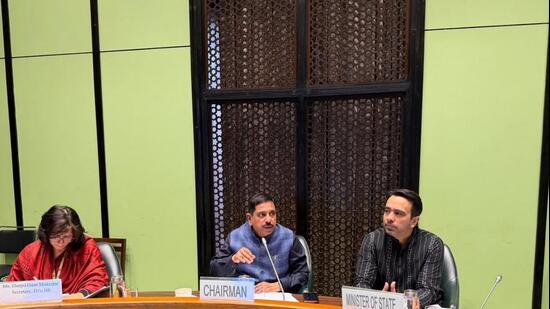
The meeting, held on November 25, was centred on the theme of “Internationalisation of Indian Education” and positioning India as a “global knowledge hub”.
In a post on X after the meeting, Joshi said, “Deliberations covered expanding Indian universities globally, facilitating foreign university campuses in India, strengthening international research partnerships, student and faculty exchange programmes, and attracting international students.”
He also said members were sensitised about measures to internationalise school education through Central Board of School Education (CBSE) Global and National Institute of Open Schooling (NIOS) expansion, multilingual learning, global teacher mobility, curriculum reforms and cross-cultural exposure.
Also Read: HT interview: Solar storage plan to address peak-hour demand problem, says Pralhad Joshi
He also pointed to the demand for CBSE schools abroad, saying it demonstrated the “credibility of Indian education programmes and their potential for scalability at the global level”.
{{/usCountry}}He also pointed to the demand for CBSE schools abroad, saying it demonstrated the “credibility of Indian education programmes and their potential for scalability at the global level”.
{{/usCountry}}On school education, the Department of School Education and Literacy (DoSEL) highlighted curriculum alignment with global standards, multilingual education, student and teacher exchange programmes and the role of the national assessment centre Performance Assessment, Review, and Analysis of Knowledge for Holistic Development (PARAKH) in academic equivalence and quality alignment.
It informed the committee that 268 CBSE-affiliated schools were functioning across 26 countries, with an overseas regional office in Dubai. A “standardised assessment framework” had also been implemented across affiliated schools globally to ensure uniformity, the ministry said in a press statement.
Addressing the committee, Joshi highlighted the historical global influence of the Indian Knowledge System (IKS) and said the ministry’s objective was to further expand its global footprint. He said steps were being taken to establish campuses of Indian higher education institutions (HEIs) overseas and facilitate foreign universities in setting up campuses in India.
Also Read: India’s continuing tradition of celebrating its teachers
The minister informed the members that around 21 foreign HEIs were currently operational in India, apart from joint academic and research collaborations.
The Department of Higher Education (DoHE) of the Union education ministry outlined four strategies for internationalisation: academic and research collaborations; attracting international students to study in India; allowing foreign higher education institutions to establish branch campuses in India; and enabling Indian institutions to set up campuses abroad.
Parliamentary Consultative Committee on Education
The Parliamentary Consultative Committee for the ministry of education is an informal platform that brings together MPs and the government to discuss the ministry’s policies, programmes and their implementation. Its purpose is to provide lawmakers an opportunity to understand the government’s work and offer suggestions on policy matters.
According to the Ministry of Parliamentary Affairs’ guidelines, the objectives of such committees include “promote informal consultation between Members of Parliament and the Government” and provide the government an opportunity to benefit from MPs’ advice and guidance.
ABOUT THE AUTHOR
Sanjay Maurya is a Principal Correspondent with Hindustan Times, where he covers education, with a focus on school and higher education, competitive examinations, education policy and governance. Working as part of the National Bureau, he is based in New Delhi and reports on the Ministry of Education and covers various statutory bodies like UGC, AICTE and NCTE and autonomous bodies like CBSE and NCERT. His reporting also tracks the implementation of key government reforms and policies from school education to higher education including in IITs, NITs, IIMs, central and state universities, and their impact on students and educational institutions. His reporting on the irregularities and rushed implementation of CBSE's On-Screen Marking (OSM) system for evaluation of Class 12 board exams 2026, triggered administrative action, leading to the transfer of the board's two senior-most officials and the constitution of a committee to probe alleged irregularities in procurement process of the system. He joined Hindustan Times in December 2024. Prior to that, he had a three-year stint at Careers360, where he reported on school and higher education, entrance examinations, admissions, rankings and various education policies involving universities and professional education bodies. Over the years, Maurya has reported extensively on major developments in India's education sector, including the implementation of the National Education Policy (NEP) 2020, reforms in the National Testing Agency (NTA) following the NEET-UG 2024 controversy, changes in school education, higher education regulation, and the evolution of entrance examinations such as NEET, JEE and CUET. He regularly produces data-driven and explanatory stories based on government documents, parliamentary proceedings, court records and official data. His focus remains on helping readers understand how education policies and institutional decisions affect millions of students, teachers and educational institutions across the country.