E-Paper



HT interview: Solar storage plan to address peak-hour demand problem, says Pralhad Joshi
The government has earmarked ₹14,500 crore for this scheme, and the Cabinet has approved it with the Prime Minister's support, the minister said.

 Prefer HTon Google


The Union government plans to increasingly link solar energy projects with battery storage to address peak-hour electricity demand, as India looks to expand its renewable energy capacity beyond its 2030 target, Union minister for new and renewable energy Pralhad Joshi said on Wednesday.
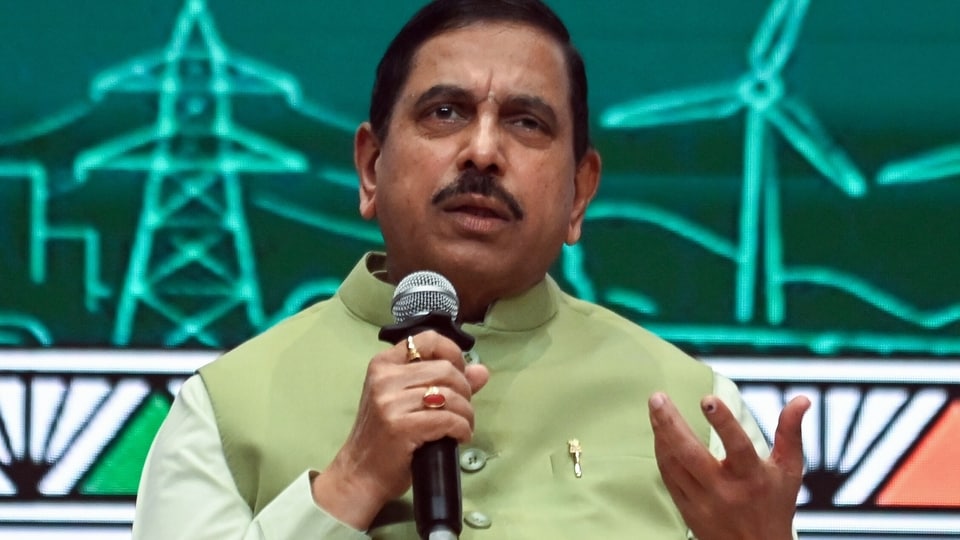
Speaking to Hindustan Times on the sidelines of the Bharat Renewable Energy Summit 2026, Joshi outlined the government's plans for energy storage, its roadmap for renewable energy capacity beyond 2030, and its push to build a domestic manufacturing ecosystem for solar components. Edited excerpts:
The Cabinet has announced a new ₹14,500 crore energy storage scheme. Experts say while India has been creating renewable energy infrastructure, the next step should be building battery energy storage systems. What is your view on this?
The Cabinet's decision is appreciable. Ultimately, most of the battery storage requirement comes from solar and wind energy. During non-solar hours, there can be a shortage of power, while during solar hours, there can be excess generation. Storage will help address this imbalance and reduce curtailment.
The government has earmarked ₹14,500 crore for this scheme, and the Cabinet has approved it with the Prime Minister's support. According to the Cabinet note, around 60 GW will be pumped-storage capacity, supported through viability gap funding. There will also be battery storage capacity of 30 GWh, in addition to 50 GWh from our side from the Green Energy Corridor Phase-3. So altogether, 140 GWh of energy storage capacity will be supported through viability gap funding by the government.
You speak about the 2030 target of 500 GW of renewable energy installed capacity. What is the government's policy and vision for the period after 2030? The Prime Minister has also given an additional target of 500 GW over the next 10 years. Where do we stand on the existing 2030 target and this additional target?
Whatever the target is for 2030, we are on track. The Prime Minister has given us a new task and whatever direction he gives, he will also support us in executing it. We will work it out and plan accordingly. Whatever target the Prime Minister has set, we will achieve it.
We will complete 500 GW by 2030. After that, the Prime Minister has spoken about adding another 300 GW, taking our total capacity to 800 GW by 2035.
Do you think India needs a comprehensive energy policy, given the country's growing demand and the fact that different ministries are working on different aspects of the energy sector? Wouldn't a comprehensive policy provide greater clarity?
No, we already have a comprehensive approach. It is because of this comprehensive approach that we are seeing such a large amount of growth. Otherwise, how would this growth have happened? We have a whole-of-government approach.
For example, battery storage is being undertaken by different ministries. The Ministry of Power is also working on it, and the Ministry of New and Renewable Energy is working on renewable energy. The Ministry of Power is working on storage along the grid, while we can look at it beyond the grid as well. The Ministry of Power is looking at grid stability and related issues. When there is excess supply, the electricity can be stored and transmitted later in the evening.
This is something we are considering, although we have not announced anything specific yet – In the coming days, for the solar and other renewable energy bids that we are going to float through SECI (Solar Energy Corporation of India Limited), we want to make three to four hours of storage mandatory. We are not looking at standalone solar projects in the same way anymore. Going forward, we want solar to come with storage.
This will help address the peak-hour demand problem. On normal sunny days, solar generation starts declining around 4 pm, 4.30 pm or 5 pm. We want storage that can provide electricity for at least four hours during this peak period. After the peak hours, electricity prices in the market are relatively lower, which can also help states manage their power requirements.
We want to attract more investment in solar and increase wind capacity wherever possible. Where generation is higher, we should be able to access and store that electricity. We can look at six hours of storage as well.
By around 10 pm, the major peak-hour demand would have been addressed. This is the comprehensive policy we are planning and working on. This is what Prime Minister Modi envisages.
COP31 begins next week, and representatives from MNRE will also be attending. What can India expect at COP31 on the renewable energy front?
I do not want to comment much on that because the delegation is being led by the Ministry of Environment, Forest and Climate Change. At present, I am not aware of the agenda or what India has planned for this particular meeting so I’ll not comment on it yet.
India continues to use equipment, components and materials from China in its renewable energy sector. What is your thinking on reducing this dependence in the future and becoming self-reliant?
I do not want to speak specifically about China or any other country. We are already doing whatever is necessary to achieve self-reliance.
You can see the progress we have made. Module manufacturing capacity was nearly 2 GW earlier. Today, it is more than 172 GW. Cell manufacturing capacity was zero earlier. Today, it has reached 47 GW. In another year, it will reach 70 GW. By December, our cell manufacturing capacity will be 70 GW. After that, in the next three to four months, it will reach 100 GW.
Manufacturing is happening in the country. Module manufacturing is taking place, and ingot and wafer manufacturing has also started. Overall, we want to build the entire supply chain in India. Make in India for the world, and Make in India for India as well. That is our plan.
There are representatives from 130 countries at the Bharat Renewable Energy Summit. What kind of partnerships, investments and MoUs are you expecting in the coming months?
Last time, we had detailed discussions with everyone about how much investment they would make in the coming days. This time, we have not done that in the same way.
Based on our experience from the last summit, if you look at the single largest sector that has attracted private-sector investment, it is renewable energy. The combined foreign direct investment and domestic private-sector investment is nearly ₹7 lakh crore. We achieved this ₹7 lakh crore in two years. Our target is to attract around ₹21 lakh crore by 2030. People have seen India's success story. After seeing this success, we expect investments to be even higher than ₹7 lakh crore. Even if we reach ₹8-9 lakh crore, our expectation is that the total investment could reach over ₹20 lakh crore over the next three years.
For this, we are also working on new initiatives. A framework agreement has been signed for data centres. There is also an MoU through SECI for three lakh tonnes per annum of green methanol. Earlier, we had an agreement for 5.5 lakh tonnes, which was the highest in the world. With the additional three lakh tonnes, the total will reach over eight lakh tonnes. We will need more green energy to support this additional capacity.
So, are you confident that the renewable energy sector will attract the ₹21 lakh crore in investment that it needs by 2030?
At present, we have estimated that requirement at ₹21 lakh crore by 2030. That way I am not just confident; I am more than confident.