
 E-Paper



‘Parliament is supreme’: Jagdeep Dhankhar stirs judicial ‘overreach’ debate again
Vice President Jagdeep Dhankhar emphasised that elected representatives are the ultimate authority regarding the Constitution.

 Prefer HTon Google


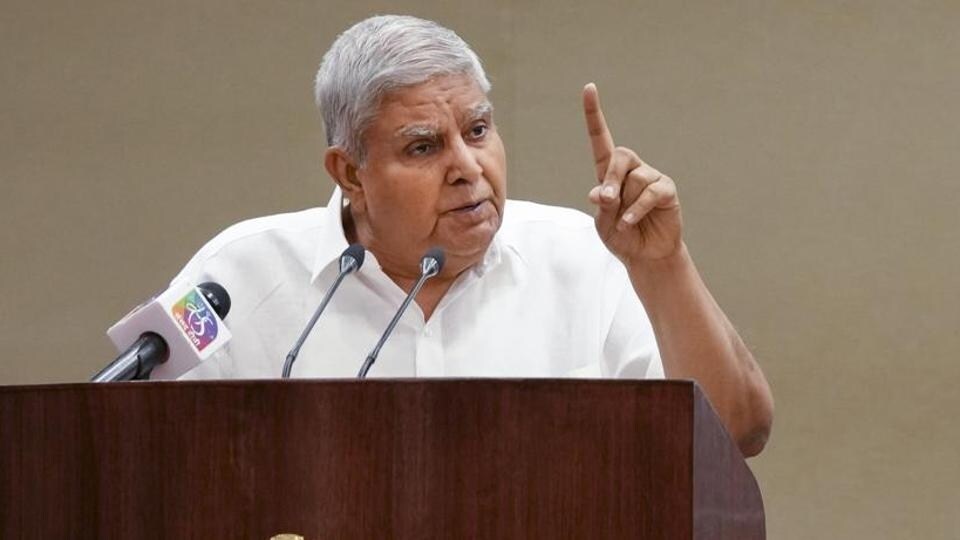
Vice President Jagdeep Dhankhar on Tuesday doubled down on criticism of judicial "overreach" and reiterated that the “Parliament is supreme”. Jagdeep Dhankhar asserted that every word spoken by a constitutional authority is guided by the supreme national interest as he hit out at his critics for questioning his remarks on a recent Supreme Court order.
The apex court had recently prescribed a three-month timeline for the President to decide on bills reserved by governors for her nod.
Reacting to the directive, Jagdeep Dhankhar had said the judiciary cannot play the role of a “super parliament” and get into the domain of the executive.
Addressing a Delhi University event on Tuesday, the vice president said every word spoken by a constitutional functionary is guided by the supreme sublime interest of the nation.
“I find it inconceivably intriguing that some have recently reflected that constitutional offices can be ceremonial or ornamental. Nothing can be far distanced from a wrong understanding of the role of everyone in this country, constitutional functionary or a citizen. According to me, a citizen is supreme because a nation and democracy are built by citizens. Every one of them has a role! The soul of democracy resides and pulsates in every citizen. Democracy will blossom, and its values will get heightened when a citizen is alert, a citizen contributes, and what a citizen contributes, there is no substitution for that.” Dhankhar said.
He also said no visualisation in the Constitution of any authority above Parliament exists. "Parliament is supreme," he asserted.
“A prime minister, who imposed the Emergency, was held accountable in 1977. Therefore, let there be no doubt about it - the Constitution is for the people and it's a repository of safeguarding it... elected representatives... they are the ultimate masters as to what the Constitution's content will be. There is no visualisation in the Constitution of any authority above Parliament. Parliament is supreme and that being the situation, let me tell you, it is as supreme as every individual in the country,” he said.
Voicing concern over a recent Supreme Court ruling prescribing a timeline for the President to decide on bills, Dhankhar had on Friday last said India had not bargained for a democracy where judges will legislate, perform executive functions and act as a "super Parliament".
Earlier this month, the Supreme Court had, for the first time prescribed that the President should decide on the bills reserved for her consideration by the governor within three months from the date such reference is received.
"There is a directive to the President by a recent judgement ... We never bargained for democracy for this day. President being called upon to decide in a time-bound manner, and if not, becomes law," Dhankhar had said.
The vice president was criticised for questioning the judiciary over the timeline for the president to take decisions, saying this is "unconstitutional".


