
 E-Paper



Emergency floats inactive on helicopter that crashed in Andaman on Feb 24: AAIB
The SoP for operations at Port Blair as approved by DGCA in the company operations manual requires floats to be armed on aircraft.

 Prefer HTon Google


The emergency floats of a Pawan Hans helicopter were not armed when it crash-landed into the sea near Mayabunder in the Andaman and Nicobar Islands on February 24, killing one passenger, according to a preliminary report released by the Aircraft Accident Investigation Bureau (AAIB) on Saturday.
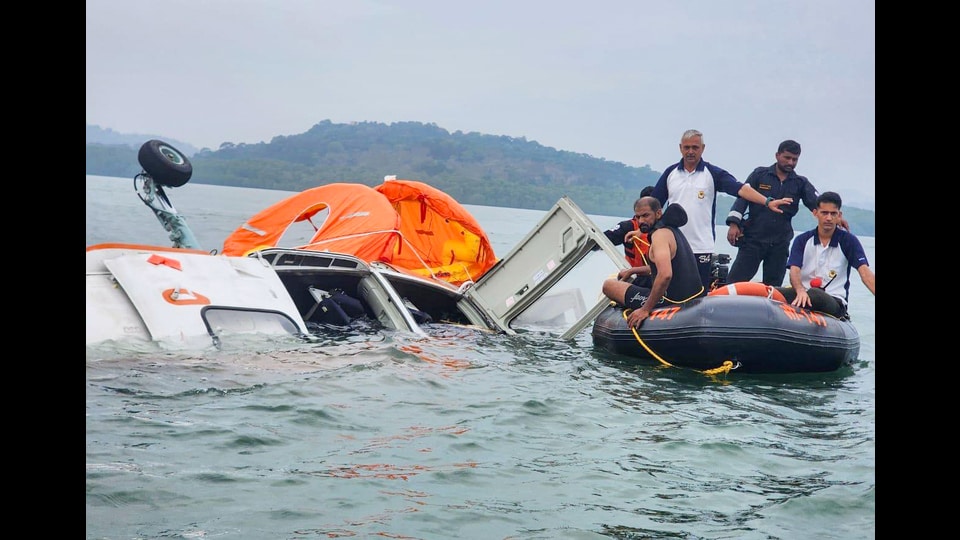
The helicopter, an Airbus AS365N3 registered as VT-PHY, was operating the Sri Vijaya Puram–Rangat–Mayabunder–Rangat–Sri Vijaya Puram sector carrying 10 passengers, including eight adults and two infants. Five passengers were bound for Rangat, and the remaining five — four adults and one infant — for Mayabunder.
“The floats were not armed in the cockpit during the approach although the same is required by the Standard Operating Procedure for operations at Port Blair as approved by DGCA in the company operations manual,” the report stated.
The floats failed to deploy on water impact. The aircraft toppled onto its starboard side, coming to rest on the seabed in four to five feet of water, leaving the port side above the waterline. Both crew members evacuated all passengers, who were ferried to a hospital in Mayabunder by boat. Three passengers, including the infant, and both crew members were subsequently airlifted to Sri Vijaya Puram by a Pawan Hans helicopter. One passenger died on the third day following the accident; two others — one adult and one infant — were discharged from hospital on March 12.
ALSO READ | What led to helicopter crash in Andamans? Pawan Hans shares details
In its interim safety recommendations, the AAIB said the Directorate General of Civil Aviation (DGCA) should direct Pawan Hans to ensure strict adherence to all passenger seat restraint mechanisms and life jackets wherever applicable, and conduct spot checks on commercial helicopter operators for compliance. It also recommended that DGCA direct the company to sensitise its pilots to arm floats for all applicable operations as per the approved operations manual.
The report noted that during the flight, crew wore full safety harnesses including shoulder straps, while passengers had only lap belts.
Separately, the AAIB released preliminary report on the crash of a Redbird aviation aircraft in Jharkhand on February 23. It found that the emergency location transmitter did not activate. The Beechcraft C90A, operating an air ambulance flight from Ranchi to Delhi with seven onboard, went down near Simaria in Chatra district approximately 17 minutes after take-off. The crew had requested to continue on runway heading owing to weather — a request approved by air traffic control — and last communicated at 7.19 pm, roughly 12 minutes after departure. The AAIB said fuel samples and weather data are being analysed.


