
 E-Paper



Piush Goyal pitches for ‘India story’ in US
In the course of interactions with academics, corporate leaders, entrepreneurs, and the Indian community, Union minister Piyush Goyal presented an image of a new culture in India.


Soon after he wrapped up his official engagements during the first day of his visit to the US on Monday evening, commerce minister Piyush Goyal was on the phone with external affairs minister S Jaishankar “seven or eight times”. In turn, minister Jaishankar was in touch with finance minister Nirmala Sitharaman on the phone, as three of India’s most senior ministers worked through a policy issue related to Singapore.
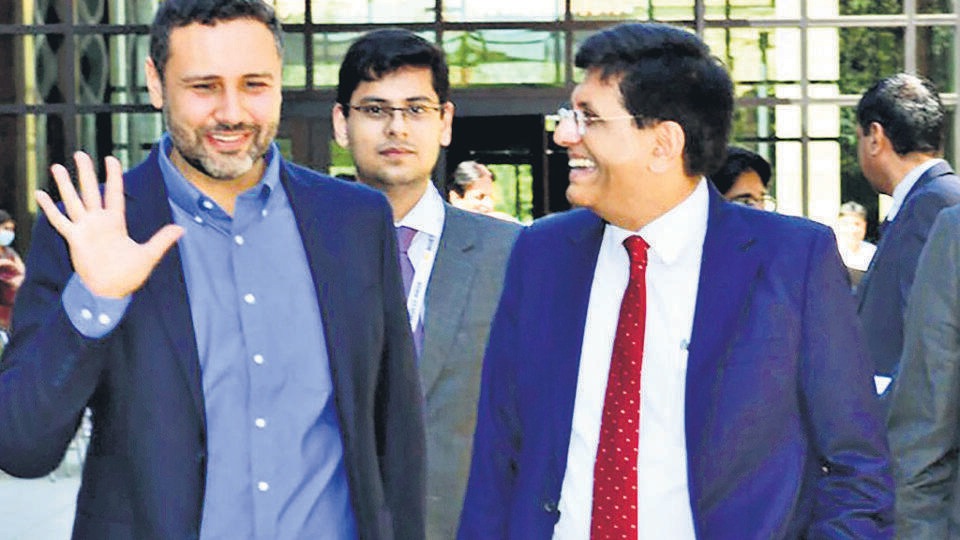
On Tuesday evening, Goyal, on his way to an Indian community event in the Bay Area of California, was presented an official file. He decided to forward it to home minister Amit Shah for his guidance and was expecting to get a response by the next morning. An important issue would get resolved and a decision would be taken promptly.
Citing these instances in response to a question by a Silicon Valley entrepreneur on the challenge posed by the lack of inter-ministerial coordination and bureaucratic maze to India’s economic story, Goyal said, “From Day 1, Prime Minister Narendra Modi has focused on breaking the silos and creating a cohesive government. We pick up the phone, we speak to colleagues and paperwork can follow.”
He added, as yet another example, how, from a time when there was a complete disconnect between commerce and foreign ministries, today, foreign service officers were being judged on “three Ts” — their ability to promote trade, technology, and tourism. Turning to India’s consul general in San Francisco, TV Nagendra Prasad, Goyal said, with a laugh, “Mr Prasad will be judged on this basis.”
In the course of interactions with academics, corporate leaders, entrepreneurs, and the Indian community, Goyal, in the course of his three-day visit to wider San Francisco area, presented an image of a new culture in India and in the government to win over an influential and prosperous segment of American economic life and prod them to invest back home.
At Stanford University’s Hoover Institution, Goyal spoke about Prime Minister Narendra Modi’s management style, citing the LED revolution in the country as a case study to explain the transformation that an ambitious vision, policy boldness, careful monitoring, and technology had brought.
But, at the same time, Goyal also showed deep respect and admiration and even expressed envy for the research and education opportunities offered at one of the world’s finest universities. The minister expressed a desire to collaborate with the newly set up School of Sustainability and encouraged engagements between Stanford Graduate School of Business and leading Indian management schools.
To two separate groups of Indian-American investors, global in their scope but still Indian in their hearts, Goyal highlighted the set of significant policy changes that had been made in the startup landscape. As these investors expressed optimism over the Indian story — citing its gigantic market, huge talent, cost competitiveness, changing geopolitics and potential to serve global markets — the minister pointedly asked these backers of some of the world’s wealthiest and most innovative companies about challenges.
From the need to avoid frequent regulatory changes to ensuring policy predictability, from taxation to cross border legal issues, from the possibility of deepening Indian capital markets to emulating the best practices from other international jurisdictions, as suggestions poured in, Goyal and his team took careful notes. The minister asked questions. He sought clarifications. He intervened and offered a corrective when participants failed to recognise Indian realities. He asked for specific policy papers, within a clear timeline, on different elements of the policy changes that were being recommended, be it on laws, taxes, enhancing industry-academia collaboration to leverage new research. He shared his coordinates generously and extended an open invitation to investors to get in touch. He promised to take suggestions that went beyond the remit of his ministry to colleagues in the government.
Goyal also launched the India-US Supporting Entrepreneurs for Transformation and Upskilling (SETU), pitched as a bridge between the two countries, where Indian-American investors and corporate leaders could act as mentors for Indian startups. Throwing in a reference to the Ramayana, Goyal suggested that just as the Ram Setu was built by squirrels, everyone present could make their own small contributions to this Setu — as a way of supporting millions of people back home who hadn’t got a chance and could do with help at the early stages of their startup journeys.
With the wider Indian community, Goyal turned what, in usual practice, is a pattern of a ministerial monologue coupled with a few questions into an almost entirely interactive session.
He gently slapped down a question on privatisation of State Bank of India and Food Corporation of India, ruling it out entirely, while explaining India’s privatisation push in non strategic sectors.
To queries on how India could leverage the moment as the world goes through a reset in supply chains, Goyal outlined domestic policy changes and offered an update on free trade pacts. India expects the one with United Kingdom to be signed soon, with a new government in place in London.
With Canada, there could be an early progress agreement by the end of this year or the first quarter of next. With Israel, citing the country’s reluctance to lift duties on services, Goyal candidly explained that India wasn’t getting much in return, and would not sign it unless it was in national interest. With the European Union, the task of bringing 27 countries on board meant that a pact could take a year and a half or two. The minister also said discussions were on with three sets of countries — from Central Asia, Switzerland and three or four countries, and in West Asia.
At the end of the day, as HT asked him about his key takeaways from his engagements, Goyal said, “I am excited about the positive sentiments from all sections of business and industry, both Indian and American. I am excited about the potential. Sometimes, you don’t realise this sitting in India and this gives you the advantage of having the full view of what’s happening…What I also love about these engagements is that there is a degree of expectation. There is an aspiration. You ask from someone who can deliver. ‘Yeh Dil Mange more’.”


