
 E-Paper



In Nepal's Lumbini, PM Modi offers prayers at Maya Devi temple, to hold talks with Deuba
Modi, who is in the Himalayan nation at the invitation of Deuba, is paying a day-long visit to Lumbini on the occasion of Buddha Purnima.

 Prefer HTon Google


Prime Minister Narendra Modi on Monday arrived in Nepal for a brief visit to Lumbini, one of the holiest places of Buddhism as Lord Buddha was born there, and also hold a meeting with his Nepalese counterpart Sher Bahadur Deuba to expand bilateral cooperation in multiple areas, including in hydropower, development and connectivity.
Modi and his entourage arrived on a special Indian Air Force helicopter from Kushinagar, Uttar Pradesh.
“Landed in Nepal. Happy to be among the wonderful people of Nepal on the special occasion of Buddha Purnima. Looking forward to the programmes in Lumbini,” Modi tweeted.
Modi was received by Deuba on his arrival in Lumbini.
Modi then offered prayers at the sacred Maya Devi temple. He was accompanied by his Deuba during his visit to the historic temple.
“Beginning the Nepal visit with prayers at the sacred Maya Devi Temple, Lumbini,” the Prime Minister's Office (PMO) tweeted.
Modi visited the Maya Devi Temple as the first stop of his one-day visit to Lumbini, the ministry of external affairs (MEA) said in a statement.
The leaders also paid their respects at the Marker Stone inside the temple premises, which pinpoints the exact birth spot of Lord Buddha. They attended the pooja conducted as per Buddhist rituals, it said.
Also Read | At Lumbini, PM Modi showcases India-Nepal shared Buddhist heritage
The two leaders also lit lamps near the Ashoka Pillar located adjacent to the temple. The pillar, which was erected by emperor Ashoka in 249 BC, bears the first epigraphic evidence of Lumbini being the birthplace of Lord Buddha.
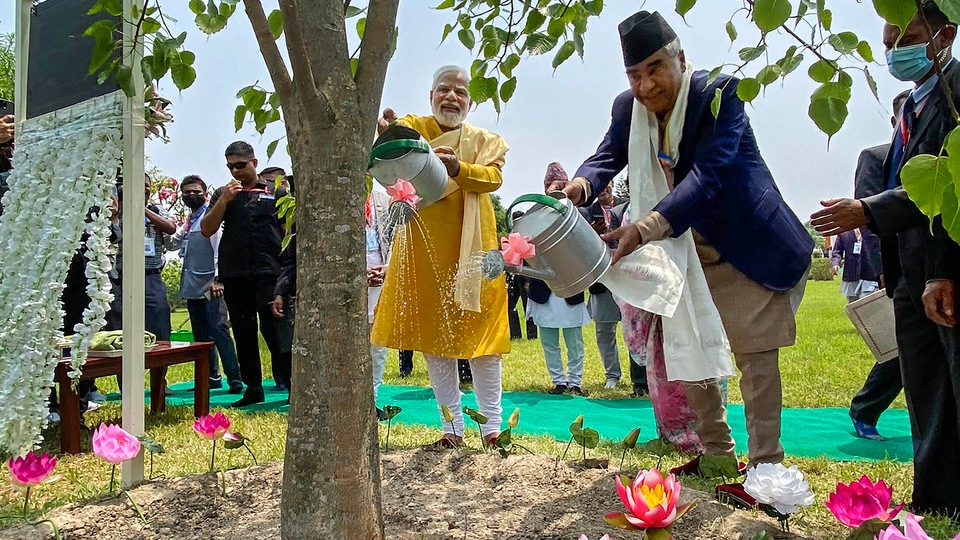
Thereafter, the two leaders watered the Bodhi tree sapling from Bodh Gaya which was gifted by Modi to Lumbini in 2014 and also signed the temple's visitor’s book.
“A timeless bond of friendship… Prime Ministers @narendramodi and @SherBDeuba at the Maya Devi Temple in Lumbini,” the PMO tweeted along with a picture of Prime Minister Modi and his Nepalese counterpart Deuba watering the Bodhi tree sapling.
It is the prime minister's fifth visit to Nepal since 2014.
Later in the day, Modi and Deuba will also hold a bilateral meeting in Lumbini.
"During the meeting, they will exchange views on Nepal-India cooperation and matters of mutual interests," according to a statement issued by Nepal's ministry of foreign affairs.
In a statement on Sunday, Modi said he was looking forward to meeting Deuba again after their "productive" discussions during his visit to India last month.
Both sides will continue to build on the shared understanding to expand cooperation in multiple areas, including in hydropower, development and connectivity, he said.
"Our ties with Nepal are unparalleled. The civilisational and people-to-people contacts between India and Nepal form the enduring edifice of our close relationship.
"My visit is intended to celebrate and further deepen these time-honoured linkages that have been fostered through centuries and recorded in our long history of intermingling," Modi said in his departure statement on Sunday.
On Friday, foreign secretary Vinay Mohan Kwatra said Modi's talks with his Nepalese counterpart Deuba at Lumbini in Nepal on May 16 will have a comprehensive agenda to further expand cooperation in multiple areas including hydropower and connectivity.
Deuba was in Delhi last month on his first bilateral visit abroad after becoming prime minister for the fifth time in July 2021.
During the visit, which was aimed at injecting fresh momentum into bilateral ties, Deuba held talks with Modi on a number of key issues, including the boundary issue.
Nepal is important for India in the context of its overall strategic interests in the region, and the leaders of the two countries have often noted the age-old "Roti-Beti" relationship.
(With inputs from agencies)


