
 E-Paper



‘Despite pressure, government will remain firm’: PM Modi rules out rethink on CAA
CAA was passed to fast-track the citizenship process for non-Muslims, who have entered India from Afghanistan, Pakistan, and Bangladesh before 2015. Opponents of the law insist it is discriminatory and unconstitutional as it leaves out the Muslims and links faith to citizenship in a secular country.

 Prefer HTon Google


Prime Minister Narendra Modi ruled out on Sunday any rethink on the Citizenship (Amendment) Act, or CAA, which has triggered protests in several parts of the country, and the nullification of the Constitution’s Article 370, which stripped Jammu and Kashmir of its special status last year.
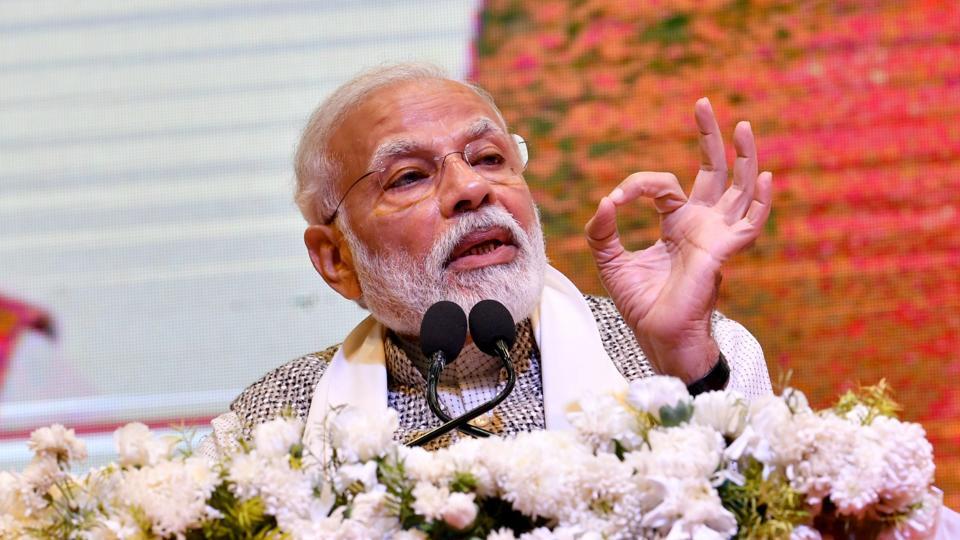
Modi said his government nullified Article 370 and passed CAA in December with Lord Shiva’s blessing, and maintained the steps were necessary. “With the blessing of Mahadev [Lord Shiva], now the country is taking all those decisions which were not taken earlier,” he said at a public meeting during a day-long visit to Varanasi, his parliamentary constituency. “Be it the scrapping of Article 370... or the Citizenship (Amendment) Act, the country waited for these decisions for years,” he said. Modi added that despite pressure, the government will remain firm on these decisions.
Article 370, which prevented non-residents from buying land and getting government jobs in Jammu and Kashmir, was nullified in August. Measures taken to prevent protests against the nullification have led to much international scrutiny. They included the detention of hundreds of politicians and activists as well as a communications blockade and a lockdown. Most of the curbs have since been eased even as access to the Internet remains restricted.
Three former chief ministers Omar Abdullah, Farooq Abdullah and Mehbooba Mufti, who were among the hundreds detained in August, have since been booked under the stringent Public Safety Act that allows for detention without trial for up to two years.
Four influential US senators last week wrote to US President Donald Trump ahead of his visit to India, seeking an assessment of the human rights situation in Kashmir and religious freedom in the country. The senators pointed out that hundreds, including key political figures, remain in preventive detention in Kashmir. They cited the longest-ever internet shutdown by a democracy in Kashmir and “other troubling steps”, including the passage of CAA, which “ threaten the rights of certain religious minorities and the secular character of the state”.
CAA was passed to fast-track the citizenship process for non-Muslims, who have entered India from Afghanistan, Pakistan, and Bangladesh before 2015. Opponents of the law insist it is discriminatory and unconstitutional as it leaves out the Muslims and links faith to citizenship in a secular country.
Modi also referred to other important decisions the government has taken during his second term, including the setting up of the trust to oversee the construction of a Ram temple in Ayodhya. “This trust will work rapidly,” he said.
The Union Cabinet on February 5 formed the trust, three months after the Supreme Court in November awarded a disputed plot of land in Ayodhya to Hindu claimants, who believe the site marks the birthplace of Lord Ram. The court had set a three-month deadline for setting up the trust.
Modi said a significant and visible improvement has been made in cleaning the Ganga. He added this could be achieved only because of the public participation. He said projects worth Rs 7,000 crore have been completed under the Namami Gange Programme, an integrated conservation mission for the Ganga’s conservation and rejuvenation.
“Our party has made its stands clear on the issue like CAA or Article 370. The BJP leaders and government might be adamant, but so is the public. They will show this government the doors. Delhi voters rejected the BJP and UP voters will oust it in 2022. People are against BJP’s policies and autocracy,” said Samajwadi Party spokesperson Rajendra Chaudhary.
Earlier in the day, Modi also launched and laid foundations for 50 projects worth Rs 1,254 crore in his constituency. He flagged off the Maha Kaal Express, the first overnight, privately run train that will connect three pilgrimage centres-- Varanasi, Ujjain and Omkareshwar (Madhya Pradesh).
Modi also inaugurated the Pandit Deendayal Upadhyaya Memorial Centre. He unveiled Upadhyaya’s 63-foot statue. Upadhyaya was a leader of the Bharatiya Jana Sangh, the forerunner of the ruling Bharatiya Janata Party.


