
 E-Paper



Modern warfare altered distance, vulnerability link: Air Marshal Ashutosh Dixit
The standoff weapons deployed by India during the operation included the Scalp, the Hammer smart weapon and BrahMos supersonic cruise missiles


Precision weapons, such as ones used by India against Pakistan during Operation Sindoor, have rendered geographical barriers “almost meaningless” and “altered the relationship between distance and vulnerability,” a top Indian Air Force officer said on Wednesday.
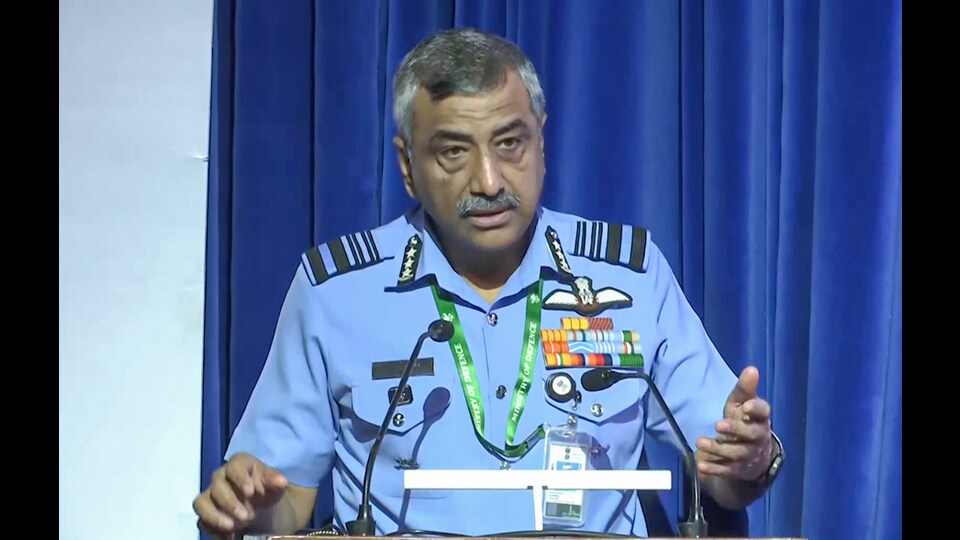
“Today, precision-guided munitions like Scalp and BrahMos (missiles) have rendered geographical barriers almost meaningless as strikes with beyond visual range air-to-air missiles and supersonic air-to-ground missiles have become commonplace,” Air Marshal Ashutosh Dixit, chief of integrated defence staff, said at a seminar on surveillance and electro-optics.
“The lessons from Operation Sindoor have reinforced what military strategists have long understood but perhaps not fully appreciated until now. Modern warfare --- thanks to technology --- has fundamentally altered the relationship between distance and vulnerability.”
Earlier, the horizon marked the limit of immediate threat, he said.
The launch of Operation Sindoor in the early hours of May 7 --- India’s strikes on terror and military installations in Pakistan and Pakistan-occupied Kashmir (PoK) following the Pahalgam terror strike in which 26 people were shot dead --- triggered a four-day military confrontation with the neighbouring country involving fighter jets, missiles, drones, long-range weapons and heavy artillery.
The standoff weapons deployed by India during the operation included the Scalp deep-strike cruise missiles, the Hammer smart weapon and BrahMos supersonic cruise missiles.
“When weapons can strike targets hundreds of kilometres away with pinpoint accuracy, the traditional concepts of front, rear and flanks, combat zones, and depth areas all become irrelevant. What we call the front and the theatre merge into one. This new reality demands that we extend our surveillance envelope far beyond what previous generations could have even imagined,”Dixit said.
The domain of surveillance and electro-optics systems was earlier a force enhancer but has now become the foundation on which modern military operations will take place, he added.
“Today we stand on the cusp of a revolution that will redefine how we perceive, process and project power in the 21st century. When we look at global conflicts commencing from Armenia-Azerbaijan to Russia-Ukraine and Israel-Hamas, and to our own experiences in Operation Sindoor; one truth emerges with crystal clarity --- the side that sees first, sees farthest and sees most accurately, prevails.”
Between the launch of the operation in the early hours of May 7 and the ceasefire on the evening of May 10, Indian forces bombed nine terror camps in Pakistan and PoK and killed at least 100 terrorists, and the IAF struck targets at 13 Pakistani air bases and military installations.
In the early hours of May 7, the IAF struck two terror sites at Markaz Subhanallah in Bahawalpur and Markaz Taiba near Muridke, both in Pakistan’s Punjab province, while the army hit targets at seven places, including Mehmoona Joya in Sialkot, Sawai Nala and Syed Na Bilal in Muzaffarabad, Gulpur and Abbas in Kotli, Barnala in Bhimber, and Sarjal.
The Markaz Subhanallah camp was the farthest target for Indian forces. Located around 100 km from the international border, it is the headquarters of the banned Jaish-e-Mohammed (JeM) and has been used for recruitment, indoctrinating and training terrorists.
Markaz Taiba is the headquarters of the Lashkar-e-Taiba (LeT) founded by Hafiz Saeed. Terrorists trained at this camp were linked to many attacks in India, including the 2008 Mumbai attacks. Ajmal Kasab, the only terrorist captured alive at the time, received training here and so did David Coleman Headley. It is located 25 km inside Pakistan.
During May 9-10, the IAF struck military targets in Rafiqui, Murid, Chaklala, Rahim Yar Khan, Sukkur, Chunian, Pasrur, Sialkot, Skardu, Sargodha, Jacobabad, Bholari and Malir Cantt in Karachi.
Later it emerged that India’s targeting of locations within Pakistan during the May 7-10 clash was more extensive than was previously known, with a Pakistani document acknowledging that Indian drones had struck locations ranging from Peshawar in the northwest to Hyderabad in the south.
The graphics in the May 18 Pakistani document detailing India’s drone strikes on May 8, 9 and 10 listed seven locations -- Peshawar in Khyber-Pakhtunkhwa province, Attock, Bahawalnagar, Gujrat and Jhang in Punjab province, and Chhor and Hyderabad in Sindh province -- that were not acknowledged as targets by Indian officials at any briefings held during or after the hostilities.
Pakistan’s Operation Bunyan-um-Marsoos, which was mounted in response to Operation Sindoor, “folded in eight hours” on May 10 belying Islamabad’s ambitious target of bringing India to its knees in 48 hours, chief of defence staff General Anil Chauhan said on June 3.


