
 E-Paper



JNU cancels booking for event on jailed activist Umar Khalid's book, organisers say university admin lying
Student union said no particular reason was given for cancelling venue. JNU on X later cited “non-disclosure of the full facts about the program” as the reason.

 Prefer HTon Google


A book discussion on ‘Fractured Communities: Adivasi Histories and the Politics of Power’, authored by jailed activist Umar Khalid, scheduled for Monday, August 10, in an auditorium at Jawaharlal Nehru University (JNU) in New Delhi, has been moved out of its originally designated venue, after a row erupted over the permission granted and withdrawn.
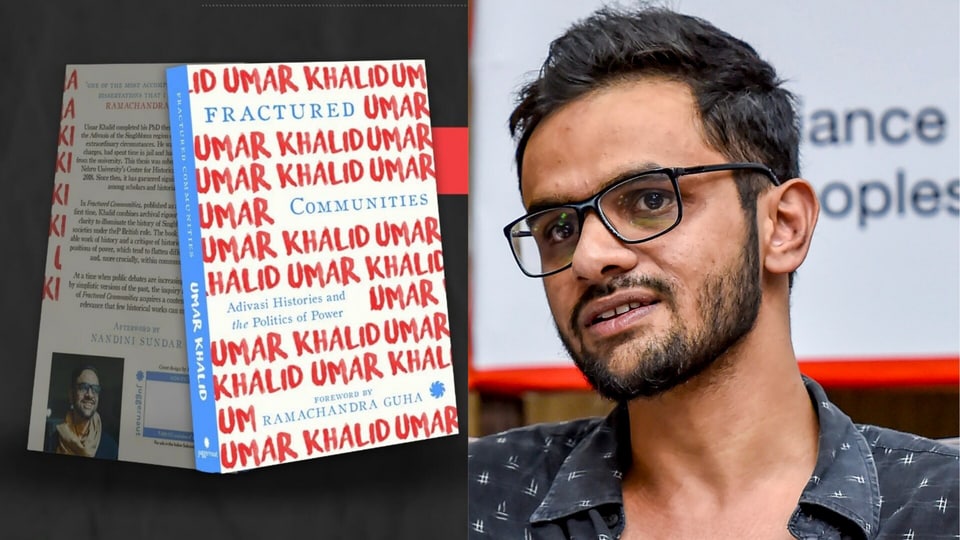
The book happens to be Khalid's PhD thesis when was a scholar at JNU.
“The event was supposed to take place in the auditorium of the School of Social Sciences, but the venue has now been cancelled,” the JNU Students' Union (JNUSU) general secretary said, adding that the alternate venue would be announced separately.
JNU on why permission cancelled
While the union asserted that no particular reason was given for cancelling the original venue, the JNU official handle on X later cited “non-disclosure of the full facts about the program” as the reason.
The university admin shared the permission letter in which the student applicant mentioned the event as “Public Talk for Adivasi Diwas (Book Discussion)”.
The X post by JNU tagged Vice-President CP Radhakrishnan, PM Narendra Modi and home minister Amit Shah's official and personal handles; finance minister Nirmala Sitharaman, external affairs minister S Jaishankar, and education minister Pralhad Joshi and his ministry.
What organisers said
However, Professor Avinash Kumar, who had submitted the requisition for booking the venue, said, “The stated reason for the cancellation of the booking of the SSS auditorium is false. The Dean, School of Social Sciences, was fully informed that the event was going to discuss Umar Khalid's book ‘Fractured Communities’.”
“The JNUSU before reaching out to me had already met and spoken to the Dean and the requisition form was filled as per his advice. So there is no question of lack of full disclosure. And if the full disclosure was not made, then why was permission for the auditorium booking approved and granted in the first place?” asked Avinash Kumar, who is an assistant professor of Political Studies at the Centre for Informal Sector and Labour Studies (CISLS) under the School of Social Sciences (SSS), JNU.
‘Real reason’
He added, “As regards the real reason for cancellation, the administration should come out clean. Why cannot they permit a discussion on this book in the SSS Auditorium? Isn't this book based on the PhD thesis submitted by Dr Khalid at CHS/SSS/JNU and subsequently was he not granted a PhD degree by JNU for that thesis?”
He noted that the book has been published by “a leading publisher” (Juggernaut) and “there is no reason why a book discussion cannot be held”.
“Instead of making false claims and hollow statements about democracy, the administration should declare under which rule of the University they have unilaterally cancelled without any consultation at any level the venue for the event,” he asked.
What event was about
The event was to feature a discussion on Khalid's book that examines Adivasi histories and the politics of power, and was organised by the JNUSU on the occasion of the International Day of the World's Indigenous Peoples (or Vishva Adivasi Diwas). It was scheduled to take place at the School of Social Sciences-I (SSS-I) auditorium at 3 pm on Monday.
According to the event poster, speakers at the discussion include Professors Prabhu Mahapatra and Uma Chakravarti, writer and journalist Shuddhabrata Sengupta, social activist Harsh Mander and scholar Banojyotsna Lahiri, who also happens to be Khalid's partner.
Umar Khalid has been imprisoned since September 2020 under the Unlawful Activities (Prevention) Act (UAPA) regarding the 2020 northeast Delhi riots conspiracy case. He continues to await the start of his trial. The violence erupted during protests against the Citizenship (Amendment) Act (CAA) and the proposed National Register of Citizens (NRC), leaving 53 people dead and over 700 injured.
What Umar Khalid's book is about
Umar Khalid completed his PhD thesis on the history of the Adivasi tribes of the Singhbhum region of Jharkhand, which has formed the basis of the book. The thesis was submitted at Jawaharlal Nehru University’s Centre for Historical Studies in July 2018, and he was awarded his PhD the following year.
Historian-writer Ramachandra Guha has called it “one of the most accomplished doctoral dissertations by an Indian that I have read”.
The publisher's note on the book's Amazon listing says, “In Fractured Communities, published in book form for the first time, Khalid combines archival rigour with analytical clarity to illuminate the history of Singhbhum’s tribal societies under British rule. The book is both a valuable work of history and a critique of histories written from positions of power, which tend to flatten differences among and, more crucially, within communities.”
It adds, “At a time when public debates are increasingly shaped by simplistic versions of the past, the inquiry at the heart of Fractured Communities acquires a contemporary relevance that few historical works can match. And running through the narrative is a political philosophy grounded in democratic values and genuine concern for the marginalised.”


