The Supreme Court on Thursday deferred by a day the Punjab government’s challenge to a high court order directing the Central Bureau of Investigation (CBI) to register a criminal case into alleged corruption linked to chief minister Bhagwant Mann’s office, refusing to pass any interim order against the probe without first allowing both judges on the bench to examine the matter.
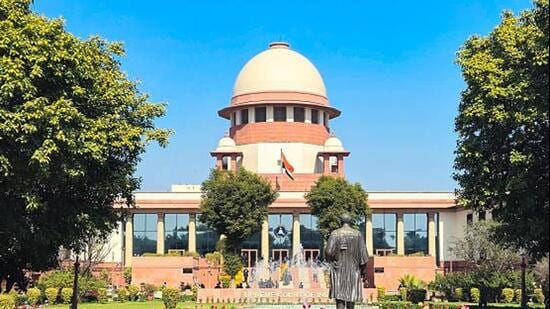
A bench of justices Dipankar Datta and Sheel Nagu agreed to hear the matter on Friday after senior counsel Vikas Singh, appearing for the Punjab government, pointed out the urgency and sought an interim direction that the CBI and Enforcement Directorate (ED) “may not precipitate the matter”.
Justice Datta, however, made it clear that such an order could not be passed without Justice Nagu having an opportunity to peruse the petition. “How can we pass this order when the file did not reach the other judge,” Justice Datta told Singh.
Deep Dive
What are the allegations of corruption against Punjab's Chief Minister Bhagwant Mann's office?
Why did the Punjab government challenge the high court's order for a CBI investigation?
How is the CBI evidencing the alleged corruption in Punjab's administrative processes?
The bench was told that the case file had not reached Justice Nagu, who was sitting as the puisne judge on the bench, in time. Singh agreed to the deferment to enable Justice Nagu to go through the state government’s challenge but pressed for the matter to be taken up at the earliest.
Justice Datta, who was heading the bench, then agreed to list the matter on Friday.
{{/usCountry}}Justice Datta, who was heading the bench, then agreed to list the matter on Friday.
{{/usCountry}}Also Read: SC orders Centre to form panel for law on unethical pharma marketing
Singh also raised a possible issue concerning Justice Nagu’s participation in the case, pointing out that the judge, while serving as chief justice of the Punjab and Haryana high court, had dealt with some matters concerning the petitioners in the Supreme Court case -- Punjab director general of police Gaurav Yadav and the chief director. Singh clarified that those proceedings were unrelated to the present case.
Justice Nagu said he would need to examine the file before taking a call on whether he could hear the matter.
The case has unfolded against a charged political backdrop in Punjab, with assembly elections due early next year and the Mann government alleging that the CBI and ED action is politically motivated targeting by the BJP.
The development came a day after the CBI’s first steps under the high court’s October 5 order, including searches at eight locations across Punjab and the summoning of Punjab chief minister Bhagwant Mann’s officer on special duty (OSD), Rajbir Singh Ghuman, and five others in the corruption case.
Ghuman and the five co-accused did not appear before the CBI at its Chandigarh office on Wednesday. While the chief minister’s office said Ghuman had not been formally served the summons, sources indicated that the accused had also held off on appearing while awaiting the Supreme Court’s consideration of the Punjab government’s plea.
The CBI registered a 251-page FIR around midnight on October 5, naming Ghuman, alleged middleman Nitin Gohal, his brother Jitin Gohal alias Raja, Romi Raja Mahajan, Bir Devinder and RS Nagra. The agency has alleged that the accused operated an organised network to manipulate IAS and IPS postings, departmental proceedings, policy formulation, administrative approvals, tenders, licensing, arms licences and land-use conversions in return for bribes. The agency also alleged that unreleased government notifications and internal draft policies were leaked to private beneficiaries.
The case originated in three communications sent by the ED to Punjab DGP Gaurav Yadav between July 24 and August 12, raising allegations of corruption involving Ghuman and others. The ED had alleged that Gohal acted as an intermediary between people seeking favours from the state government and Ghuman, including for transfers and postings of officials, government approvals and arms licences.
The Punjab and Haryana high court, while directing the CBI to register an FIR and investigate the allegations, had said the material supplied by the ED prima facie indicated the involvement of senior public officials. It had also criticised the Punjab Police for failing to act on the ED inputs and directed the state authorities to extend full cooperation to the central agency.
The high court’s order followed a public interest litigation by advocate Nikhil Saraf, who alleged that the state authorities had failed to act on the ED’s communications despite the seriousness of the allegations. The court directed the CBI to submit an investigation report within two months.
The Punjab government approached the Supreme Court within hours of the high court order, arguing that the direction to register a CBI case was issued without sufficient material to establish a cognisable offence and raised serious questions concerning the federal structure.
When the matter was mentioned before Chief Justice of India Surya Kant on Tuesday, senior counsel Vikas Singh sought an immediate hearing and argued that the high court had ordered a CBI inquiry against state government officers without adequate material. The CJI declined to hear it the same day but said the matter would be accommodated on Wednesday or Thursday.
The CBI subsequently carried out searches at Ghuman’s official residence in Sector 2, Chandigarh, which was being used as a camp office, and his ancestral home at Gharachon in Sangrur district, besides six other locations. Electronic devices, including laptops and mobile phones, as well as financial and administrative documents were seized, according to officials.
The raids also triggered a political controversy after villagers and local opposition workers reportedly showered the CBI team with flower petals and distributed sweets during the search at Ghuman’s residence. The state government has alleged that central agencies were being used by the BJP to target the Mann government ahead of the Punjab assembly elections.
The CBI has clarified that its search was conducted at a residence used by the chief minister’s OSD and not at the Punjab chief minister’s Secretariat.