E-Paper



Number theory: Coolest ever May 1 in keeping with erratic weather in 2023
The May 1 temperature reading is not an aberration but in keeping with erratic weather patterns this year. Here are four charts which explain this in detail
Updated on: Jun 11, 2023, 21:41:21 IST


Share via


Copy link

With an average maximum temperature of 29.46 degrees Celsius (°C), May 1, 2023 was the coolest this day has ever been in India since 1951, the earliest period for which data is available in the India Meteorological Department’s (IMD) gridded dataset. The May 1 temperature reading is not an aberration but in keeping with erratic weather patterns this year. Here are four charts which explain this in detail.
The charts that matter
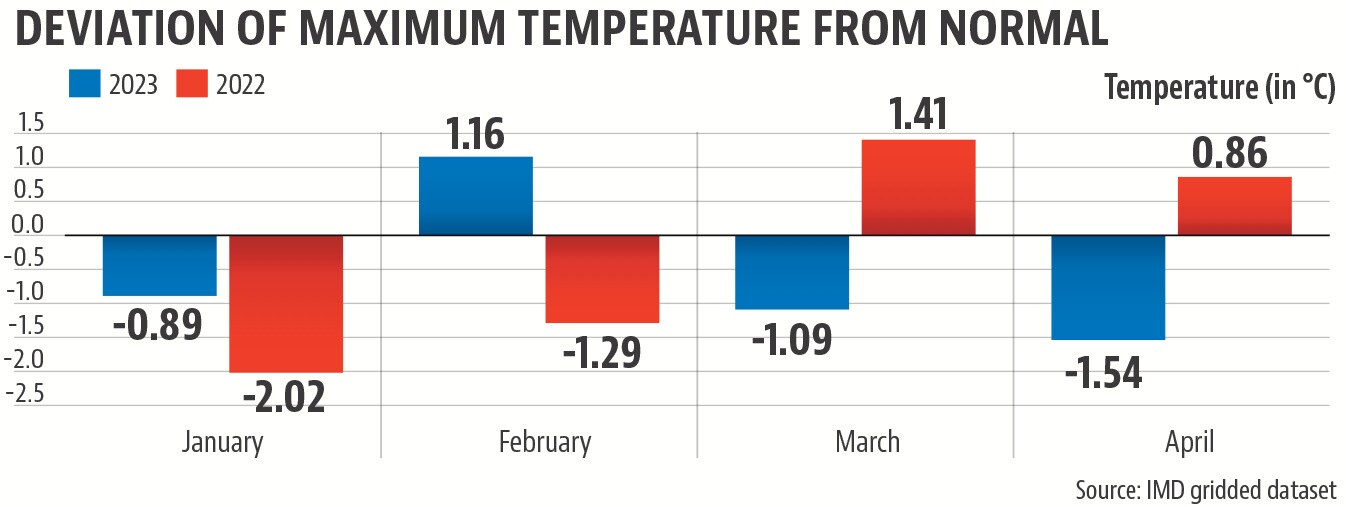
 From 13th hottest February to 4th coolest AprilOn February 18, HT reported that temperatures in mid-February were already running ahead of mid-March levels in India. This was a worrying statistic because India had lost a significant part of its wheat crop to a premature heatwave in 2022. In terms of average maximum temperature, February 2023 was the 13th hottest in IMD’s gridded dataset. Thankfully, the February heat did not persist, and March 2023 was the 11th coolest March since 1951. Data for April 2023 shows that it was the fourth coolest April since 1951, which means that instead of a premature summer India is having a delayed one. This is very different from what the situation was last year.
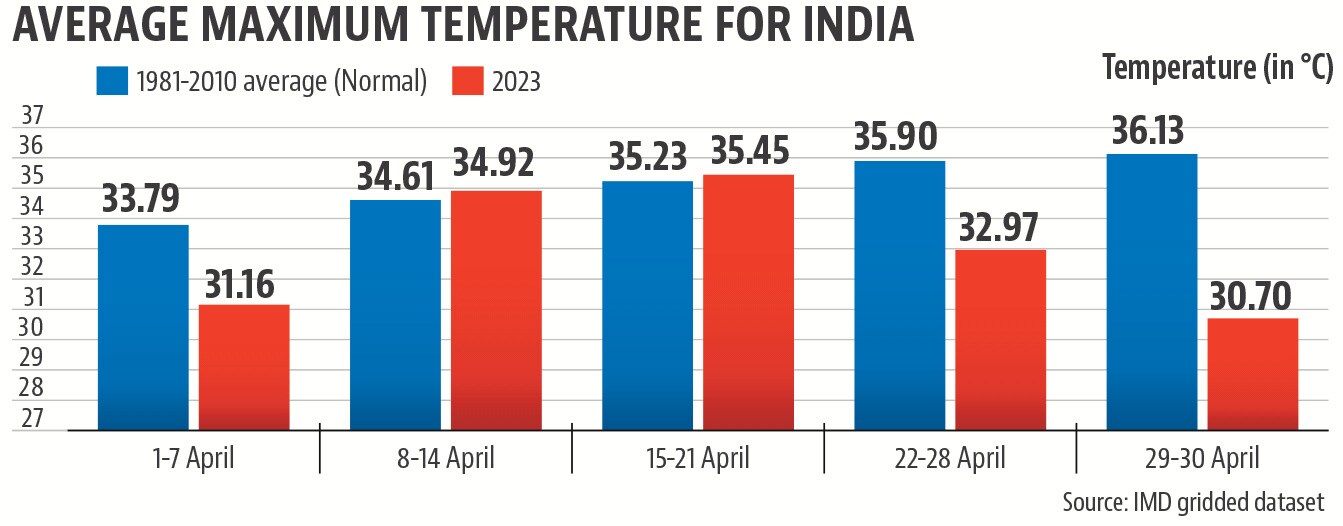
- April was the 4th coolest despite warmer than normal two weeks in-betweenA week-by-week analysis shows that two weeks of April were somewhat warmer than normal. But April turned out to be substantially cooler than normal despite this because the other two weeks were much cooler (with respect to normal) than the warmer weeks. To be sure, even the two weeks that were warmer than normal (the week ending April 14 and the week ending April 21) were not warm in their entirety. Daily data shows that 21 of 30 days of the month were cooler than normal.
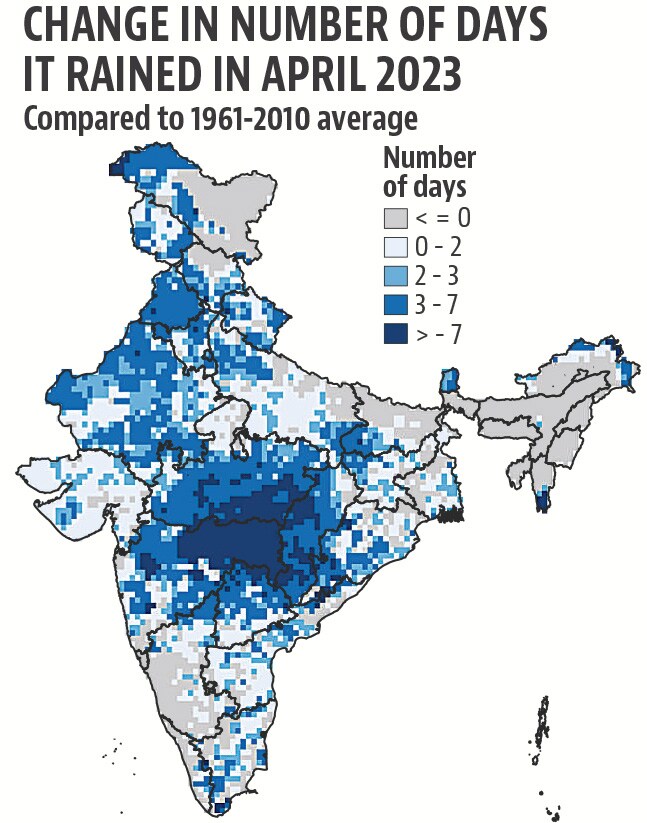
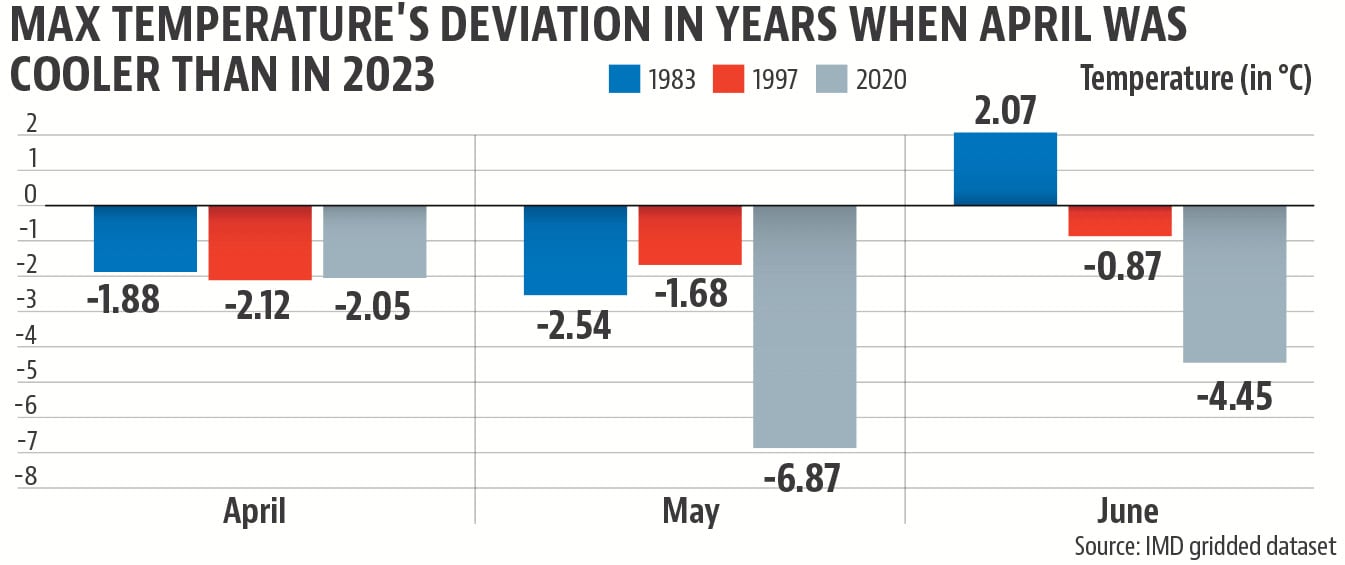
- Amount of rain not the only reason for a cooler AprilAnecdotally, we know that April was cool because of unusually rainy weather. However, the relation between rain and temperatures is not that straightforward. India received 41.2mm rain in April, which is the 28th highest rainfall for this month since 1951. Of the 27 years when it rained more, April was cooler only in three (1983, 1997 and 2020). An example can clarify that the amount of rain does not have a straight relation with maximum temperature. April 2022 was at the other end of the spectrum compared to April 2023 as far as maximum temperature is concerned (13th warmest April month since 1951), but received 46.9mm rain, more than the rain last month. What explains this contradiction? The intensity of rain is one explanation. 40% of the April rain was of heavy and extreme intensity last year compared to just 12% this year. This means that almost half of the rain fell too quickly and in too concentrated a region in 2022, allowing the rest of the places and days to be warm, driving the average maximum temperature higher. This disparity was such that, on average, it rained only on 4.66 days in April in 2022 (27th lowest days of rain for April since 1951). In comparison, it has rained on average on 7.25 days this April in different parts of India. This is the fourth highest “days of rain” number for April since 1951. Rain was even more frequent in some parts of India this year. Of the 4,685 grids for which IMD gives rainfall data, the days of rain were the highest since 1951 for 637 grids; among the top five for 1,618 grids; and among the top ten for 2,240 grids.
- What to expect in May and JuneIMD gives an extended range forecast for a four-week period. Currently, this is available from the week ending May 4 to the week ending May 25. This shows that in each of these four weeks, maximum temperature is going to remain below normal for most of India. The deviation from normal is currently expected to be bigger and more widespread in the first two of those four weeks than the latter two. This is in keeping with the trend seen in the other three years when April was as cool as it has been this year. May in 1983, 1997 and 2020 were the ninth, 11th, and coolest ever since 1951. To be sure, this is largely a matter of coincidence and the weather was not exactly the same in all these years. While June was also cooler than normal in 1997 and 2020, it was 2.1°C warmer than normal in 1983.