
 E-Paper



Right to approach court is heart of Constitution: CJI Chandrachud
The right to approach court is the heart and soul of the Constitution, Chief Justice of India Dhananjaya Y Chandrachud emphasised on Sunday, adding that every case and every court in the country is an extension of constitutional governance.

 Prefer HTon Google


The right to approach court is the heart and soul of the Constitution, Chief Justice of India Dhananjaya Y Chandrachud emphasised on Sunday, adding that every case and every court in the country is an extension of constitutional governance.
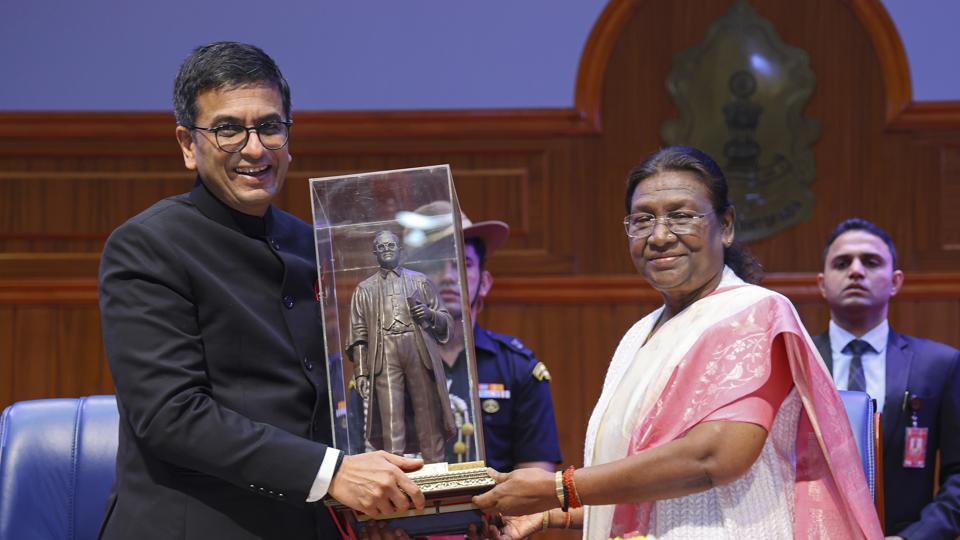
Speaking at the Constitution Day celebrations, the CJI was emphatic that people should not be afraid of going to court or view it as a last resort because all endeavours of the judiciary are aimed with a hope that citizens of any class, caste, and creed can repose trust in the court system and view it as a fair and effective forum for resolution of disputes to enforce their rights.
“Sometimes, we, as a society, may frown on litigation as a disreputable entanglement. But, just as the Constitution allows us to resolve our political differences through established institutions and processes, our court system helps resolve our many disagreements through established principles and processes. In this way, every case in every court in the country is an extension of constitutional governance,” justice Chandrachud underlined.
With President Droupadi Murmu in attendance, the CJI lent an assurance to all citizens that the doors of the Supreme Court are always open for them and will remain open, as he highlighted that perhaps the Indian Supreme Court is the only court in the world where a citizen can set into motion the constitutional machinery simply by writing a letter to the CJI or by sending an email.
“Aapko court aane se darne ki kabhi zarurat hi nahi hai. Nyayapalika ke prati aapki aastha hame prerit karti hai. Aapka vishwas hamara shradha sthaan hai (You don’t need to be afraid of coming to courts. Your faith in the judiciary encourages us. Your confidence in the judiciary is our place of worship),” said justice Chandrachud.
Stressing that the Supreme Court has been making continuous endeavours to ensure that administrative processes are citizen-centric, the CJI cited various initiatives of the Supreme Court to remove a spate of barriers to access to justice, including live-streaming of court proceedings, translation of judgments into regional languages, use of artificial intelligence, release of a software for quick despatch of bail orders to trial courts and jail officials for ensuring speedy relief to prisoners.
The CJI recalled how the President on the Constitution Day celebration in 2022 had expressed concerns over prisoners languishing in jails owing to different handicap, assuring Murmu that the judiciary is committed to alleviating issues faced by such prisoners.
“I want to assure you (Murmu) that we are constantly working to ensure that legal processes become easier and simplified, so that citizens do not languish in jails unnecessarily. The version 2.0 of the FASTER initiative that will be launched today ensures that judicial orders of release of a person are immediately transferred to jail authorities via electronic means, so that the person is released on time. In addition, on the judicial side, the Supreme Court has been hearing cases relating to prisoners’ rights, overcrowding, etc. I have also tasked the research centre of the Court to come up with a project to improve the conditions of prisons,” said the CJI.
The software was later launched by Murmu. On the occasion, the President also launched a virtual justice clock for the top court that would exhibit vital statistics regarding cases in the Supreme Court.
At the Constitution Day celebrations in 2022, Murmu had flagged the plight faced by prisoners, who remain incarcerated for years together without being aware of their fundamental rights while their trials protract.
Earlier in the day, Murmu unveiled a statue of Dr BR Ambedkar in the Supreme Court precincts in the presence of the CJI.
During his address, justice Chandrachud said that installation of Ambedkar’s statue is an extension of the thought that right to approach courts is the heart and soul of the Constitution.
“India not only maintained its Constitution, but also the people imbibed it as a symbol of their aspirations. Celebration of Constitution Day thus symbolises the social life of an independent nation. Our Constitution has allowed us to take unbridled passions and energy and streamline them through institutional structures of government,” said the judge.
He added that the Constitution and its framers successfully channelled the energies of liberty and independence to build a ship and chart a course for liberty, equality, and fraternity. “As we honour their achievements, we must also recognise our generation’s solemn duty to keep the ship afloat, ensure there is wind in its sails, and continue the journey,” said the CJI.
Justice Sanjay Kishan Kaul, delivering the welcome address, highlighted the significance of constitutional consciousness saying all parts of our society must be empowered to nurture its values.
“The exercise of breathing life into the Constitution has largely been seen as a judicial project, in particular of the higher judiciary. My hope for the future is that the conversations about constitutional values are not limited to litigation before our courts, but infused in all spheres, including private spheres,” said the judge.
Justice Kaul added that a dialogue on constitutional consciousness, when extended beyond public forums and institutions, will ensure that key values are internalised, making the Constitution truly come alive.



