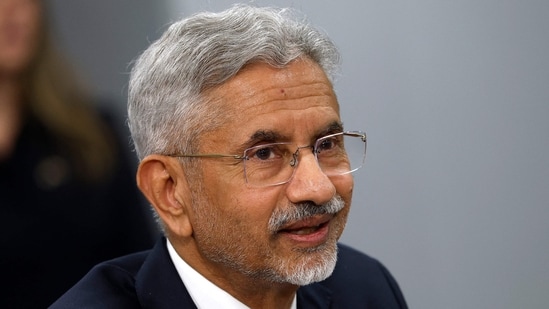
External Affairs Minister S Jaishankar is set to travel to China, his first visit to the country in five years as India and China aim to resolve ties that soured in 2020 with the Galwan Valley clash.
The visit is also crucial as it comes weeks after China's military support to Pakistan during the India-Pakistan conflict triggered by the Pahalgam terror attack that left 26 civilians dead.
Jaishankar, who is on a two-nation tour, was reportedly scheduled to arrive in Beijing on Sunday evening after wrapping up his Singapore visit.
While in China, Jaishankar will attend a meeting of foreign ministers of the Shanghai Cooperation Organisation (SCO) Foreign Ministers' in Tianjin on Tuesday, and will also hold bilateral talks with his counterpart Wang Yi.
As Jaishankar visits China, a look back at five years of India-China relations:
Galwan Valley clashes
The bilateral relationship between India and China hit a six-decade low with a military stand-off along the Line of Actual Control in May 2020.
A seven-hour deadly conflict on June 15 led to the deaths of 20 Indian soldiers, including a commanding officer. While Beijing initially only acknowledged casualties without disclosing numbers, reports said the Chinese army possibly suffered more than twice the casualties as India.
{{/usCountry}}A seven-hour deadly conflict on June 15 led to the deaths of 20 Indian soldiers, including a commanding officer. While Beijing initially only acknowledged casualties without disclosing numbers, reports said the Chinese army possibly suffered more than twice the casualties as India.
{{/usCountry}}It was the first deadly conflict between Indian and Chinese along the LAC in 45 years, plummeting the bilateral ties significantly.
Over four years after the clashes began, Prime Minister Narendra Modi and Chinese President Xi Jinping reportedly decided to reactivate several mechanisms to resolve the border issues when they met on the sidelines of a summit in Kazan in October 2024.
Soon after, India and China announced a breakthrough in terms of patrolling along the LAC arrangements along eastern Ladakh to resolve their stand-off in Depsang and Demchok, negotiating an agreement to resolve their military dispute.
China's Pak-backing move against India
Even as the two countries said they were attempting to ease tensions fuelled by the military standoff from 2020, the Chinese military supported Pakistan during its recent conflict with India.
Not only did China come out in support of Pakistan following the April 22 Pahalgam terror attack that killed 26 civilians on Indian soil, it also provided military support to Pakistan after the launch of India's Operation Sindoor, targeting terrorist infrastructure in Pakistan and POK.
According to India's Deputy Chief of Army Staff Rahul R Singh, 81 per cent of Pakistan's military hardware used was manufactured by the Chinese. "Few lessons that I thought I must flag as far as 'Operation Sindoor' is concerned. Firstly, one border, two adversaries. So we saw Pakistan on one side. But the adversaries were two and if I would say actually four, or three actually. So, Pakistan was the front face. We had China providing all possible support," the deputy chief of army staff was quoted as saying by news agency ANI.
While China did condemn the Pahalgam terror attack saying it "opposed all forms of terrorism”, it did say it supported its close ally Pakistan in safeguarding its sovereignty and security.
Even after New Delhi and Islamabad announced ceasefire following a three-day military conflict in May, China openly vowed support to Pakistan in defending its “national sovereignty and territorial integrity”.
A statement from China's foreign ministry said, Wang called Pakistan an “ironclad friend” and vowed to deepen the “all-weather strategic cooperative partnership” between the two countries.
With India and China sharing a tumultuous relationship over the past few years, it would be noteworthy to see if Jaishankar's visit leads to any constructive dialogue between the two countries.
The External affairs minister's visit also follows visits by Defence Minister Rajnath Singh and National Security Advisor Ajit Doval in June.