
 E-Paper



SC hints Koli might be let off in last case
A bench of CJI and justices Surya Kant, Vikram Nath reserved its verdict on Koli’s petition, while remarking: “This matter deserves to be allowed in a minute.”

 Prefer HTon Google


The Supreme Court on Tuesday indicated that Nithari killings convict Surendra Koli may be acquitted in the sole case in which his conviction still stands, observing that it would be a “travesty of justice” to sustain the 2011 verdict when he has been acquitted in 12 other cases arising from the same set of facts and evidence.
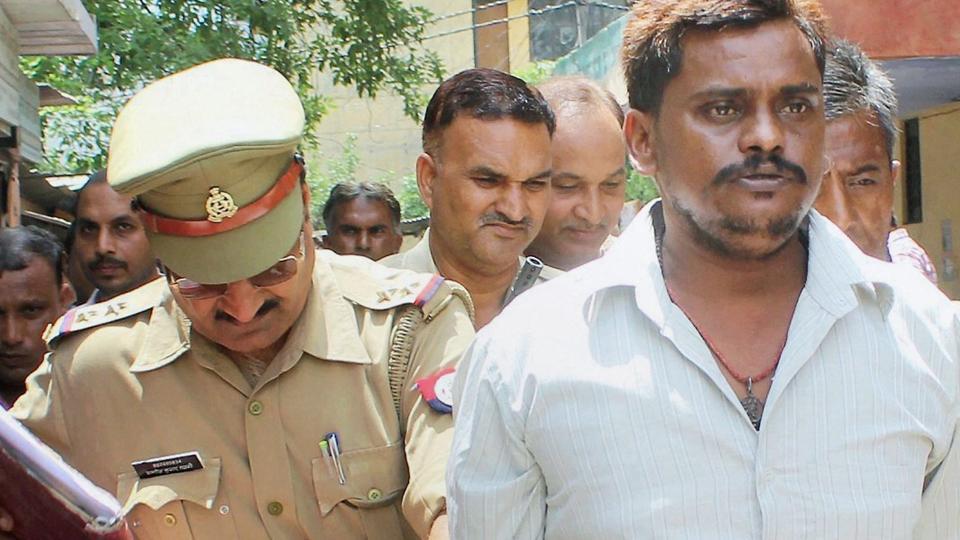
A bench of Chief Justice of India Bhushan R Gavai and justices Surya Kant and Vikram Nath reserved its verdict on Koli’s curative petition, while remarking: “This matter deserves to be allowed in a minute.”
“Will this not be anomalous? If on the same set of facts, this court has acquitted him in other cases, and he is convicted in this case on the same facts… will this not be a travesty of justice?” the bench asked Additional Solicitor General Raja Thakare, who appeared for the Central Bureau of Investigation (CBI).
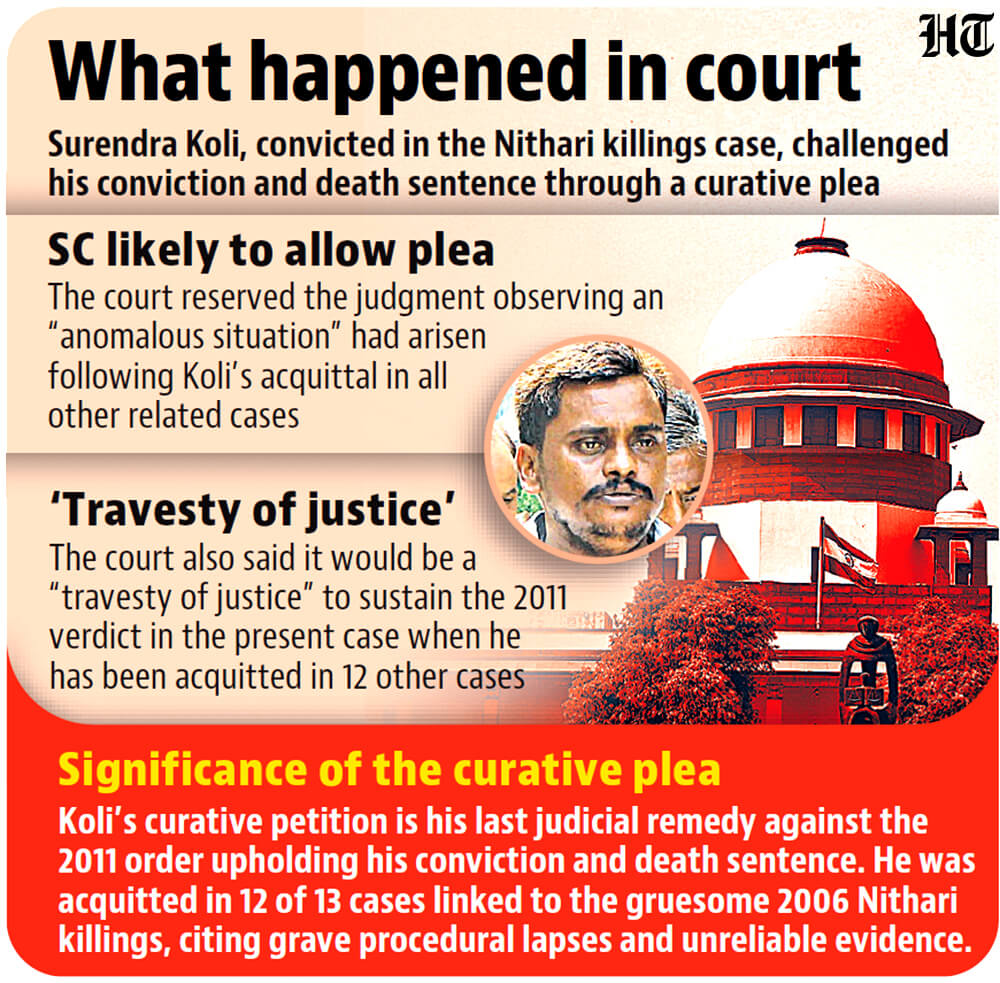
The court pointed out that Koli’s conviction in the remaining case rested solely on his confession and the recovery of a kitchen knife from a lane behind his house -- the same evidence on which he was acquitted in the other trials.
“What was the recovery? A kitchen knife? And it was recovered from a gully behind his house?” the CJI asked, turning to ASG Thakare.
When Thakare sought to distinguish the case on factual grounds, the bench reminded him of his duty to the court. “As a solicitor, we expect you to be an officer of the court,” said the bench, before reserving orders.
Koli’s curative petition -- his last judicial remedy against the top court’s 2011 order upholding his conviction and death sentence -- was taken up for open court hearing after a preliminary order on September 1. The Supreme Court , in July, acquitted him in 12 of 13 cases linked to the gruesome Nithari killings, citing grave procedural lapses and unreliable evidence.
A curative petition, typically heard in chambers, is considered only in exceptional circumstances, such as denial of a fair hearing, judicial bias, or manifest abuse of the court’s process resulting in grave injustice.
The Nithari killings, which came to light in 2007, shocked the country after skeletal remains of several children were recovered from a drain behind the Noida home of businessman Moninder Singh Pandher, where Koli worked as a domestic aide. Koli and Pandher were arrested after the revelations triggered nationwide outrage.
CBI, which later took over the probe, alleged that Koli lured girls to the house, sexually assaulted, and murdered them, even accusing him of cannibalism. Between 2005 and 2007, 16 cases of rape and murder were registered; trial courts convicted Koli in 13, and Pandher in two.
Over time, higher courts overturned these convictions. The Allahabad High Court, in October 2023, acquitted Koli in 12 cases, raising doubts over the investigation and even hinting at the possibility of an unexplored organ trade angle. The CBI’s appeals were dismissed by the Supreme Court on July 30, when it ruled that the prosecution had failed to prove guilt beyond reasonable doubt.
While acquitting him, the top court observed that the recovery of weapons and other materials during the investigation was not supported by a valid statement under Section 27 of the Evidence Act, which governs the admissibility of such evidence.
Koli was sentenced to death in February 2011 when the Supreme Court upheld his conviction in one of the cases. However, the Allahabad High Court commuted his sentence to life imprisonment in 2015, citing prolonged delay in deciding his mercy plea.
Tuesday’s hearing marks the culmination of Koli’s two-decade-long legal battle and the first time the top court has formally indicated that it might erase his final conviction.
By the end of the brief but pointed hearing, the CJI summed up the court’s view succinctly: “This matter deserves to be allowed in a minute.”



