E-Paper



SC restrains Sambhal court from taking further steps on mosque survey until Jan 8
The Supreme Court asked the mosque committee to approach the high court against the local court’s order of survey and added such petition would be listed within three days

 Prefer HTon Google


The Supreme Court on Friday asked the Uttar Pradesh government to ensure peace and harmony in Sambhal as it restrained a local court from taking any further steps regarding the survey of the Shahi Jama Masjid until January 8. It asked the mosque committee to approach the high court against the local court’s order of survey and said such petition would be listed within three days.
The top court said the advocate commissioner’s report based on the survey shall also be kept confidential. “We hope and trust the trial court would not take any further steps in the matter until the high court takes up the proceedings in relation to the matter and passes suitable orders.”
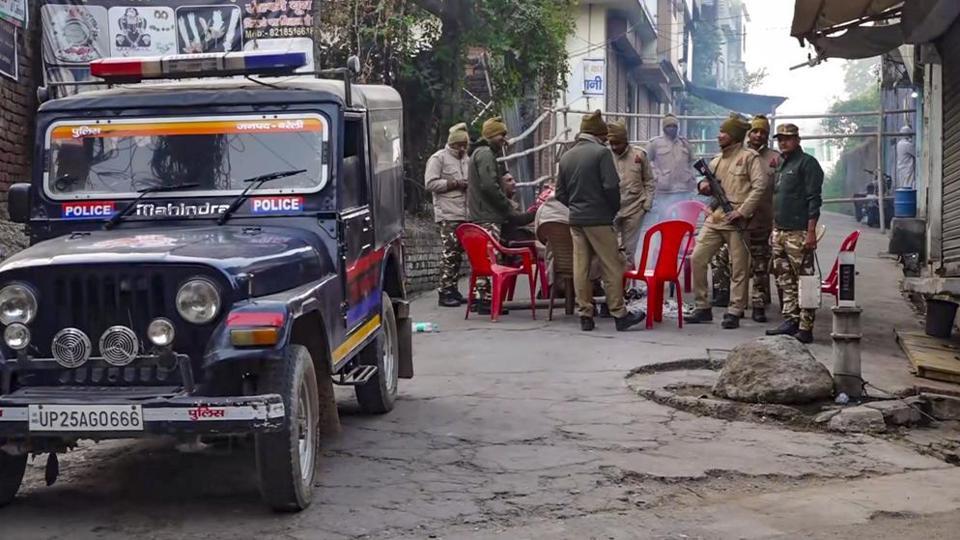
The top court heard the matter days after violence erupted during the survey on November 24 and left four people dead. The Uttar Pradesh government late on Thursday night named former Allahabad high court judge Devendra Kumar Arora as the head of a three-member committee to probe the violence.
Eight plaintiffs, including Supreme Court lawyer Hari Shankar Jain, filed a suit in Sambhal’s civil court on November 19 claiming the Shahi Jama Masjid was built on the site of a “Harihar Temple”. They sought access to the site, referring to it as a temple.
Jain and his son, advocate Vishnu Shankar Jain, have filed similar suits including on Varanasi’s Gyanvapi mosque adjoining the Kashi Vishwanath temple and Mathur’s Shree Krishna Janmabhoomi-Shahi Idgah.
The local court appointed the advocate commissioner on the day the suit was filed for the mosque’s photographic and videographic survey. The order was passed ex parte. No notice was issued to the mosque management and within hours, the survey was conducted. Another survey was carried out five days later with barely six-hour notice to the mosque committee.
In its petition to the Supreme Court, the mosque’s managing committee sought an immediate stay on the survey. It argued that such surveys, particularly of historic places of worship, could exacerbate communal tensions and undermine the country’s secular fabric. The plea questioned the legality and how the survey was ordered.
The plea, which bypassed the Allahabad high court, urges the Supreme Court to intervene directly to prevent further communal tension and reinforce judicial propriety in handling sensitive disputes involving historic places of worship.
The petition said that these actions were undertaken in undue haste and without providing the committee with an opportunity to contest the order or seek remedies.
It argued that the case violates the Places of Worship (Special Provisions) Act, 1991, which prohibits the conversion of a religious place’s character as it existed on August 15, 1947. It cited the Ancient Monuments and Archaeological Sites and Remains Act, 1958, which protects historic places of worship from desecration or misuse.
The petition highlighted procedural lapses in the civil court’s order, including the absence of any reasons or terms of reference for the survey. It underlied such surveys are being increasingly ordered in disputes over places of worship, potentially inflaming communal passions.
The Supreme Court on November 22 acknowledged the necessity of determining the legal maintainability of a suit in light of the Places of Worship Act, 1991 of a group of Hindu women seeking the right to worship Hindu deities within the Gyanvapi mosque complex. In this case, the mosque management committee has argued that all suits are barred by the 1991 Act, which freezes the religious character of all places of worship as of August 15, 1947, except for the Ayodhya Ram Janmabhoomi-Babri Masjid dispute.
A batch of petitions seeking the scrapping of the 1991 Act and asking for its tight enforcement have been pending before the Supreme Court since March 2021.