
 E-Paper



SC slams onerous bail conditions, stresses on reasonable judgments
The Supreme Court emphasized that excessively onerous bail conditions undermine bail's purpose, ruling that bail conditions should be reasonable and proportionate.

 Prefer HTon Google


The Supreme Court on Thursday underscored the need for courts to exercise caution while imposing bail conditions, noting that excessively onerous requirements could undermine the very purpose of granting bail.
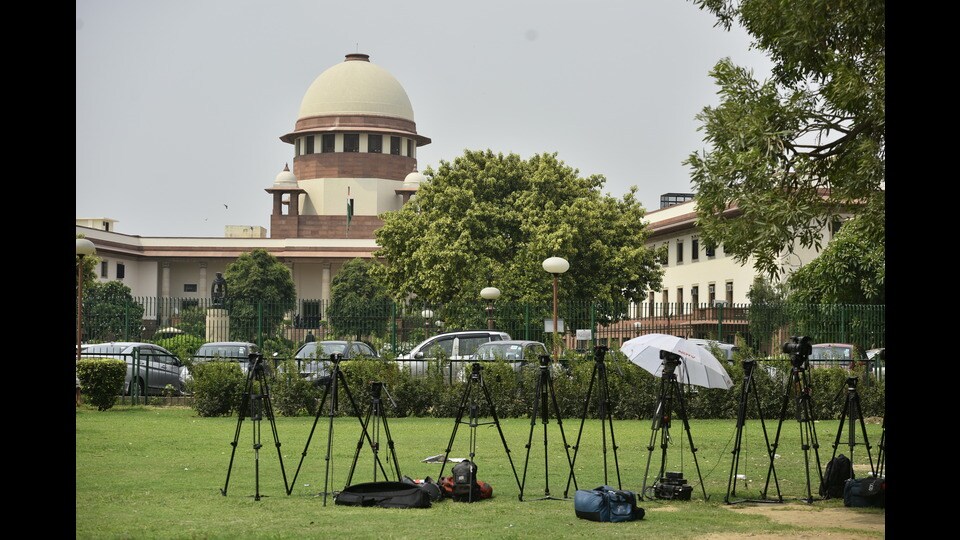
A bench of justices Bhushan R Gavai and KV Viswanathan stressed that the essence of bail should not be diluted by imposing conditions that are virtually impossible to fulfill, thereby negating the relief intended by the order.
“From time immemorial, the principle has been that excessive (conditions with) bail is no bail. To grant bail and thereafter to impose excessive and onerous conditions, is to take away with the left hand what is given with the right,” held the bench.
The case in question involved a petitioner, Girish Gandhi, who faced multiple criminal cases across six states, Kerala, Haryana, Uttar Pradesh, Rajasthan, Punjab and Uttarakhand. Despite being granted bail in several cases, the petitioner remained in custody due to the inability to furnish sureties in some states.
The court observed that while the petitioner had managed to comply with the bail conditions in some instances—such as providing sureties in Kerala and Haryana—he continued to struggle in other states where separate sureties were required.
In its judgment, the court cited the Oxford Dictionary’s definition of “surety” as a person who takes responsibility for another’s obligation” and acknowledged the difficulties individuals face in finding sureties, especially in criminal proceedings.
The court recognised that the pool of potential sureties is often limited to close relatives or longtime friends, and in many cases, individuals are reluctant to disclose their legal troubles to others, further narrowing their options.
“In a criminal proceeding, the circle may get even more narrowed as the normal tendency is to not disclose about the said criminal proceeding to relatives and friends, to protect one’s reputation. These are hard realities of life in our country and as a court of law we cannot shut our eyes to them. A solution, however, has to be found strictly within the framework of the law,” said the bench.
The court reiterated the longstanding principle that “excessive bail is no bail,” adding what constitutes “excessive” depends on the facts and circumstances of each case. In the present case, the petitioner was facing genuine difficulty in finding multiple sureties as required by the various courts.
While the bench acknowledged the importance of sureties in ensuring the accused’s presence during trial, it also highlighted the need to balance this requirement with the fundamental rights of the accused under Article 21 of the Constitution of India.
The court stated that any order related to bail should be reasonable and proportionate, considering the need to secure the accused’s presence and their right to personal liberty.
In support of its ruling, the court referenced its earlier judgment in Satender Kumar Antil Vs Central Bureau of Investigation & Anr (2022), where it had held that “imposing a condition which is impossible of compliance would be defeating the very object of release.” It also referred to its order in In Re Policy Strategy for Grant of Bail (2023), where it had endorsed the suggestion that courts should not insist on local sureties and should consider modifying or relaxing bail conditions if the bonds are not furnished within a month from the date of the bail order.
Granting relief to Gandhi, the court finally relieved him of the requirement of producing a fresh local surety in each case, directing that Gandhi would be released on bail after he furnishes personal bond with the same set of two sureties that will hold good for all cases in which he has secured the reprieve. “We feel that this direction will meet the ends of justice and will be proportionate and reasonable,” held the bench.
Earlier this month, the Court has held that bail should be the rule and jail an exception even under laws such as the Unlawful Activities Prevention Act (UAPA), while granting bail to a man accused under the anti-terror law.



