...
...
Next Story

Spikes in delhi’s pollution have direct link to rise in farm fires

Stubble burning just serves to push the AQI into the very poor (300-400) or severe (400-500 ) category.

Published on: Nov 16, 2021, 02:33:16 IST
By , , Hindustan TImes, New Delhi
Prefer HTon Google
Advertisement

There can be no arguing that stubble burning is a major contributor to the bad air in Delhi at this time of the year, just as there can be no arguing that Delhi’s average annual air quality index (AQI) is in the poor or the upper end of the moderate category.
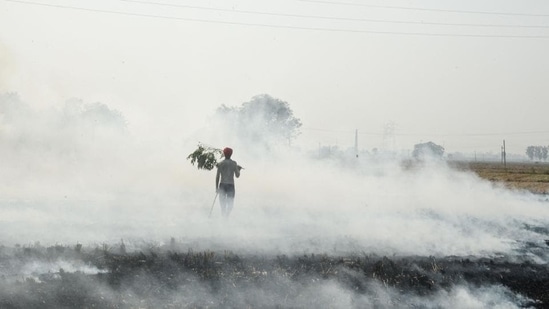
Stubble burning in adjoining states of Delhi remains a major issue.  (HT FILE)

This may seem to be at odds with the claims made in an affidavit submitted by the environment ministry in the Supreme Court that downplays the contribution of stubble burning to the Capital’s bad air. The affidavit is clearly an example of the damage averages can wreak on policy making when used without context.

The facts are thus.

One, Delhi always has bad air.

In 2018, the average AQI was 225.4; in 2019, it was 214; in 2020, it was 185.2; and in 2021, till November 14, it was 188.2. The number of stations measuring AQI across these years is not the same, but the metric is still a good indicator of how good (or bad, in this case) Delhi’s air was.

For instance, between October 20 and November 14 this year, Delhi’s AQI has been in the severe zone on seven days. On each of these days, the contribution of farm fires to Delhi’s PM2.5 contribution was between 26%-48%.

This isn’t an aberration.

For instance, according to a paper, “Objective evaluation of stubble emission of North India and quantifying its impact on air quality of Delhi”, in the first fortnight of November 2018, the contribution of stubble burning (biomass) to AQI was 9, 10, 30, 58, 29, 9, 10, 8, 7, 13, 22, 24, 5, 9, and 29%. That’s an average of around 18%.

Three, Delhi doesn’t see that many days when the AQI is severe.

Given that Delhi’s AQI has been in the severe category on a maximum of 25 days (in one year) in the period between 2016 and 2020 according to an affidavit filed by the environment ministry in the Supreme Court – including days when AQI was very poor, the number was 64 in 2020 and 80 in 2019 – it is clear that stubble burning has a clear impact on the Capital’s air. Long-term interventions – more public transport, better garbage disposal, moves to combat desertification, electric vehicles – will be needed to get Delhi’s average AQI down, but it is clear that short-term interventions (combating stubble burning, for one) will be needed to keep it from slipping into the very poor and severe categories.

 
ABOUT THE AUTHOR
Roshan Kishore

Roshan Kishore is the Data and Political Economy Editor at Hindustan Times. He heads the newsroom's data journalism team, which produces Number Theory, a daily data-driven feature for the print edition and the HT app. Number Theory uses data analysis and story-telling based on it to add value to the newsroom’s daily coverage by putting stories in a larger context on a range of issues, including politics, macroeconomy, markets, global affairs and climate. Under his leadership HT’s data journalism work has established itself as a niche product in Indian journalism and pushed the boundaries of marrying academic rigour with news sense and speed. Along with writing and editing data stories, he has also been writing a weekly political economy column called Terms of Trade for HT Premium. A trained economist with an MPhil degree from Jawaharlal Nehru University, Kishore has also been a visiting fellow at the Centre for Advanced Studies of India (CASI) at the University of Pennsylvania. Along with his journalistic work, his writings have also appeared in journals such as the Economic and Political Weekly and working papers for CASI and UNESCAP.

ABOUT THE AUTHOR
Abhishek Jha

Abhishek Jha is Assistant Editor-Data at Hindustan Times. He uses statistical programming to generate newsworthy insights from large datasets. He is part of the team that produces Number Theory, a daily data story feature of the paper’s print edition. Since March 2024, he has been writing Weather Bee, a weekly column for the Hindustan Times website. He is a chemical engineer by training, who specialises in stories related to weather, climate, and the environment. Jha has been at HT since 2018, where he offers data-driven perspective and analysis on politics, environment, weather, climate, economy and society. His work includes data coverage of elections in India and abroad, including the 2019 and 2024 Lok Sabha elections; the disasters and extreme weather resulting from changing climate, such as floods, droughts, heat waves, cold waves, and dwindling snow cap in the Himalayas; the factors that drive poor air quality in northern India; the changing patterns of land use; the Covid-19 pandemic and its impact on labour market conditions; the changing pattern of consumer spending seen in the new consumer spending surveys; and social norms seen in the surveys such as the National Family Health Survey.

Get the latest India News, breaking headlines and real-time updates from across the country. Stay informed about politics, government policies, crime, weather major national developments and Karnataka Bandh LIVE.
SHARE THIS ARTICLE ON
Hindustantimes wants to start sending you push notifications. Click allow to subscribe