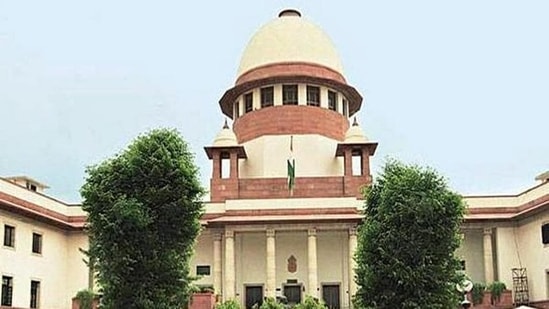
The Supreme Court collegium on Thursday recommended Justice N Kotiswar Singh, currently chief justice of the Jammu & Kashmir and Ladakh high court, and Justice R Mahadevan, acting chief justice of the Madras high court, for elevation to the apex court.
Justice Singh’s elevation will mark the appointment its first judge from Manipur, more than 70 years after the country gained independence.
The collegium, led by Chief Justice of India Dhananjaya Y Chandrachud, considered factors including seniority, merit and judicial integrity before selecting the two names. Other members of the collegium are Justices Sanjiv Khanna, Bhushan R Gavai, Surya Kant and Hrishikesh Roy.
The Supreme Court currently has 32 judges, two short of its sanctioned strength of 34, following recent retirements. Justice Hima Kohli is set to retire in September, adding urgency to new appointments.
HT had on July 8 first reported about the collegium’s plan to finalise the names of two new judges to fill vacancies in the apex court, and that justices Singh and Mahadevan figured among the shortlisted names.
Also Read | Supreme Court Collegium recommends 2 high court judges for elevation
{{/usCountry}}Also Read | Supreme Court Collegium recommends 2 high court judges for elevation
{{/usCountry}}On justice Singh, the collegium’s resolution stated: “His appointment as a judge of the Supreme Court will provide representation to the North-East, and in particular he will be the first judge from the state of Manipur to be appointed as a judge of the Supreme Court.”
Justice Singh was appointed as the chief justice of the Jammu & Kashmir and Ladakh high court in February 2023. He started his judicial career as an additional judge of the Gauhati high court in October 2011.
It added that Justice Singh has “an impeccable record, both in judicial capacity and in terms of the work which has been rendered by him on the administrative side”.
Justice Mahadevan, appointed to the Madras High Court in October 2013, belongs to a backward community from Tamil Nadu. The collegium noted his appointment would bring diversity to the bench.
The resolution explained why Justice Mahadevan was preferred over two senior Madras High Court judges: “The collegium has given precedence to the candidature of Mr Justice R Mahadevan in order to give representation to the backward community.”
Also Read | Centre clears collegium recommendation after 6 months
According to people aware of the matter, the collegium also finalised names of new chief justices for eight high courts, including Delhi, Madras, Himachal Pradesh, J&K and Ladakh, Madhya Pradesh, Kerala, Jharkhand and Meghalaya. The resolutions are expected to be officially released on Friday morning, they added.
As many as three Delhi high court judges have been recommended by the collegium to take over as chief justices in different high courts. Delhi high court acting chief justice Manmohan has been recommended as the chief justice of the same high court while justice Rajiv Shakdher has been proposed as the chief justice of the Himachal Pradesh high court. Delhi high court judge Suresh Kumar Kait has been recommended as the chief justice of the Jammu & Kashmir and Ladakh high court following the elevation of justice Singh to the Supreme Court.
Justice MS Ramachandra Rao, the present chief justice of the Himachal Pradesh high court, has been proposed to be transferred to the Jharkhand high court to take over after the current chief justice there retires on July 20.
Punjab high court judge Gurmeet Singh Sadhawalia has been proposed to be appointed as the chief justice of Madhya Pradesh high court while Bombay high court judge Nitin M Jamdar has been recommended as the chief justice of the Kerala high court.
Bombay high court judge justice KR Shriram has been recommended as the chief justice of Madras high court while justice Tashi Rabstan, a judge in the J&K and Ladakh high court has been proposed to take over as the chief justice of Meghalaya high court after the present chief there retires in August.
The Supreme Court collegium, comprising the Chief Justice of India and the four senior-most judges, is responsible for selecting judges. A memorandum of procedure framed in 1999 guides the appointment and transfer of judges in India’s Supreme Court and high courts.
Justice PB Varale was the last appointment to the Supreme Court in January 2024, marking the first time the court has had three judges from the Scheduled Caste category.
In April 2023, Chief Justice Chandrachud announced the involvement of the Centre of Research and Planning, the court’s in-house think tank, in preparing a list of potential future appointments to the top court.
CRP, he announced, was tasked to assist the permanent secretariat in the top court, which deals with various aspects of judicial appointments, including collection of information, preparation of records and putting them up before the collegium.
According to people aware of the matter, the collegium also finalised names of new chief justices for eight high courts, including Delhi, Madras, Himachal Pradesh, J&K and Ladakh, Madhya Pradesh, Kerala, Jharkhand and Meghalaya. The resolutions are expected to be officially released on Friday morning, they added.