
 E-Paper



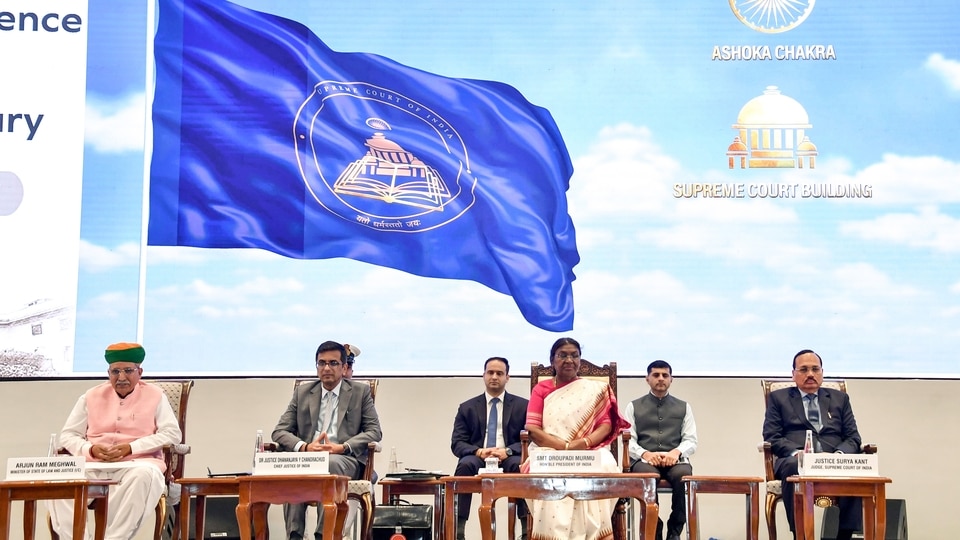
Supreme Court’s new flag and insignia unveiled by President Murmu
The Supreme Court's new flag has ‘Yato Dharmastato Jayah’ inscribed on it in Devanagari script.

 Prefer HTon Google


President Droupadi Murmu on Sunday unveiled the new flag and insignia of the Supreme Court at the two-day National Conference of District Judiciary in New Delhi. The newly unveiled flag features symbols central to India's legal and cultural heritage: the Ashoka Chakra, the Supreme Court building, and the Constitution of India. The new Supreme Court flag is blue in colour. The insignia has ‘Supreme Court of India’ and ‘Yato Dharmastato Jayah’ (in Devanagari script) inscribed on it.
What does ‘Yato Dharmastato Jayah’ mean?
The phrase "Yato Dharmastato Jayah" is a Sanskrit expression that translates to "Where there is Dharma, there is victory" or “Victory lies where Dharma (righteousness) prevails.”
President addresses the event
Addressing the event, the President commended the Supreme Court for its invaluable contribution to Indian jurisprudence, saying it has stood as a vigilant sentinel of justice since its establishment. She also appreciated the efforts of all those, past and present, who have contributed to the Indian judiciary's legacy, which has strengthened public trust in the legal system.
President Murmu also addressed the persistent issue of case backlogs, urging for innovative solutions to reduce the pendency of cases. She called for more frequent initiatives like special Lok Adalat weeks to expedite the resolution of cases, noting that such efforts are essential for maintaining public confidence in the judicial system. The President was pleased that discussions during the conference had focused on case management, expressing hope that these deliberations would lead to practical reforms.
Also Read | President Droupadi Murmu calls for efforts to change ‘culture of adjournments’ in courts
In her speech, the President proposed the idea of a justice system at the local level, akin to the powers and responsibilities granted to Panchayats and Municipalities by the Constitution. She suggested that providing justice in local languages and under local conditions could bring the judiciary closer to the people.
Highlighting the need for collaboration among the judiciary, government, and police, President Murmu stressed the importance of addressing issues related to evidence and witness protection.
Also Read | ‘Enough is enough’: Full text of President Murmu's statement on Kolkata rape-murder case
She also voiced concerns over the delays in justice delivery, especially in heinous crimes like rape, which she said could erode public faith in the judicial process.
President Murmu said it is a sad aspect of our social life that, in some cases, people with resources continue to roam around fearlessly and freely even after committing crimes, and those who suffer from their crimes live in fear, as if those poor people have committed some crime.


