The Taliban regime of Afghanistan used its first-ever public reception on Indian soil on Monday to send out a message of deeper engagement that builds on the shared past of the two countries and contributes to regional stability and connectivity.
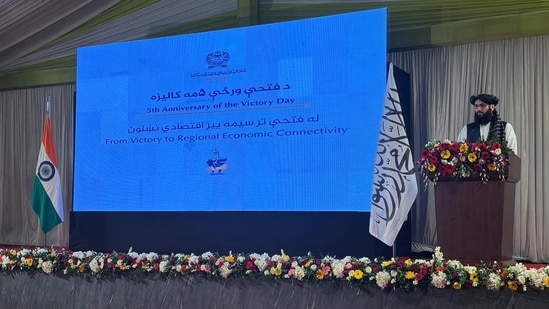
Standing on a stage with the flags of India and the Taliban, charge d’affaires Noor Ahmed Noor outlined the Islamic Emirate of Afghanistan’s foreign policy based on “balanced engagement” and non-interference, and plans to forge greater political trust and an economic partnership with India.
The event was held to commemorate the fifth anniversary of Victory Day or the Taliban’s return to power in Kabul on August 15, 2021. The Indian government, which does not officially recognise the Taliban government, was represented at the event by Anand Prakash, the joint secretary heading the Pakistan-Afghanistan-Iran division of the external affairs ministry.
Also Read I Afghan embassy hosts event marking 5th anniversary of Taliban's return to power in Kabul
A relationship of “constructive understanding”
Noor, who spoke in Pashto and had his remarks translated into English, noted the “significant progress” in India-Afghanistan ties based on mutual respect, political engagement and shared interests.
{{/usCountry}}Noor, who spoke in Pashto and had his remarks translated into English, noted the “significant progress” in India-Afghanistan ties based on mutual respect, political engagement and shared interests.
{{/usCountry}}“We believe that stronger political trust, economic partnership and continued engagement between Afghanistan and India will not only benefit both countries, but will also make an important contribution to regional stability, connectivity, and shared prosperity,” he said.
Diplomatic contacts have expanded, embassies and consulates have become more active and high-level delegations have exchanged visits, while “constructive understanding” has developed in political, economic, and humanitarian cooperation, he said.
Also Read I I lived through the first Taliban girls’ school ban — watching it happen again is heartbreaking
Visits by foreign minister Amir Khan Muttaqi and other ministers have led to understandings in various areas and expanded cooperation, Noor said, while also highlighting the connections dating back several centuries in trade, transit and a shared cultural heritage.
“The ancient cities of Afghanistan, such as Kabul, Herat and Kandahar, welcomed Indian traders and caravans, while Indian cities such as Delhi and Lahore benefited from the influence of Afghan scholars, poets and Sufis,” he said.
“In the political sphere as well, the two countries influenced one another in their struggles for freedom and independence from British colonial rule. This is our shared past, from which we draw inspiration for a better future,” he said.
International forums and representation
Noor thanked India’s leadership and external affairs minister S Jaishankar for “their support in protecting and respecting the international rights” of Afghanistan. “We also appreciate their emphasis at international forums on the need to ensure Afghanistan’s legitimate international rights. We hope that greater attention and practical efforts will be made in this regard,” he said.
Afghanistan’s foreign policy is based on the principles of balanced engagement, mutual respect, non-interference and shared interests, and the country seeks “positive, constructive, pragmatic and sustainable” ties with all countries, Noor said.
“We believe that Afghanistan’s stability is not only a success for Afghans; it is also an important opportunity for economic growth, trade, energy, transit and security across the entire region,” he added.
Also Read I Suffocating restrictions and a humanitarian crisis: Taliban marks five years in power in Afghanistan
Among the handful of countries that were represented at the event by their ambassadors were Bhutan, Iran, Eritrea, Jamaica, Niger, Palestine and Serbia. The event was also attended by diplomats of countries such as China, Russia, Qatar, Iraq, Oman and the United Arab Emirates. Though diplomats from Western and European countries were invited to the reception, they were conspicuous by their absence.
While Muttaqi’s visit in October 2025 had triggered a controversy as women journalists were not invited to his first news conference in New Delhi, several women reporters were part of the reception.