The much-hyped Kaleshwaram lift irrigation project (KLIP) built on Godavari river in Telangana, considered to be the biggest lift irrigation project in the country, will be defunct for at least for six to seven months, as it is a gigantic task to restore Medigadda barrage, which suffered major damages in October, people familiar with the matter said.
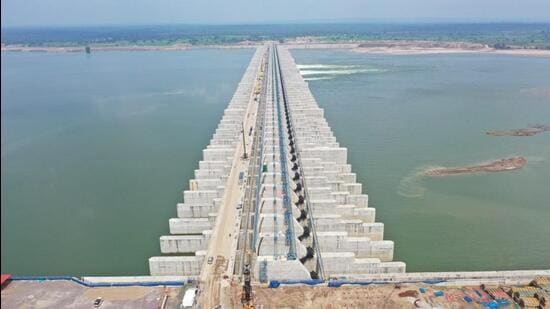
“There is no way Godavari water is pumped from the Kaleshwaram project to the command area of Kaleshwaram for another two seasons. Medigadda barrage is the first of the three barrages of Kaleshwaram lift scheme and unless it is restored, the other two barrages upstream – Annaram and Sundilla will not be functional, as water cannot be lifted and pumped into these barrages. So, the entire project is in a limbo,” a senior engineer associated with the project said.
As a result, the entire 19.63 lakh acres of ayacut (command area) under KLIP cannot get water from the project for irrigation, at least for this year. “The only hope for providing irrigation to this ayacut is heavy rains to Godavari river, which will supply water directly to the crops through a series of existing reservoirs like Sripada Sagar, Sri Ram Sagar Project (SRSP) and Mid-Manair through gravity and pumping,” the engineer quoted above said.
What happened at Medigadda?
{{/usCountry}}What happened at Medigadda?
{{/usCountry}}During the visit of a group of ministers led by state irrigation minister N Uttam Kumar Reddy to the project site on Friday, Telangana engineer-in-chief (irrigation) C Muralidhar explained how the Medigadda barrage suffered damages.
It happened around 6.20 pm on October 21, when field engineers of the irrigation department heard a loud sound coming from the barrage and rushed to the spot. They noticed damages at piers 19, 20 and 21 of block no 7, resulting in sinking of piers 18, 19, 20 and 21 along with slabs and parapet wall. By night, the water stored in the barrage was depleted to avoid further damage, he said.
He said the following day, chief engineer of the Central Designs Organisation (CDO) along with his technical team inspected the Medigadda barrage to asses the situation. On October 24, a six-member committee of the National Dam Safety Authority visited the site and examined the reasons for the incident.
On October 28, chairman of dam safety review panel and former Central Water Commission chairman Ashwin B Pandya, along with his team of engineers visited the site and gave the inspection report. “The panel observed that piers had sunk due to a combination of issues involving planning design, quality control and operation and maintenance,” the engineer-in-chief said.
The national dam safety authority told the state government that it required a thorough investigation to find out whether the barrage was constructed as per the original project designs and drawings along with the results of geotechnical and geological investigations.
“Considering the commonalities, there is a likelihood of similar damages in other blocks resulting in a similar failure. Therefore, all piers and rafts of the barrage must be surveyed, especially in the adjoining blocks 6 and 8,” the NDSA report said.
Muralidhar told the group of ministers that the exact causes can be determined only after proper inspection of the foundation. “A coffer dam is being constructed by the contracting agency to divert the water and facilitate a thorough inspection. Only after that, the extent of damage can be assessed,” he said.
The engineer-in-chief indicated that the three piers – No. 19, 20 and 21 of block 7 would have to be dismantled using diamond-cutting technology, along with their radial gates. In their place, new piers would be built and new gates would be erected.
When can these repairs be completed?
“It is easier said than done,” said another senior engineer working on the project. “First of all, the present Congress government has to show the will to restore the project. As the things stand, it is showing more interest in fixing the accountability on the previous government by ordering a judicial inquiry into the lapses in the construction of the project, than on restoring the project,” he said.
Secondly, the NDSA and the CDO authorities have to make a thorough inspection to study the root cause of the damages. “It can be done only after the construction of the coffer dam, so that no water would reach the damaged site and help the engineers to assess where exactly the problem is. The work is going on at present and it will take a few more weeks to complete the exercise,” he said.
After that, the irrigation department should take up the demolition of damaged piers using diamond-cutting technology. “This is very time consuming and most expensive method. Yet, it is the only possible option, as using blasting technology might cause damage to the adjacent blocks and make the entire barrage useless,” Muralidhar said.
According to the tentative estimates by the department, it requires ₹500 crore to restore the damaged part of the Medigadda barrage. The question is whether the present government is willing to spend such huge amount. “It again depends on the will of the government,” the second engineer quoted above said.
Thirdly, even for this exercise and reconstruction of the damaged portion, the government has to obtain revised designs and permission from the NDSA and other central agencies. “It is not so easy, as they do stringent inspections and raise a lot of queries before approving the designs,” he said.
So, the Kaleshwaram project, for all practical purposes, will be defunct for the next six to seven months. “It may even take a year or more, given the financial position of the state government,” the engineer added.