E-Paper



The bird mothers keeping a species extant
Nikhila Purohit cares for eight Great Indian Bustard chicks at a breeding centre in Jaisalmer, part of efforts to save the critically endangered species.

 Prefer HTon Google


At 7am, Nikhila Purohit, 29, dons her bright blue apron and makes her way outside to meet her children. She has eight, and like most young ones, they are always hungry, so they are happy to see her (as most children are to see their mother). But Purohit’s children are special, and not just in her eyes -- they account for almost 4% of the numbers of their species, perhaps more.
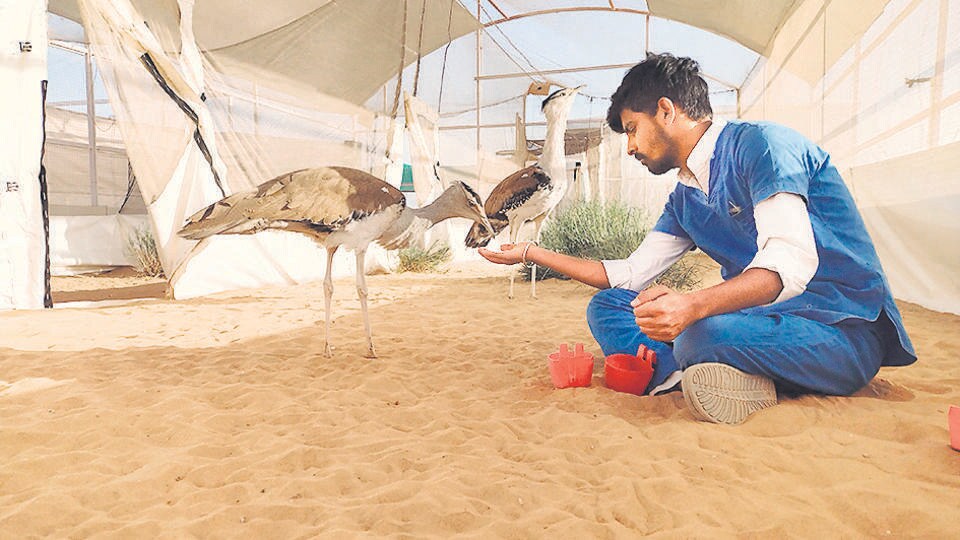
Purohit is the surrogate mother to eight Great Indian Bustard (GIB) chicks that are being raised at a special enclosure in Ramdevra near Jaisalmer. They are part of 45 of the critically endangered species of varying age (they hatched at various times since 2019) being raised in other similar enclosures in the centre. There are less than 150 of the species in the wild -- some experts believe the number is already below 100 -- with almost all being found in a limited habitat in Jaisalmer, and the breeding centre’s goal is simple: to ensure captive breeding, and, at some point in time in the future, release the captive-bred GIBs into the wild.
Purohit’s eight wards are special because they are among the 15 that have hatched in the past two years, from birds that were bred in the centre (the original batch of birds were hatched from 30 eggs collected in the wild). She isn’t alone; there are 13 other mothers (including eight men), all volunteers, and all working under the aegis of the Wildlife Institute of India (WII) to ensure the species does not vanish in the wild.
The population of the GIB has seen a sharp decline. Once found in parts of Gujarat, Maharashtra and Andhra Pradesh, the numbers have seen a plunge; habitat loss, and threats posed by predators and (in Jaisalmer) by overhead electricity transmission lines carrying power from solar projects are the main causes for the decline.
Covered from all sides, the enclosures are a safe space for the species. Carrying a red feeder which has alfalfa (a flowering grass), mustard seeds, live crickets and mealworms, Purohit feeds the birds , as she will every 30 minutes through her shift of seven hours (which is broken into two parts). She is also tasked with observing their feeding patterns and behaviour.
“They are excited to see us every morning. It is because they know they are getting food, but also that their mother is back. They have not seen the outside world so they are dependent on us. At the same time there are no natural threats, so they feel safe and have been breeding successfully,” says Purohit who has degrees in zoology and biodiversity.
Each of the birds has its own name, with coloured rings to help caretakers identify them. Like most mothers, Purohit can identify them by appearance and mannerisms alone. “They have distinct personalities. Some are extroverted, whereas others prefer to stay in a corner,” she explains, while feeding them with a tweezer, which replicates a mother bustard’s beak.
From 7am to 11am, Purohit spends the first half of the day with the birds, feeding and observing them; she comes back at 4pm for another three-hour shift.
Dwindling numbersEight may seem like an insignificant number, but it is more than one. Which is the number of eggs GIBs usually lay every year. They nest on open ground, leaving these eggs often vulnerable to predators, including feral dogs, which have emerged the most significant hazard to wildlife across India.
In recent years, cases of electrocution deaths have shot up too – owing to a labyrinth of high-tension wires now covering large parts of Jaisalmer as both wind and solar projects come up. The state bird of Rajasthan, also called Godawan, has found the going tough. A 2018 census, the latest for the species, pegged its population to be just 128 in the state. In comparison, the count was 745 in 1978, 600 in 2001 and 300 in 2008, data showed.
Harish Ram, 25, is another surrogate mother. A resident of Jaisalmer’s Sam, he joined the WII centre in 2020 as sanitation staff. “I loved spending time with the birds. Even when I would be sweeping inside, I would try to play with them and the senior staff noticed my interest in them. They asked me to join the keeping team instead and that same year, I was trained to be a surrogate mother,” he says, adding that, as a local, he is aware of the importance of the species and what protecting it means.
Ram said while the blue aprons are what the birds have seen since their birth, they also recognise faces. “The idea was that even as surrogate mothers work in different shifts, the birds are able to identify us based on the blue apron. But they also recognise faces.”
Jog Singh, 34, is another surrogate mother. Singh, also from Sam, which is famous for its dunes, is an old-timer who has been at the centre since 2018; he has seen the process of the eggs being collected in the wild and being incubated. “I have raised them as my own children. Godawan is a special bird for Rajasthan,” he says, adding that he derives personal satisfaction , like every mother should, from feeding them and watching them grow.
Near his village and in other parts of Jaisalmer, Singh has seen multiple GIBs perish from electrocution.
The 2018 census by WII also revealed that at least 18 birds died from electrocution. Locals have long been calling for their removal, but in 2024, the Supreme Court reduced the area in the region where the overhead wires were not allowed, citing the need to balance the need to conserve GIBs, with that to generate green power.
Power playThough WII has two centres in Jaisalmer – the breeding centre at Ramdevra near Pokhran and an incubation centre in Sam -- there are still habitats for the bird in the wild. Rasla, a village 50km southeast of Jaisalmer city is part of a habitat where the bird once thrived. Now, frequent bird deaths are a common sight. After a GIB death in September 2020 barely a few hundred metres from the village, local residents decided to build a statue dedicated to the vanishing species, hoping to appeal to the conscience of the powers that be.
“To this date, we still see bustards in our area. However, it is worrying too, since there are close to 14 high-tension power lines in this area which is also called Deghrai oran (sacred grove forest). In recent months, I have seen other birds die as well, including demoiselle cranes,” said Sumer Singh Bhati.
Bhati is a leading voice for the village of Rasla, which has been organising various local-level protests, seeking the shifting of power lines. “Last year, two of these lines were moved underground. This was after eight years of efforts. However, 14 power lines are still above ground and until that is fixed, this habitat is a landmine for GIBs,” he said.
Power project developers cite the high cost of moving wires underground.
The GIB is among the heaviest birds in the world that are able to fly, with the adult male typically weighing 10 to 12kg. The average flying height is usually between five and 15 metres, going up to 60 metres for long-distance flights. High-tension wires typically stand at heights of 20 metres, putting the birds at risk.
While Rasla is a disturbed habitat, around 100km towards Ramdevra is a relatively undisturbed patch – one where the bustards are frequently spotted between the villages of Dholiya and Tekholai.
Dholiya resident and local conservationist Radheshyam Bishnoi, 28, who has been fighting for protection of the bird for nearly a decade , says vested interests are making the fight difficult. “People in villages across Jaisalmer have sold their land to companies to set up solar and wind farms. The number of power lines is only increasing and that makes the bird’s survival difficult,” Bishnoi says, pointing to a group of three godawans in the wild. The stretch of land near his village is among the areas these cables have not yet reached. Protectors like him also have to keep feral dogs and wild pigs at bay. “There are several villagers who act as guardians for the bird. We even captured feral dogs and moved them away from the area,” he adds.
The other prominent habitat where the bird exists in the wild presently is the Desert National Park (DNP), a protected sanctuary where the forest department has created multiple enclosures using a predator proof fencing (PPF) to provide safe havens for the bird.
Battle for survivalEven as questions remain over the quality of habitat outside, efforts at WII’s breeding centre mean the species may not become extinct -- at least not anytime soon. Dr Sutirtha Dutta, the lead scientist for the WII’s project is shifting gears to the next phase – the construction of a large dome-shaped tunnel which will allow all subsequent newborns to be trained to return to the wild.
“Typically, after three to four years, the adults can breed and so from 2023, under stable conditions which includes food security, no predatory threats or any stress, there has been successful mating and 14 birds hatched this way. For the last bird, we even tried artificial insemination, with the adult ejaculating in a dummy resembling a female bird. Even that proved to be successful and that means there is a population of 45 birds here that can be our breeding population going forward,” explains Dutta, adding that while these birds are solely reliant on human beings, the aim is to ensure the next generation has no human contact.
“In order for them to survive in the wild, they will have to feed on their own. For this, a rewilding aviary is being created, where the newly hatched birds will be kept for a period between three and nine months. While we will drop food such as grasshoppers there, they will not see any humans and thus it will be an environment closer to the wild,” says Dutta, stating this aviary, being developed by Rajasthan Government, will be at least 150 metres long, at least 50 metres wide and have a height of at least 10 metres. “This will allow the young birds to move freely and even take small flights from one spot to another,” he says. The plan is to eventually release these newly hatched birds post acclimisation into the wild by next year. Potential sites for releasing birds are the DNP and the Pokhran area, he says, adding that the next step includes scientifically informed habitat restoration.
The way forward The bustard recovery programme was announced in 2013 by the Union environment ministry and was ultimately launched in 2016. Breeding efforts began in 2019. To add impetus to this, Prime Minister Narendra Modi chaired the seventh meeting of the National Board for Wildlife (NBWL) on March 3, announcing a National Great Indian Bustard Conservation Action Plan.
Experts say that while captive breeding of the critically endangered species is a good move, the focus on habitat restoration has been missing.
“There are two types of conservation – in-situ which is in the wild and the habitat that you are protecting. This is the most important type of conservation as it not only protects the species in the wild, but its habitat too. The other is ex-situ conservation, which is protecting the species outside of its natural habitat and that is what we have been doing. Here, in-situ has almost been forgotten,” says and former bureaucrat MK Ranjitsinh, who has worked extensively on protection of the species and was one of the petitioners in a 2019 public interest litigation in the Supreme Court seeking protection for the bird from power lines.
Wildlife biologist, Sumit Dookia, who has been working on the species since 2006 says a key component of protecting the species is habitat restoration. “What was required was to equally protect and improve the natural habitat outside. This needed to be done simultaneously so that if there are rewilding plans, there is safe and protected habitat outside. So far, it appears there are limited safe habitats outside.”