Number Theory: The festival season has begun, what does the economy look like?
The festive season is an extremely important part of the fiscal year for the Indian economy as consumers are expected to spend more money on non-durables such as clothing and durables such as household appliances and vehicles.
The southern state of Kerala is celebrating Thiruvonam on September 8, marking the beginning of the long festive season in India, which includes the festivals of Durga Puja, Diwali and Christmas and ends with the new year.
PREMIUM
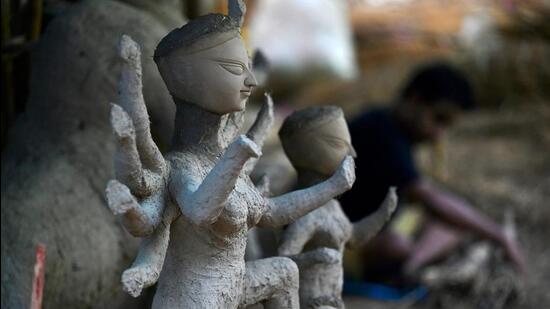
An artisan clays an idol of the Hindu Goddess Durga at a workshop ahead of Durga Puja festival in New Delhi (AFP)
{{^htLoading}} {{/htLoading}}
The festive season is an extremely important part of the fiscal year for the Indian economy as consumers are expected to spend more money on non-durables such as clothing and durables such as household appliances and vehicles. Private consumption spending accounts for more
Customers wishing to buy an expensive car this festive season will likely face a waiting period extending beyond the season itself.
... but there is enough data to suggest that the poor are still struggling
{{^htLoading}} {{/htLoading}}
Real rural wages, which are a good proxy for the incomes of unskilled workers in both rural and urban labour markets, have been contracting continuously between November 2021 and June 2022 (the latest period for which this data are available). While a sharp rise inflation has been an important reason for this contraction, average rural wages were below previous year’s levels even in nominal terms in the month of June. These findings are in keeping with the insights from the quarterly round of Periodic Labour Force Survey (PLFS) for the April-June period which shows that even though unemployment rates have come down, quality of jobs has actually seen deterioration.
While a sharp rise inflation has been an important reason for this contraction, average rural wages were below previous year’s levels even in nominal terms in the month of June.
Inflation might have hurt the poor, but it is helping government finances
{{^htLoading}} {{/htLoading}}
There is a widespread consensus that high inflation has hurt the purchasing power of the relatively non-rich in the Indian economy. However, inflation has not been an unambiguous curse for the Indian economy, and ironical as it may sound, the government is one of the biggest beneficiaries of the high inflation phase via the public finance route. High inflation, by boosting nominal incomes, also generates tailwinds for revenue collections. The nominal growth component of GDP growth for the quarter ending June was 13.2 percentage points. Because the GDP deflator is more aligned to the Wholesale Price Index (WPI) than the Consumer Price Index (CPI), it will be important to see what happens to WPI over the festive season. If it continues to remain at high levels – WPI growth was 13.9% in July – one can expect a high nominal growth component driven boost to revenues in the both the September and December quarter. This will definitely help tax collections. Not only will this help the cause of government spending it will also ensure the government stays close to its declared deficit targets, which, in turn, will ease the sentiment in markets such as those for government securities and neutralise some of the headwinds from monetary tightening in advanced countries.
{{^htLoading}} {{/htLoading}}
High inflation, by boosting nominal incomes, also generates tailwinds for revenue collections.
Inequality notwithstanding, a good festive season might boost consumer sentiment
While there is every reason to believe that the Indian economy is undergoing a K-shaped recovery where the rich, both among firms and households, have experienced a faster revival than the poor, spending by the rich in a ‘normal’ festive season will definitely help. Firstly, it is important to underline the fact that the last festive season came after the scars of the deadly second wave of the pandemic and was followed by the third wave driven by the Omicron variant of the Covid-19 virus. Weeks after the third wave subsided, the economy had to deal with the external shocks of Russian invasion of Ukraine. With the pandemic under control and international commodity prices below their peaks (at least for now) even the rich will be more inclined to spend money than they would have been a few months ago. The trickle-down effects of such spending -- such as through eating out and travel and tourism -- will help to restore the purchasing power and sentiment of the poor, which has the potential to provide a limited boost to the virtuous cycle of rising consumer sentiment and spending. The first evidence of whether or not this is happening will come in RBI’s Consumer Confidence Survey (CCS) after its October and December Monetary Policy Committee meetings.
{{^htLoading}} {{/htLoading}}
All Access. One Subscription.
Get 360° coverage—from daily headlines to 100 year archives.
Roshan Kishore is the Data and Political Economy Editor at Hindustan Times. He heads the newsroom's data journalism team, which produces Number Theory, a daily data-driven feature for the print edition and the HT app. Number Theory uses data analysis and story-telling based on it to add value to the newsroom’s daily coverage by putting stories in a larger context on a range of issues, including politics, macroeconomy, markets, global affairs and climate. Under his leadership HT’s data journalism work has established itself as a niche product in Indian journalism and pushed the boundaries of marrying academic rigour with news sense and speed. Along with writing and editing data stories, he has also been writing a weekly political economy column called Terms of Trade for HT Premium. A trained economist with an MPhil degree from Jawaharlal Nehru University, Kishore has also been a visiting fellow at the Centre for Advanced Studies of India (CASI) at the University of Pennsylvania. Along with his journalistic work, his writings have also appeared in journals such as the Economic and Political Weekly and working papers for CASI and UNESCAP.
Get the latest India News, breaking headlines, and real-time updates from across the nation. Stay informed on politics, government policies, crime, weather, and major national developments.
Get the latest India News, breaking headlines, and real-time updates from across the nation. Stay informed on politics, government policies, crime, weather, and major national developments.
Home/India News/Number Theory: The festival season has begun, what does the economy look like?
{{^htLoading}}
Advertisement
{{/htLoading}}
SHARE THIS ARTICLE ON
{{#usCountry}}{{/usCountry}}
Notifications
Get breaking alerts directly from the newsroom
Notifications are on!You'll be notified when news breaks