A complaint was filed with the Mumbai Police on Friday against the Cockroach Janta Party (CJP) leaders for their protest at Shivaji Park against chief election commissioner Gyanesh Kumar.
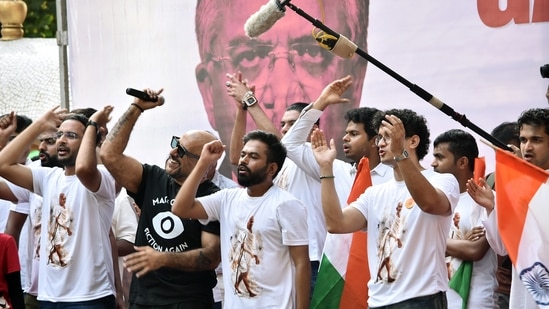
The complainant, identified by the news agency ANI as advocate Siddhi Deolekar, who said she has been a resident of Shivaji Park for the last 10 years, said that while she was not against the right to protest, there were “designated sites” for doing so. She cited the Bombay high court order that the Mumbai Police had referred to when denying permission for the protest.
She told the news agency: “I have lodged a complaint against the CJP founders for conducting an illegal protest today. They were not granted permission, and this is the letter issued by the Shivaji Park Police Station to Ajinkya Shinde…. Despite the order of the Bombay high court, they decided to conduct the protest on the roads today. Well, I am not against protests. Everyone has the right to protest, but there are designated places for protests. So why come onto the road and protest like this?”
Deep Dive
What were the reasons given by Mumbai Police for denying permission to the CJP protest at Shivaji Park?
Why is the Cockroach Janta Party demanding the resignation of Chief Election Commissioner Gyanesh Kumar?
What alternatives to protesting at Shivaji Park were suggested by the complainant against the CJP's protest?
The complainant said that the protesters can go to Azad Maidan or Jantar Mantar for the stir.
{{/usCountry}}The complainant said that the protesters can go to Azad Maidan or Jantar Mantar for the stir.
{{/usCountry}}"Why block the roads and traffic and sit outside other people’s houses to protest? What kind of protest is this? If you want the Election Commissioner to resign, then go and protest at Jantar Mantar, but not opposite our houses,” she added.
Deolekar thanked the Mumbai police for the assurance given to her, saying that she and others with her “simply needed assistance and wanted to feel secure”.
“I really want to thank the Mumbai Police. They assured us—not just me, but many other citizens like me who went and complained. We simply needed assistance and wanted to feel secure. There were many people like me who approached the police, and we were assisted very well...I hope appropriate action will be taken against them," she added.
The CJP protest in Mumbai
CJP founder Abhijeet Dipke announced the Mumbai protest as the first leg of a nationwide agitation, alleging irregularities in electoral rolls and demanding greater accountability in the Election Commission's functioning.
The protest comes days after Mumbai Police denied permission for the gathering at Shivaji Park, citing, among other issues, concerns over noise pollution, traffic congestion and disruption to movement in the area. Dipke subsequently announced the ‘Jail Bharo Andolan’ at the venue.
Separately, student activists and AAP leaders are holding a protest at Delhi’s Jantar Mantar, also demanding Kumar’s resignation.
More than 500 protesters have reportedly been detained in Delhi, including AAP leaders Atishi and Sanjay Singh. Several attempts have also been made to detain All India Students' Association (AISA) president Neha Bora.
Why is CJP demanding Gyanesh Kumar’s resignation?
An Indian Express report alleged that Sandhu and Joshi had recorded objections to several decisions of the poll panel over a 10-month period, including matters relating to electoral rolls and the Special Intensive Revision (SIR) exercise. The reported objections included concerns over changes to Form 6, the centralisation of access to the electoral roll database and decisions concerning voter additions, deletions and restoration.
The report triggered a political controversy, with opposition parties calling for Kumar’s resignation and seeking the Supreme Court’s intervention, while raising questions about the poll panel's functioning.
The Election Commission, however, rejected the suggestion that the reported objections reflected a breakdown or lack of consensus within the poll panel. It said individual views, observations and suggestions are part of deliberations in a multi-member constitutional body, and maintained that final decisions, including those related to SIR, were taken unanimously.
In a subsequent statement, the ECI also sought to present a united front, saying decisions on SIR had the approval of all three commissioners.