E-Paper



Understanding the significant changes in 3 criminal law bills
Union government proposed to expand definition of “terrorist act” under the penal law by bringing within its fold threats to “economic security” of the country.

 Prefer HTon Google


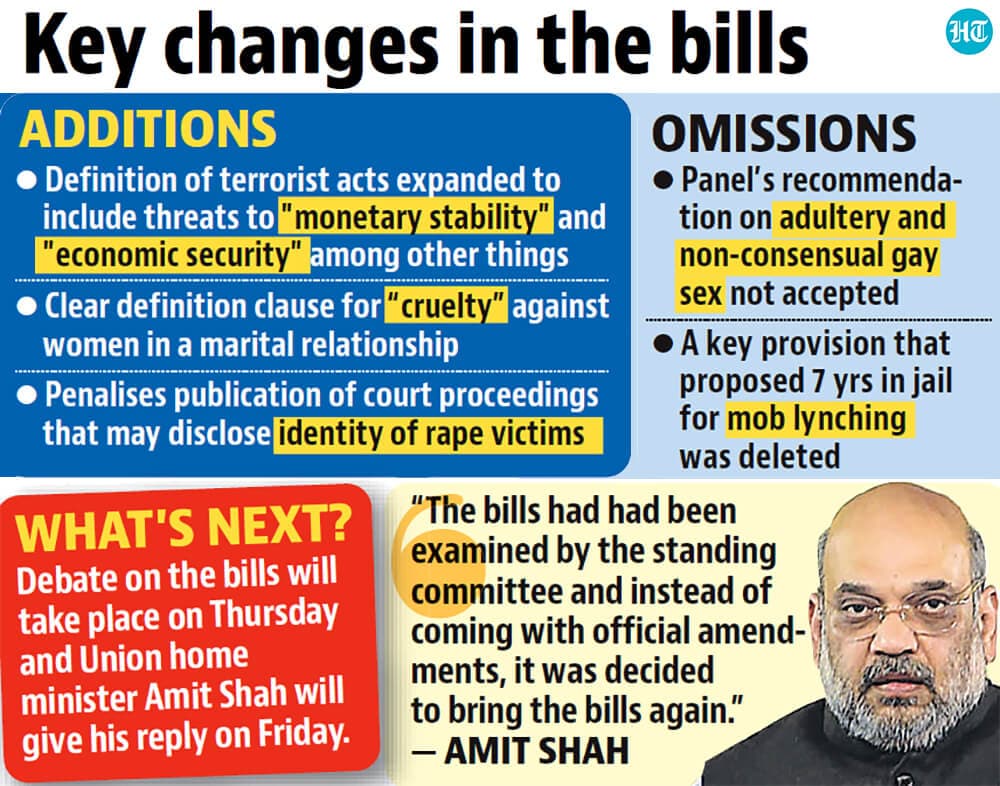
The Union government on Tuesday proposed to expand the definition of “terrorist act” under the penal law by bringing within its fold threats to “economic security” and “monetary stability” of the country, while not including a parliamentary panel’s recommendation to include a gender-neutral provision criminalising adultery and a clause to separately criminalise non-consensual gay sex.
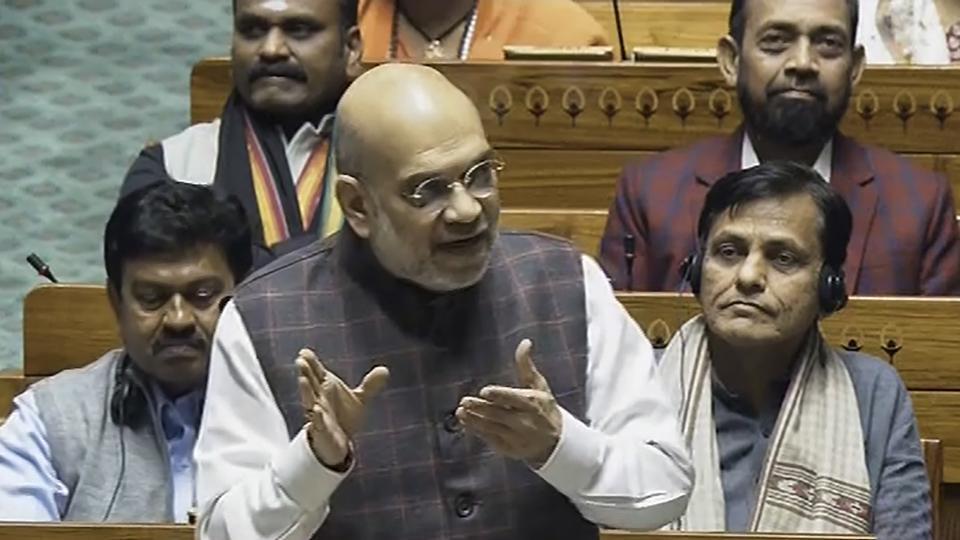
Among the other notable changes, the revised Bharatiya Nyaya (Second) Sanhita Bill, 2023, which was tabled by Union home minister Amit Shah in the Lok Sabha on Tuesday to replace the colonial-era Indian Penal Code (IPC), added two new provisions to define “cruelty” against women in a marital relationship and to penalise the publication of court proceedings that may disclose the identity of a rape victim.
Shah, on Tuesday, also introduced the two other updated criminal law bills -- Bharatiya Sakshya (Second) Sanhita, and Bharatiya Nagarik Suraksha (Second) Sanhita, which are set to replace the Indian Evidence Act and Code of Criminal Procedure (CrPC) respectively. The bills will be debated on Thursday, the home minister informed the House.
The three criminal law bills, which were first introduced by the government in August, were referred in the same month to the parliamentary standing committee on home affairs for review. Shah on Monday withdrew the original bills to reintroduce their modified versions, incorporating the panel’s recommendations.
Community service explained
While the previous version of the bill on the penal code for the first time in the country had proposed to introduce community service as one of the punishments for “petty” offences, including for criminal defamation, the new bill to replace the CrPC has now defined what the “community service” would mean. The new bill states that community service shall mean the work which the court may order a convict to perform as a form of punishment that benefits the community, for which the convict shall not be entitled to any remuneration. It also clarifies that magistrates of first and second class can now pass orders sentencing offenders to community service.

The revised bill also clarifies that the judicial magistrate of the first class may pass a sentence of imprisonment for a term not exceeding three years, or of fine not exceeding ₹50, 000, or of both or of community service.
Terrorism defined
Giving an expansive definition to terrorist acts, BNS-Second stipulates that a person is said to have committed a terrorist act if they do anything with the intent to threaten or likely to threaten the unity, integrity, sovereignty, security, or “economic security” of India.
The proposed Section 113 of the revised code goes on to add that any act causing damage to the “monetary stability” of India by way of production or smuggling or circulation of counterfeit Indian paper currency, coin or of any other material shall also be termed a terrorist act. For committing a terrorist act resulting in the death of a person, the code contemplates a punishment of death or life term, whereas for other acts coming under the purview of the section a jail term ranging between five years and life term has been proposed.
While IPC, 1860, does not contain any provision regarding a “terrorist act” or economic or monetary stability of the country, the first bill introduced in August to revamp the penal law made terrorism a crime under the penal code and included a whole set of offences under its ambit -- using explosives, acts that are likely to cause death or injury to any public functionary, and detaining any person and threatening to kill or injure such person in order to compel the government to do or abstain from doing any act. Counterfeiting currency or coins have been retained as separate offences under BNS-Second but with a caveat that if such acts tend to adversely impact the monetary stability of India, they will amount to acts of terrorism.
The previous version defined terrorist act as one that destabilised or destroy the political, economic or social structures of the country, or create a public emergency or undermine public safety. The new bill removes this clause while adding “sovereignty”, “economic security” and “monetary stability” under the proposed section.
The proposed Section 113 also explains that the officer not below the rank of Superintendent of Police shall decide whether to register the case under this clause or under the Unlawful Activities (Prevention) Act – the law made to specifically deal with the offence of terrorism.
Ignored recommendations
The panel’s final report submitted to the government last month recommended the re-criminalisation of the adultery law and criminalisation of non-consensual sex between men, women or transpersons as well as acts of bestiality. As first reported by HT on October 25, the recommendation to bring back the two key provisions was among nearly 50 amendments suggested by it.
But BNS-Second does not incorporate the panel’s recommendations, conveying the government’s indisposition to reviving the two provisions that have been dealt with by two Constitution bench rulings of the Supreme Court.
While the penal provision on adultery (Section 497, IPC) was quashed by the Supreme Court in 2018 on the ground of being discriminatory, unconstitutional and against the dignity of women, the offence of non-consensual gay sex under Section 377 of the IPC was dropped by the government in BNS. The Supreme Court had in its 2018 judgment decriminalised gay sex between consenting adults by reading down Section 377. Even as the 2018 ruling affirmed the other part of Section 377 which penalised non-consensual gay sex, the panel had flagged that after BNS dropped any reference to Section 377, there was no provision for non-consensual sexual offence against “men, women, transpersons and for acts of bestiality”. BNS-Second does not include this recommendations.
Two new sections
Among other key changes, BNS-Second adds two new sections. Section 73 makes printing or publishing of court proceedings that may reveal the identity of a rape victim a penal offence, entailing a maximum imprisonment of two years if such publication lacks a prior approval of the court. In the previous bill, the restraint was confined to printing or publishing the name or any matter which may make known the identity of a rape victim. The new clause specifies that the restraint will apply equally to the court proceedings even as printing or publication of the judgment of a high court or the Supreme Court will not amount to an offence. The proposed clause may act as a deterrent against publication of proceedings and developments, including details of charge sheet, order on charge or testimonies during the trial of a rape case.
Another addition to BNS- Second is Section 86 that proposes to define “cruelty” against a woman by her husband and his relatives, which is punishable with a jail term up to three years. An act of cruelty has been defined as any wilful conduct that is of such a nature that it is likely to drive the woman to commit suicide or to cause grave injury or danger to the life, limb or health (whether mental or physical) of the woman. Although “cruelty” has now been defined in BNS-Second through a separate provision, the old Section 498A as well as Section 84 in BNS defined cruelty using the same terms in their “explanation” clause. Thus, the new section in BNS-Second, in effect, does not really add anything new to the proposed penal code.
Key deletions
The new bill has also made a crucial deletion from a provision that proposed to introduce mob lynching as a distinct crime. BNS proposed that when a group of five or more people acting in concert commits murder on the ground of race, caste or community, sex, place of birth, language, personal belief or any other ground, each member of such group shall be punished with death or imprisonment for life or “imprisonment for a term which shall not be less than seven years”. The revised BNS-Second omits the reference to seven years. An offence of murder is still punishable either with life term or death sentence.
BNS-Second also corrects the language of Section 23, which deals with acts of a person incapable of judgment by reason of intoxication caused against their will. The revised provision states that nothing is an offence which is done by a person who, at the time of doing it, is, by reason of intoxication, incapable of knowing the nature of the act, or that they are doing what is either wrong, or contrary to law; “provided” that the thing which intoxicated them was administered without their knowledge or against their will. The provision in the previous bill had the word “unless” instead of “provided”, which had led to confusion.