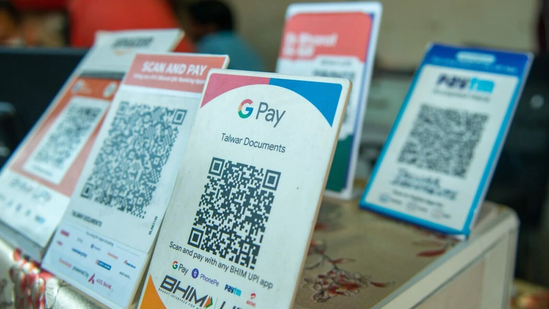
UPI payments above ₹2,000 made to merchants will attract a 0.4% Merchant Discount Rate (MDR), according to detailed guidelines issued by the National Payments Corporation of India (NPCI) on Tuesday.
For person-to-person transactions, there will be no charges at all, irrespective of transaction value. P2P transactions constitute 37% of the total UPI transaction in volume terms and 70% in value terms. (Representative image)
{{^htLoading}} {{/htLoading}}
This comes after the Centre had on September 14 notified that UPI transactions up to ₹2,000 will attract zero MDR.
{{^usCountry}}{{/usCountry}}
The new rules apply only to person-to-merchant (P2M) transactions above ₹2,000. There will be no charges on person-to-person (P2P) UPI transactions, irrespective of the transaction amount.
Deep Dive
What transactions are subject to the 0.4% MDR fee?
The 0.4% Merchant Discount Rate (MDR) applies only to Person-to-Merchant (P2M) UPI payments that exceed ₹2,000. Payments below this threshold and all person-to-person (P2P) transactions are exempt from any charges.
Why has the government decided to levy MDR on UPI transactions above ₹2,000?
The government aims to manage the costs associated with running UPI, which has become integral to digital payments in India. The MDR will help sustain necessary investments in technology, cybersecurity, and infrastructure as UPI continues to scale.
How will the MDR fee impact small merchants and vendors?
The new MDR is expected to affect only about 4% of merchant transactions because most UPI payments are below ₹2,000. Moreover, specific exemptions are in place to protect small vendors, such as those receiving up to ₹1 lakh monthly through P2PM accounts, which will remain free of MDR.
Powered ByAsk HT
For transactions of ₹75,000 and above, the MDR will be capped at ₹300 per transaction, according to the notification.
The 0.4% charge will be shared among banks, payment apps and other partners in the payment ecosystem.
What is MDR?
{{/usCountry}}
{{#usCountry}}
The 0.4% charge will be shared among banks, payment apps and other partners in the payment ecosystem.
What is MDR?
{{/usCountry}}
MDR is a small fee that merchants pay to banks and payment companies each time a customer makes a digital payment. A customer pays a shopkeeper through a digital payment system, and the shopkeeper pays a small processing fee to the payment provider.
While that is the norm, in reality, many pass on MDR to customers, especially in high value card transactions where it does not have the same waiver as it does in UPI.
UPI had been exempt from MDR since 2020, a policy choice meant to push India away from cash and towards digital payments. However, now, a “nominal MDR of 0.4% will be levied on P2M transactions above ₹2,000”, says the government notification.
Flat MDR, rules for P2PM transactions
Certain essential sectors such as railways, telecom, insurance and fuel, will have a flat MDR of ₹5 per transaction for payments above ₹2,000.
Payments involving mutual funds, securities, stock brokers and dealers will attract a lower MDR of 0.02%, capped at ₹300.
In huge relief for small vendors, transactions of up to ₹1 lakh a month through UPI QR codes under the Person-to-Person-Merchant (P2PM) category will continue to have zero MDR on all transactions.
{{^htLoading}} {{/htLoading}}
“This bridges informal street vendor setups with formal merchant acquiring accounts, promoting digital adoption in the unorganized sector,” said the notification.
Consumer Safeguards
The new framework also includes measures aimed at ensuring that customers do not have to pay extra for using UPI.
No platform fees: UPI apps will not be allowed to charge users any platform fee or hidden charges for transactions.
Merchants cannot pass on MDR: Banks have been advised to ensure that merchants do not recover the MDR from customers by adding it to the bill.
Unlimited free UPI transactions: Individuals will continue to have access to free UPI transactions without any monthly or transaction-volume limits.
Daily limits are not charges: Transaction limits of ₹1 lakh to ₹5 lakh, depending on the category, are meant only for security and risk management. They do not mean customers will be charged after reaching a certain number or value of transactions.
How will merchants be impacted?
{{^htLoading}} {{/htLoading}}
Centre said that according to data analysis, the new MDR rate will only impact 4 percentage of merchant transactions because most of such transactions fall below the threshold of ₹2,000.
This would ensure that micro and small businesses remain shielded from cost burdens.
Nikita Sharma is a Senior Content Producer with Hindustan Times. She is a Delhi-based digital journalist with five years of experience writing and editing news stories across beats including crime, politics, tech, trends and much more, both national and international. At Hindustan Times, she is part of the news team and focuses on breaking news, keeping a track of what is happening where, and chasing ever-developing news stories. She has a penchant for covering crime, geopolitics, and Indian politics with a keen eye for stories often overlooked in the daily news cycle. At Hindustan Times, she has extensively covered several key events including the US Presidential elections, Air India plane crash, Pahalgam terror attack and Operation Sindoor, US’ tariff war, and others. As a Delhi aficionado, she particularly enjoys roaming and writing about the national capital — its heritage, food, art and culture, and the many problems that come with it — the pollution, waterlogging, traffic, and more. Nikita did her Bachelor in Journalism and Mass Communication from GGSIPU and started working as a digital journalist in 2021. During her first stint, she covered hyperlocal news at a Delhi-based newsroom, writing and editing stories on builder-buyer conflicts, civic issues such as potholes, waterlogging, lack of facilities at hospitals in Delhi, crippling of the city during peak monsoon season. She also wrote features covering Delhi’s art exhibitions, heritage walks, artist profiles, museums, classical Hindustani music concerts and dance shows. She entered mainstream news in 2023 and has previously worked at NDTV.
Get Latest News, breaking headlines, and top India News, and today real-time updates from across the nation. Stay informed on politics, government policies, crime, Today Weather, and major developments on Hindustan Times
Get Latest News, breaking headlines, and top India News, and today real-time updates from across the nation. Stay informed on politics, government policies, crime, Today Weather, and major developments on Hindustan Times
Home/India News/UPI charges of 0.4% to be levied on merchant transactions above ₹2,000
{{^htLoading}}
Advertisement
{{/htLoading}}
SHARE THIS ARTICLE ON
{{#usCountry}}{{/usCountry}}
Notifications
Get breaking alerts directly from the newsroom
Notifications are on!You'll be notified when news breaks