Prime Minister Narendra Modi said his government has changed the notion that a strong government should control everything and everyone, and underlined that the New Education Policy (NEP) 2020 “ensures greater freedom for youth” to take decisions.
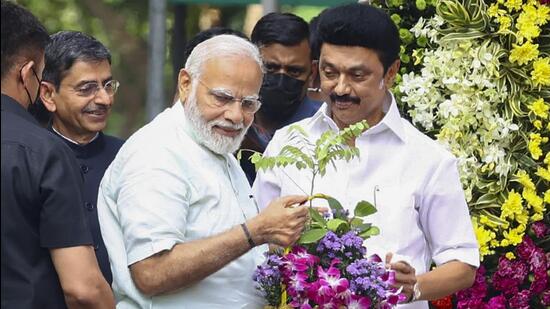
PM Modi, who was speaking at the 42nd convocation of Anna University in the presence of chief minister MK Stalin, also defended the new education policy, aspects of which have been vehemently opposed by the Stalin-led DMK government. Tamil Nadu is drafting its own state education policy.
PM Modi said that in the era of tech-led disruptions, there are three important factors in favour of graduates; the third factor being that his “strong government” does not interfere and gives freedom which is offered by NEP 2020. “Earlier, there was a notion that a strong government means it should control everything and everyone. But we have changed this,” said PM Modi, who is on a two-day visit to Chennai.
“A strong government does not control everything or everyone. It controls the system’s impulse to interfere. A strong government is not restrictive but is responsive. A strong government does not move into every domain. It limits itself and makes space for people’s talents. A strong government’s ability lies in its humility to accept that it cannot know or do everything. This is why you see reforms in every sphere that makes greater space for people and their freedom. The new National Education Policy ensures greater freedom for youth to take decisions according to evolving situations.”
{{/usCountry}}“A strong government does not control everything or everyone. It controls the system’s impulse to interfere. A strong government is not restrictive but is responsive. A strong government does not move into every domain. It limits itself and makes space for people’s talents. A strong government’s ability lies in its humility to accept that it cannot know or do everything. This is why you see reforms in every sphere that makes greater space for people and their freedom. The new National Education Policy ensures greater freedom for youth to take decisions according to evolving situations.”
{{/usCountry}}The DMK government has refused to adopt the three-language formula under the NEP and decided to continue with the state’s two-language policy of English and Tamil which has been in place since the 1960s.
Stalin spoke of the vision for the state’s education under the Tamil Nadu government’s Dravidian model. “Education is the only wealth which no one can steal or take away from you. So we believe that there should be no obstruction to education,” the chief minister said.
“So our government’s Dravidian model is to take education forward. The Dravidian ideology of social justice is based on education for everyone.”
Stalin added that everyone should study up to higher education and research education and listed the welfare schemes provided by his state government to increase enrollment in schools and colleges. “We are bringing in an education revolution. We don’t want to restrict just students getting degrees but we are also aiding in job opportunities, life skills and societal growth,” Stalin said. He recalled that Tamil Nadu’s higher education institutions scored one of the highest in the NIRF rankings and industrial growth.
The chief minister told the graduates that they could proudly tell their children that they received their degrees from the Prime Minister.
Higher education minister K Ponmudi spoke of how DMK patriarch and late chief minister M Karunanidhi abolished entrance tests to engineering colleges for the benefit of rural students. Though Ponmudi did not mention the National Education cum Entrance Test (NEET), it was indicative that he defended the Tamil Nadu government passing a legislature to abolish NEET. A Bill to that effect is pending with the President’s office.
“Previously only 25,000 rural students were in engineering colleges but it increased to 77,000 rural students in engineering colleges after Kalaignar (Karunanidhi) abolished the entrance exam,” he said, without any direct reference to the medical entrance examination that his government opposes.