Around half of 2026 is still to come. This means that any answer to the question posed above is likely to be uncertain. Answering this question with any degree of certainty is also best left to climate scientists, who are better equipped to handle it. However, a layman’s understanding of the possible answer – this year can easily rank second warmest, although being the warmest is not impossible – can help us understand some important things about the climate crisis.
2026 may rank among the hottest years ever recorded as global temperatures remain close to the critical 1.5°C warming threshold. (AP Photo)
The short summary of the climate crisis implications of the possible answer is as follows. The first thing the possible answer shows is that breaching the 1.5°C threshold in particular months does not necessarily need an El Nino. The second thing it shows is that breaching that threshold appears relatively easy even in the annual average. The third thing it shows is the corollary of the first two: does the rank of the year matter when no special circumstances are needed for breaching the 1.5°C threshold? The long answer is as follows.
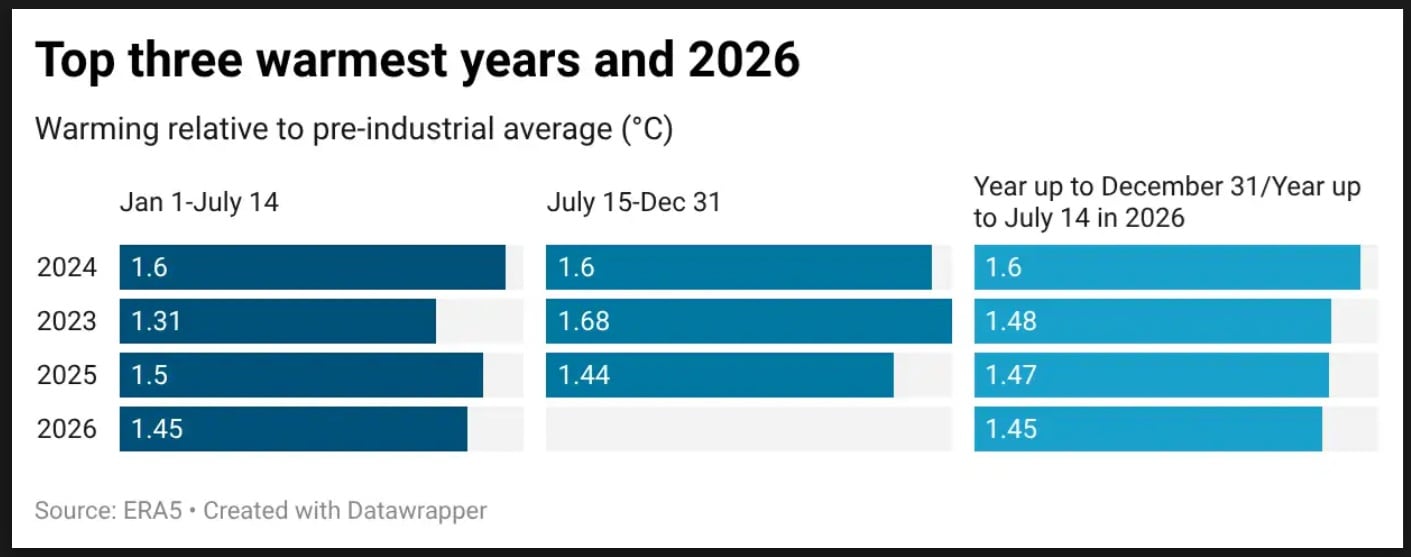
The reason why checking possible warming scenarios for 2026 is interesting at all is because of what has come before. The past years – 2023, 2024, 2025 – were the warmest on record; and are ranked the second warmest, the warmest, and the third warmest, respectively. Moreover, while only 2025 breached the 1.5°C threshold – scientists expect catastrophic changes in climate if long-term warming relative to the pre-industrial baseline breaches this threshold – both 2023 and 2025 were very close to the threshold. These two years recorded 1.48°C and 1.47°C warming, and the average warming in the 2023-2025 period is 1.52°C. In other words, 2026 will confirm if 1.5°C is going to continue as the new normal.
It is not just the past three years that raise the spectre of 2026 possibly being the warmest-ever year. The first half of 2026 is quite warm, too. The average temperature for the year up to July 14 (the latest available data from the ERA5 dataset published by the Copernicus Climate Change Service (C3S)) is 1.45°C warmer than the pre-industrial average. This is the third-highest average for this part of the year, behind 2024 and 2025.
With past trends summarised, one can now check how much warming is required in the rest of the year for 2026 to breach particular thresholds. To maintain the third rank 2026 holds for the year up to July 14, the rest of the year needs to average 1.50°C. Similarly, the rest of the year needs to average 1.53°C, 1.56°C, and 1.77°C, respectively, to be ranked second warmest, to breach the 1.5°C threshold at the end of the year, and to be ranked the warmest ever.
Warming in the 1.50-1.56°C range should not be hard at all for the rest of 2026. Here is why. 2026 hit the 1.50°C threshold in February and recorded 1.47°C and 1.48°C warming in January and February despite La Nina-like conditions being in place in November and December. La Nina is a periodic cooling of the surface of the central-eastern equatorial Pacific that is expected to cool global temperatures with a 2-4 month lag. That temperatures were still around 1.50°C warmer than normal suggests the baseline warming in the world is teetering on the edge of that threshold for at least the cooler months of the year (long-term warming has so far been relatively higher in the northern hemisphere’s cooler months at the beginning and end of the year than in other months).
If baseline warming of the cooler months is close to 1.5°C, the rest of the year should not have a problem recording warming in the 1.50-1.56°C range because La Nina’s warmer counterpart – El Nino, which warms global temperatures – was in place in May. In 2023, another recent year when El Nino arrived in May, the July 15-December 31 period averaged 1.68°C warming.
gfx
To be sure, it is possible that El Nino’s impact will be seen in global temperatures with the usual lag of two-four months, but it seems to have already eroded any lingering impact of La Nina conditions. While months up to April were ranked fourth or fifth warmest, both May and June this year were the second warmest on record. Clearly, the only question is whether El Nino’s impact will be strong enough for the rest of the year to average the 1.77°C warming required for the year to be the warmest ever. That is a tall order. Only two months in human history have breached the 1.77°C threshold: December 2023 and February 2024, which recorded 1.78°C and 1.77°C warming. However, it may not be impossible. Scientists widely expect this year’s El Nino to mature into one of the strongest ever.
Abhishek Jha is Assistant Editor-Data at Hindustan Times. He uses statistical programming to generate newsworthy insights from large datasets. He is part of the team that produces Number Theory, a daily data story feature of the paper’s print edition. Since March 2024, he has been writing Weather Bee, a weekly column for the Hindustan Times website. He is a chemical engineer by training, who specialises in stories related to weather, climate, and the environment.
Jha has been at HT since 2018, where he offers data-driven perspective and analysis on politics, environment, weather, climate, economy and society. His work includes data coverage of elections in India and abroad, including the 2019 and 2024 Lok Sabha elections; the disasters and extreme weather resulting from changing climate, such as floods, droughts, heat waves, cold waves, and dwindling snow cap in the Himalayas; the factors that drive poor air quality in northern India; the changing patterns of land use; the Covid-19 pandemic and its impact on labour market conditions; the changing pattern of consumer spending seen in the new consumer spending surveys; and social norms seen in the surveys such as the National Family Health Survey.Read More
Get the latest India News, breaking headlines and real-time updates from across the country. Stay informed about politics, government policies, crime, weather and major national developments.
Home/India News/Weather Bee: Will 2026 Rank As The Warmest Year On Record?

 E-Paper