The Congress-backed National Students’ Union of India (NSUI) registered a major win in the Delhi University Students’ Union (DUSU) elections on Friday, with its Vice President candidate Rahul Jhansla emerging victorious.
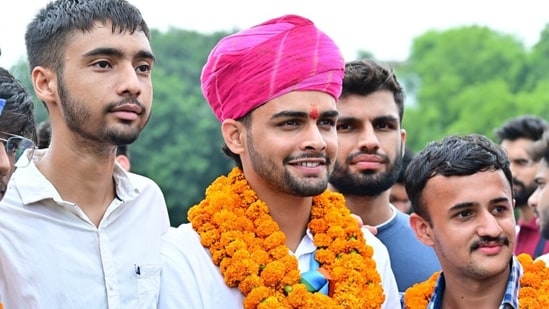
After last rounds of counting, Jhansla secured 29, 339 votes, defeating Akhil Bharatiya Vidyarthi Parishad (ABVP) contender Govind Tanwar, who trailed with 20,547 votes.
His NSUI colleague Joslyn Nandita Choudhary, who contested for the President’s post, lost to ABVP’s Aryan Maan.
The RSS-affiliated Akhil Bharatiya Vidyarthi Parishad (ABVP) bagged the key posts of President, Secretary, and Joint Secretary in DUSU elections.
Who is Rahul Jhansla?
The NSUI candidate, Rahul Jhansla's website describes him as a politically active student leader, known for his persistent work on student rights, youth empowerment, and campus issues.
A graduate of Delhi University’s Shaheed Bhagat Singh College, Jhansla pursued a Bachelor of Law (2022–2024) at the university, according to his LinkedIn profile. He is currently a postgraduate student.
Jhansla has been at the forefront of campus activism, leading multiple hunger strikes and protests that spotlighted hostel hygiene and sports infrastructure. His ability to manage large-scale student movements has brought wider attention to pressing university concerns.
{{/usCountry}}Jhansla has been at the forefront of campus activism, leading multiple hunger strikes and protests that spotlighted hostel hygiene and sports infrastructure. His ability to manage large-scale student movements has brought wider attention to pressing university concerns.
{{/usCountry}}“Rahul Yadav Jhansla envisions a university ecosystem where every student’s voice matters and youth participation leads to real political change,” his website noted.
NSUI campaign promises
Jhansla’s manifesto reflected both academic and welfare demands, with key pledges including the rejection of the National Education Policy (NEP) 2020, provision of up to 12 days of menstrual leave per semester, transparent examinations to curb paper leaks, the introduction of smart classrooms, and improved hostel facilities.
He also promised to set up functional counselling centres, expand scholarship opportunities, and improve transport facilities for students.
For women students, the manifesto also promised sanitary vending machines, legal aid, 24*7 emergency response against harassment, gender sensitisation workshops, and stronger safety infrastructure across colleges.