The Delhi High Court on Wednesday asked Cockroach Janta Party (CJP) leaders Saurav Das and Ashutosh Ranka their ages and told them they were “not Gen Z”. The court was hearing a plea by the two CJP leaders against the extension of their judicial custody by a special executive magistrate (SEM) court.
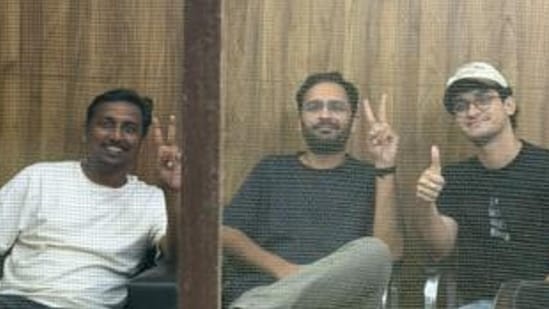
During the hearing, Justice Subramonium Prasad asked Abhik Chimni, counsel for the petitioners, about their ages. Chimni informed the court that Saurav Das was 27 years old and Ashutosh Ranka was 32.
According to Bar and Bench, the court remarked, “Then you are not GenZ. What is GenZ? Court is informed that people born after 1997 are GenZ. Then you are not GenZ.”
CJP founder Abhijeet Dipke reacted to the court's remarks. He shared a picture of Prime Minister Narendra Modi on X, captioning it, "The only person who qualifies as a GenZ."
Deep Dive
Why did Saurav Das and Ashutosh Ranka challenge the extension of their judicial custody?
Why did Saurav Das and Ashutosh Ranka withdraw their plea in the Delhi High Court?
What did the Delhi High Court question about the CJP leaders’ Jantar Mantar protest?
Additional Solicitor General Chetan Sharma and advocate Ashish Dixit, appeared for the Delhi Police. Chimni represented Saurav Das, Ashutosh Ranka and the other petitioners.
CJP leaders withdraw plea from Delhi HC
The duo withdrew their plea challenging the extension of their judicial custody after the high court refused to entertain it.
{{/usCountry}}The duo withdrew their plea challenging the extension of their judicial custody after the high court refused to entertain it.
{{/usCountry}}The court raised questions about the petitioners' identity and association.
“People remain the same, cause is changing. Correct? The next question will be who are you. What are you? What is your association what is the purpose of your association? Please understand when there is apprehension of peace and tranquility, all these questions will assume importance...You are drawing the court into a debate which might ultimately not go in your favour," Bar and Bench quoted the bench.
Das and Ranka's hearing
Das and Ranka were detained and subsequently sent to judicial custody after they trespassed Jantar Mantar, a denotified protest site, on October 13. The SEM court later extended their custody by two days.
The CJP leaders' legal challenge was against this custody extension.
The magistrate had cited concerns over public peace and security, and said the CJP leaders showed “no respect for law” by repeatedly calling for protests at de-notified sites, supporting Delhi Police’s contention that their release could pose an imminent threat to public order, HT earlier reported.
"When your bail bonds are accepted, sureties are given. When a bail bond is broken there is a procedure in BNSS. Instead of following that procedure which can be forfeiting your surety etc, probably they are more benevolent to you by giving you fresh notice," the court remarked.
Also Read | 'Barricades have a purpose': Delhi HC pulls up Saurav Das and Ashutosh Ranka, cites arson outside India
‘Barricade there for a purpose’: Delhi HC questions conduct
During the Wednesday hearing, the Delhi HC also questioned the petitioners' conduct, pointing out that they were at the forefront of the protest and had allegedly breached barricades despite not having permission.
"Barricade is there for a purpose… and when you break the barricade, there is a chance of 10-20 people coming," the court told duo's lawyer Abhik Chimni, referring to incidents of “arson” and unrest in other countries.
“We are seeing what is happening outside our country... Arson etc. You may have started with something you say is peaceful. For that purpose you take police permission which is to prevent unwanted persons who join your group and spoil your name,” Bar and Bench quoted the high court as observing.
The high court also questioned Chimni about the procedure followed after the leaders furnished their bail bonds and allegedly breached the conditions in connection with the Jantar Mantar trespass incident.
The court observed that the petitioners had furnished bail bonds on October 11, the same day Jantar Mantar was de-notified as a designated protest site, before being arrested again. It questioned why the procedure prescribed under the Bharatiya Nagarik Suraksha Sanhita (BNSS) for breach of bail bonds was not followed.