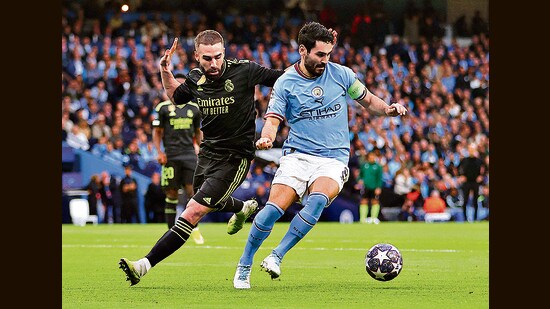
Manchester City are well on course for that most elusive, most coveted thing in European football: the treble (domestic league, primary domestic cup, Champions League), something that has been done only once by an English team, when City’s fiercest derby rivals Manchester United brought the league, FA Cup and Champions League titles home in 1999.
City blew away Real Madrid, the most successful club in Europe, in the Champions League semi-final on Wednesday. They look unstoppable.
Earlier this month, Napoli
Manchester City are well on course for that most elusive, most coveted thing in European football: the treble (domestic league, primary domestic cup, Champions League), something that has been done only once by an English team, when City’s fiercest derby rivals Manchester United brought the league, FA Cup and Champions League titles home in 1999.
City blew away Real Madrid, the most successful club in Europe, in the Champions League semi-final on Wednesday. They look unstoppable.
Earlier this month, Napoli won the Serie A for the first time since Diego Maradona dragged a nowhere club to the Italian title back in 1986-87 and 1989-90. Giant flags adorned with his face flew in the stadium and in the streets of Naples, where the late Argentinian is still a god.
Meanwhile, earlier this week, Barcelona sealed their comeback season, with their former midfield maestro Xavi at the helm as manager, by winning La Liga after a three-year gap in which the Catalan club was always on the edge of catastrophe.
Each of these domineering clubs has that one quality that makes a team truly great: a set of dazzling players whose skills and abilities are a step away from magic, and another set of players who are grafters and enablers, and work under the radar to enable the full flowering of the former’s genius.
Consider Ilkay Gundogan. The 32-year-old German midfielder is easily City’s most invisible player. He’s a quiet presence among raucous rockstars. But without Gundogan, this City team would not be dreaming of a treble. He is the versatile playmaker who can take the central role of linking play so that Kevin De Bruyne, inarguably the best midfielder ever to play in Premier League, can focus entirely on more creative aspects.
Gundogan is not a great tackler, but his keen footballing intelligence means he knows exactly what spaces to plug so City can retain midfield control. And he can play offensively, making perfectly timed runs into the box that no one picks up because they were too busy trying to mark De Bruyne or that goal-scoring machine Erling Haaland.
It was Gundogan’s goal that led City to the Premier League title on the final day last season. Last weekend, he stepped out of his slippery role and stood in the limelight in a game against Everton, scoring a goal that would have made Dennis Bergkamp proud — cushioning a cross with his thigh while facing away from goal and hooking it behind and into the net with the same foot — before slamming in a freekick and setting up Haaland for City’s third.
At Barcelona, Xavi has announced a new era with a team that was written off at the beginning of the season. He’s done this by building a rock-solid defence. When they won the title with a 4-2 victory over Espanyol — their first in this century without Lionel Messi — Real Madrid were 16 points behind them in second place. They’ve done all this by letting in just 13 goals.
Goalkeeper Marc-André ter Stegen has made more saves than anyone else in Europe this season, broken the Barca record for most clean sheets in a season (25), and is one clean sheet away from the European record. This is not the thrill-a-second, skill-crazed Barca when the likes of Messi, Xavi, Iniesta and Ronaldinho would simply outscore all teams. This is a more sedate Barca, but also a highly organised team, which is what they sorely needed after Messi’s exit.
This team’s performance owes as much to the ball skills of Pedri and Gavi as it does to the rock-like defensive work of Ronald Araujo, and as much to the goalscoring abilities of Robert Lewandowski as to Sergio Busquets’s efficiency in intercepting the ball.
Napoli’s title-winning run was also built on the back of both genius and grit. The genius is represented by 22-year-old Georgian attacker Khvicha Kvaratskhelia, who has been compared to Maradona, George Best and Cristiano Ronaldo; and Victor Osimhen, who is the epitome of the perfect modern striker.
But crucial to their league-winning campaign was the way Korean defender Kim Min-jae stepped into the shoes of the outgoing Kalidou Koulibaly. When Koulibaly was sold to Chelsea, he was being seen as the best new centreback in Europe. Kim has made that position his own in Napoli and surpassed even Koulibaly in his first season.
Finally, in Stanislav Lobotka, Napoli has a player in the mould of Gundogan, a man who can pull all the strings in the midfield to allow Kvara and Osimhen to shine. It’s a pity that Napoli’s small-club stature means it will lose most of these players by next season, and will have to strive yet again for that perfect combination of flair and fortitude.
One Subscription.
Get 360° coverage—from daily headlines
to 100 year archives.
Archives
HT App & Website