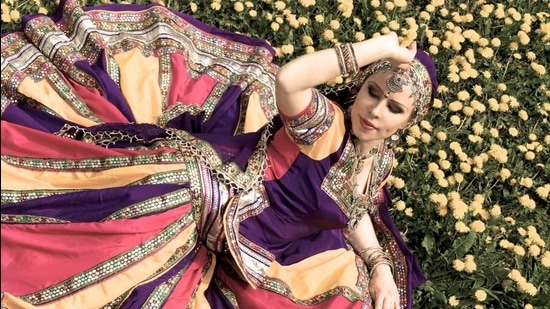
At first glance, a white person immersing themselves in Indian culture invites curiosity and wonderment, and Finnish danseuse Ilona Kolachana was no exception. Her tryst with India began when she visited the country in 2008, on a backpacking trip, and it was love at first sight. The music and dances further piqued her interest. “Indian traditional music and dance are very expressive, while the rhythmical complexity of both is fascinating. You can hear and see the echoes of long traditions and generations of dedicated practice,” she says.
“I started learning contemporary dance and Broadway style dance when I was 16. When I was 18 and joined Helsinki University majoring in philosophy and later cultural studies, I discovered the ethnic dances like African and Middle Eastern dances, as well as became interested in music from different cultures. I researched possibilities to study Indian dances in Finland and joined Bhangra, Bharatanatyam and Bollywood dance classes in Helsinki. That time, there was no Kathak teacher in Finland. The deeper I got into Indian dances and music, thirstier I became to learn more. I realised it is my calling to study Indian classical and folk dances, perform, and share the knowledge with my students and dance community in Finland,” says the 33-year old danseuse who has been performing professionally since 2014 under her group Bollywood Kamlees.
In addition to performing classical dance forms, she does Bollywood numbers, which are an instant hit with her Finnish audience. “(They) love Bollywood dance even if they can’t understand the lyrics right away. When it comes to choreographing Bollywood songs, I always try to be true to the music by using elements from traditional Indian dance forms, which has been appreciated especially by the Indian audiences,” she says. Kolachana says she loves Bollywood dance, “especially the musical scenes that are inspired by folk and classical dance and music. I admire Madhuri Dixit for her grace, skill and beauty, and Saroj Khan for everything she created during her life. AR Rahman’s and Ismail Darbar’s music keeps blowing my mind time after time, and I love the work of Amit Trivedi, Shreya Ghoshal and Sid Sriram. If I had to mention all in the movie industry that I admire, it would be a really long list,” she says in awe. At a competition held in Germany in 2015, she got to perform for Bollywood dance exponent, late Saroj Khan. “To hear the feedback from Saroj ji is one of the most memorable moments of my career,” she says.
{{/usCountry}}In addition to performing classical dance forms, she does Bollywood numbers, which are an instant hit with her Finnish audience. “(They) love Bollywood dance even if they can’t understand the lyrics right away. When it comes to choreographing Bollywood songs, I always try to be true to the music by using elements from traditional Indian dance forms, which has been appreciated especially by the Indian audiences,” she says. Kolachana says she loves Bollywood dance, “especially the musical scenes that are inspired by folk and classical dance and music. I admire Madhuri Dixit for her grace, skill and beauty, and Saroj Khan for everything she created during her life. AR Rahman’s and Ismail Darbar’s music keeps blowing my mind time after time, and I love the work of Amit Trivedi, Shreya Ghoshal and Sid Sriram. If I had to mention all in the movie industry that I admire, it would be a really long list,” she says in awe. At a competition held in Germany in 2015, she got to perform for Bollywood dance exponent, late Saroj Khan. “To hear the feedback from Saroj ji is one of the most memorable moments of my career,” she says.
{{/usCountry}}Read: Rajasthan Governor emphasises on preserving folk art and culture
Having studied Rajasthani dance styles like Ghoomar, Chari and Kalbeliya with several teachers in Europe and in India, Kolachana faced her share of challenges, too. “The challenge with presenting Indian classical dances in Finland is the lack of cultural knowledge of the audience. For example, to understand some Abhinaya pieces, it would require knowing mythological stories about Krishna and Radha, or to fully appreciate Hindustani classical music performance, listeners should know at least something about Taals. Luckily, the number of people with interest in these art forms is growing in Finland, and overall in Europe too,” she explains.
She met her husband, Aditya, in Finland and the two have been married for a decade. She has studied Hindi and Hindustani classical music to convey her emotions easily, both in dance and otherwise. “It was my 7th trip to India last February visiting our Indian family in Hyderabad and celebrating my husband’s cousin’s wedding in Nellore. My husband’s parents and some of the relatives have visited Finland too,” she shares, adding that she has worked at the Indian Embassy to Finland and Estonia: “I have worked closely with the former ambassador Vani Rao to increase awareness of Indian arts in Finland, and took part in organising some of the biggest Indian dance and music events seen in Finland so far.”
Even though there are certain fundamental differences in the Indian and Finnish way of life, she stresses upon the importance of understanding them. “It’s priceless to have the awareness and understanding of these differences, and to have the wisdom to choose when to be accepting, when to hold on to your boundaries,” she explains.
Read more: International Dance Day: Classical Indian dance gurus take digital avatar for disciples
During the lockdown period, she held classes online. “The international dance community has become more connected and united during this year, and even in the midst of crises we have shared many beautiful moments together,” she concludes.
Interact with Etti Bali @TheBalinian
Follow @htlifeandstyle for more