On a November morning in 1924, readers of Hindustan Times opened their newspaper and discovered a milestone in the story of Indian journalism. Tucked between the usual reams of linotyped text was a smudgy, monochromatic anomaly: a photograph.
Mahatma Gandhi during a fast was the first picture ever published in this newspaper, then less than two months old.
In the 100 years since, photographs have sat alongside Hindustan Times’s expansive reporting, strengthening its mission to hold power to account, keep its readers informed, and spotlight the marginalised.
In the early decades, the photographs chronicled a colonised nation’s battle to free itself of centuries of foreign rule. Then, they traced an infant country’s early steps, and a maturing India’s confident strides as it left its mark on the world.
People and communities, events and turning points, rivers, fields, forests and mountains… Hindustan Times also captured India’s vibrancy and magnificence.
A lot has changed about how we take our photographs, and how and where we share them. The media house has transitioned from early Kodak moments to Instagram feeds with millions tuned in, and from giant lenses to the slimmest smartphones. Colour burst in, and became more vivid. Through it all, we have documented celebrations and heartache, wins and milestones… all that makes up the evolution of a nation.
A journey in pixels that began in 1924, with an image captured on a hulking camera, painstakingly developed in a darkroom and pasted onto a page by precise hands in the newsroom, has grown in breadth and ambition.
{{/usCountry}}A journey in pixels that began in 1924, with an image captured on a hulking camera, painstakingly developed in a darkroom and pasted onto a page by precise hands in the newsroom, has grown in breadth and ambition.
{{/usCountry}}Hindustan Times has led the way for Indian newsrooms in its vision for storytelling, and its treatment of images.
In 1961, HT appointed the globally acclaimed photographer Kishor Parekh as chief photographer, a designation new to Indian newsrooms. Full-page photo essays followed, featuring Parekh’s work. A culture of visual storytelling within the ecosystem of news became, and remains, a hallmark of the newspaper’s coverage.
Parekh’s gut-wrenching images of the famine in Bihar in 1966 raised public awareness and contributed to the establishment of a famine relief fund.
HT has since published evocative, impactful photo features on coal miners, ecological degradation, drought; as well as moments that have brought us great pride: World Cup wins, Olympic medals, festivals, elections, and a republic joyfully turning 25, 50, 75…
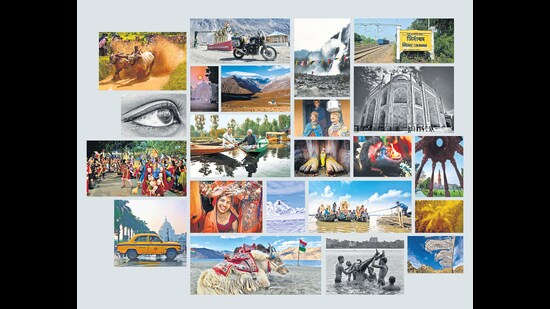
In its 100th year, Hindustan Times handed the lens to the reader.
My Country, My Lens began as a way to carve out space within the newspaper for the millions who read it every day. The response was overwhelming. We received thousands of entries from across the country, as people shared their lives, passions, and their view of their country with us.
They captured the harmony of our communities, the majesty of our rivers, the glory of our monuments and the resilience of our borders. They shared moments of prayer, celebration and mourning. How would we pick 100 of the best, from 100 times as many images?
HT turned to some of the keenest eyes in the country. A jury of photographers Rohit Chawla, Dhritiman Mukherjee and Ajay Aggarwal assessed and weighed each image to emerge with a final list of 100, divided equally between four categories: Communities, Rivers, Monuments and Borders. (To take a look at the 12 winning images and the top 100 entries, click here.)
We have shared those images with our readers, one a day, for the past three months. Today, we celebrate the 12 most evocative submissions. They illustrate, each in their own way, a journey that began a century ago, and continues to elevate, delight and evolve.
How we chose the winners
HT received over 10,000 entries from hundreds of towns and cities across India in four categories: Communities, Rivers, Monuments and Borders. The photographs captured India’s geography and culture in locations ranging from the frosty mountains of Ladakh to the sweeping coastlines of Kulasai. A jury of photographers Rohit Chawla, Dhritiman Mukherjee and Ajay Aggarwal assessed each image and picked the top 100 entries, clicked by readers from over 30 towns and cities. The jury then narrowed this list down to the top three in each category, which are featured in these pages today.